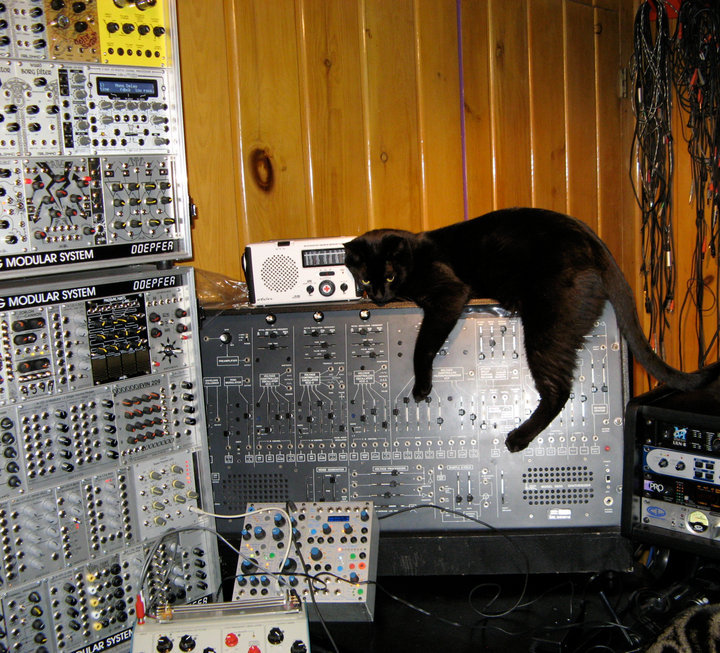
Weekend Cat Blogging: Roll

Luna obliged with some cuteness for this photo series. She really is a fantastic photography model, when she chooses to be.


Weekend Cat Blogging #243 is hosted this week by Jules and Vincent at Judi’s Mind Over Matter.

The Carnival of the Cats will be hosted on Sunday at Kashim, Othello and Salome.

And of course the Friday Ark is at the modulator.

SF Recology Artists in Residence

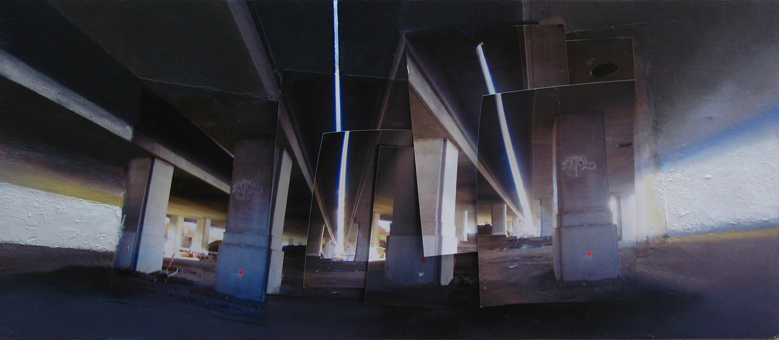
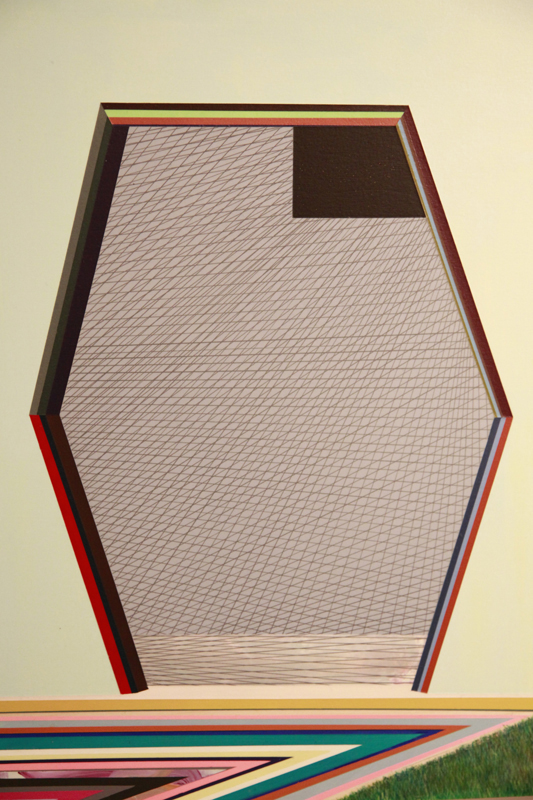
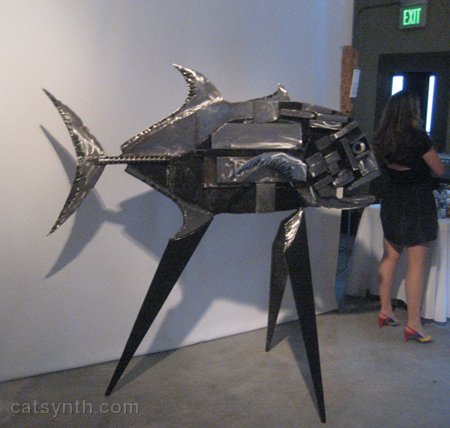
Last Friday, I attended an exhibition for the Artist in Residence program at Recology San Francisco (formerly known as, SF Recycling & Disposal, Inc.). Yes, this was an art opening at the SF dump. The program has been around for almost twenty years, and provides space and support for artists who work with materials from the city’s waste stream, including recycled wood, paint and metal. Pretty much anything the artists can scavenge. This exhibition marked the end of the residency for artists Erik Otto and Christina Mazza.

We first enter the gallery through an anteroom, with some smaller works including Erik Otto’s Rebuild, featuring the title word cut into scrap paper (including a musical score and furniture assembly instructions) and illuminated by a recycled light box.

Erik Otto. Rebuild, 2010. (Click to enlarge.)

The title and the materials of this piece set the tone for the show. In addition to my standing interest in text as a visual element, I liked the inclusion of music as part of its texture.

Moving into the main room, one immediately sees Otto’s Road of Prosperity (The Start of a New Beginning), with over one hundred small wooden houses suspended from the ceiling on fishing line, forming a chaotic spiral that descends towards the ground.

[Erik Otto.  Road of Prosperity (The Start of a New Beginning), 2010.  (Click each image to enlarge.)]

The houses, made of recycled wood, all have a similar iconic shape. Stepping back, one can see the the wooden frame at the base is itself another house. Indeed, the houses reappear throughout Otto’s work, either as central or peripheral elements, in his paintings and mixed media pieces and even in a video installation featuring recycled television sets:

Erik Otto. In the Abundance of Water, We Are Still Thirsty. (Click to enlarge.)

I am drawn to recurring icons in a series of work. So what is the significance of the houses? Certainly, they are a symbol of our current economic crisis, and a very visible part of natural and human-made disasters. Otto’s own words are informative:

My work is a narrative told by the recurring characters/elements I use often in my artwork. The house is a physical embodiment of our spiritual being. Inspired by the notion that being home is “knowing” – knowing your mind, knowing your heart – that if we know ourselves, we are always “home”, anywhere. It is often depicted in chaotic landscapes and is found seeking safety from a storm and/or rising water levels, which refer to our current social and economic climate.

His paintings, which also prominently feature the houses, include other elements such as found text, such as the “OPEN” sign in the large painting Moment of Reflection. Devotion 5 features a house (perched on stilts above a body of water) painted over book covers and a Scrabble board – certainly a powerful symbol of out-of-context text.

Erik Otto. Moment of Reflection. (Click to enlarge.)

Erik Otto. Devotion 5. (Click to enlarge.)

While Erik Otto’s work seemed to focus on discrete elements, icons and text, Christina Mazza’s pieces were about more continuous textures. Many of her finely detailed drawings feature entanglements of string or rubber bands or rope.

Christina Mazza. Construction. (Click to enlarge.)

She takes this theme of complex tangles to a larger scale with this wall piece made of shredded packing paper.

Christina Mazza. (Click to enlarge)

Mazza presents a very different texture with Redemption: SF Dump, which features a video inset in a wall made of brightly colored wood panels. Up close, one can see the imperfections, nails and slightly off angles of the the recycled wood. From a distance, it can seem a texture of precisely generated color rectangles with a moving image at the center.

Christina Mazza. Redemption:SF Dump. (Click to enlarge)

Mazza found inspiration in the discoveries she made at the dump, and documents her adventures on her blog. Looking through the images, I can see piles of discarded items that served as “subjects” for her drawings. One image which I found interesting but was not reflected in the pieces at the show was a discarded Chinese paper frame .

Christina Mazza. Chinese paper frame.

I find this image a fitting conclusion as I turn my attention to other recently visited exhibits and my own upcoming projects.

Thanks to Recology SF for providing many of the photos for this article. You can see more pieces from this exhibition and previous artists in residence at their flickr site.

Analogue Haven

Our last post from NAMM 2010 features more images from the Analogue Haven booth, where I spent a fair amount of time.

First up, a modular from Make Noise:

I was particularly intrigued by the two-dimensional sequencer module (in the lower left). A wide variety patterns can be generated along the X and Y axis and modified by selectively removing elements or subsections.

This video probably doesn’t do it justice, but it at least provides some atmosphere:

A portable modular rock (from Analog Rocket) featuring modules from The Harvestman, including the Hertz Donut and Piston Honda:

If I put together a modular system anytime soon, I would want that monorocket case.

Livewire modules, also some remakes of Wiard modules by Malekko Heavy Industry:

Of course, there are a splattering of Doepfer modules in many of these setups.

A compact modular setup from Tiptop Audio:

Muzundrum

Muzundrum is a “game of musicians”. In the standard game, players take turns rolling 12-sided (dodecahedral) dice that contain one of the twelve tones in standard Western music and attempting to place the die on the board to form chords and scales from standard tonal music theory. For example, if a player rolls a G, he or she can place it next to a C and E on the board to form a C-major triad.

There are of course many variations on the game. And the twelve sided dice can also be interesting tools for chance compositions or guided improvisation.

We now have a pair of sample dice here at CatSynth HQ:

The black die has the standard tones as described above, while the white has the solfege syllables do, re, mi, fa, so, etc.

Weekend Cat Blogging: Rain

It’s been very stormy week here, with sometimes violent winds and heavy rain, and flash floods. Indeed, it has been raining at least once every few hours continuously since I departed from Los Angeles last Sunday. It’s the kind of weather where one really just wants to curl up and stay warm:

In additional to seeing Luna napping on one of her favorite chairs, I liked the way the clothing draped on top formed this perfect triangle above her. This image has a very symbolic quality – the triangle is a very powerful element in my own visual ideas, and I have often talked about juxtaposing geometric elements against more natural organic shapes.

This morning, the sun has appeared at CatSynth HQ for the first time in over a week, and Luna peers out into the world:


Weekend Cat Blogging #242 is hosted by Nikita Cat.

The Carnival of the Cats will be up this Sunday at When Cats Attack.

And of course the Friday Ark is at the modulator.

Mungo State Zero

One of several instruments I encountered at the Analogue Haven booth at NAMM, the Mungo State Zero from Mungo Enterprises:

The State Zero is a large patchable synthesizer. Among its novel features are polyphony (patchable synthesizers are typically monophonic per oscillator unit) and the ability to “memorize” the most recent state of the patch even after the cords of removed. There is also a display feature that shows the signals of the most recently patched elements:

I like the industrial design and the textless graphical elements representing knobs and units, reminiscent of international symbols.

Eigenlabs Eigenharp

The Eigenharp Alpha from Eigenlabs:

The instrument looks a bit like an “electronic bassoon”, but beyond the mouthpiece, long thin shape and wood finish, it is quite different. It has 128 discrete keys that are also sensitive to pressure and motion in two directions, several large heavier keys and continuous controller ribbons. As such, it has the potential to be a very expressive instrument.

There is also a small version, the Eigenharp Pico:

And a new intermediate version, the Tau:

I particularly like the sleeker, modernist design on the Tau.

I did hear some demonstrations, which showed the features of the instrument, but focused on very conventional sounds and performance techniques. There were standard software synthesizers with keyboard and wind control, percussion sounds and beats and patterns controlled by the keys. With so many degrees of freedom and the ability to map different axes of expression to different musical parameters, I would like to see such an instrument used to push musical expression in novel directions.  To this end, it is great to see that they are making their SDK open source.  The first extension I would recommend is an OSC (OpenSound Control) protocol interface.