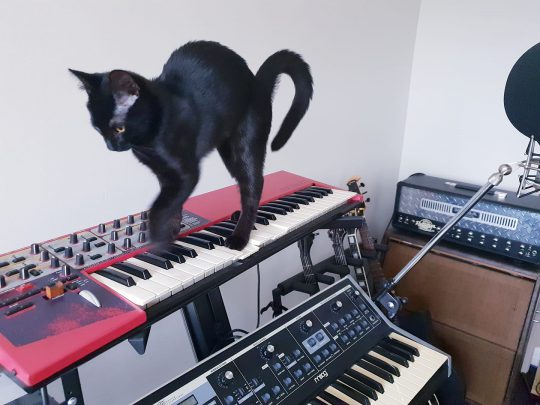
Our friend Charles Whiley demonstrates his main mixing console…wait for it 😸
We at CatSynth also enjoy the classic four-on-the-floor beat in the background.

On this dreary, rainy afternoon, we turn our attention southeast to the small town of Belen, New Mexico.



 Belen is near the geographical center of New Mexico, south of Albuquerque. It is wedged between Interstate 25 to the west and the Rio Grande to the east. Business Loop 25 serves as the town’s Main Street, as well as the terminus for New Mexico state roads 314, 309, and 109. In its past, it served as a major railroad hub, even earning the nickname “Hub City.”
New Mexico is a place steeped in a unique character, bringing together Native American, Spanish, and Northern European heritage. Its landscape is bleak and beautiful. It has attracted generations of artists. Judy Chicago is one of those artists, and she chose to make her home in Belen.
Chicago is one of the founders of feminist art, a collection of art movements that serve to both create and critique art from the perspective of women. Early work by Chicago and others in this movement often turned assumptions upside down, sometimes slyly but sometimes not so subtly inserting womanhood into all types of artistic practice. But she has also been involved in work beyond feminism, notably The Holocaust Project.
Perhaps her best-known piece is The Dinner Party, which is now a permanent installation at the Brooklyn Museum in New York. I have had the opportunity to view it on multiple occasions.
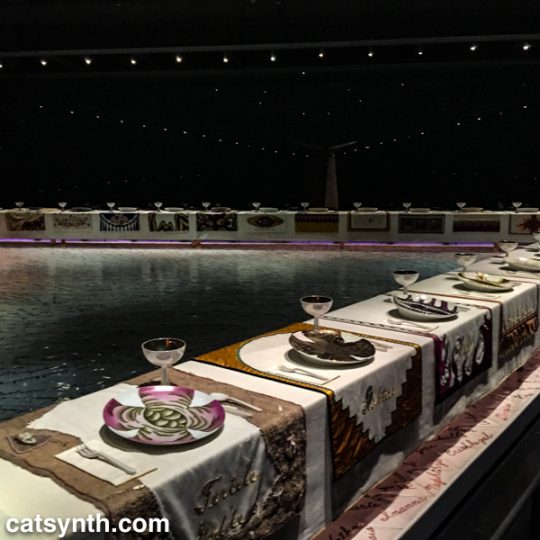
The Dinner Party imagines women artists, thinkers, and leaders throughout history sitting at a large triangular table. Each of the place settings bears the name of an accomplished woman and the contents of her plate represent a stylized version of her accomplished. Additionally, the porcelain tiles surrounding the table identify nearly 1000 other women. The plates and their contents are often described as representing female sexuality through vulva-like, floral, and butterfly forms.
Returning from Brooklyn to Belen, we pick up the story in this weekend’s New York Times, about an effort by the town to host a museum dedicate to its famous resident and the art she creates and supports. This would seem to be a slam dunk for a town that appears to have fallen on hard times, but it apparently generated quite a bit of opposition.
The quarreling reflects not just the power of Ms. Chicago’s art to ignite emotions, but also the limits of tolerance in New Mexico, a state long known as a welcoming mecca for artists. Evangelical Christian leaders in Belen have mobilized to thwart the project, calling Ms. Chicago’s art pornographic and indecent.
[link]
“I love fine art, but I would never want to see a vagina hanging on my wall,” said John K. Thompson, 62, a retired stockbroker.
It seems odd that the state that celebrates Georgia O’Keefe would have a problem with vaginal imagery in art. So why this place, and why now?
Paula Castillo [a sculptor who was born and raised in Belen] believes that the friction reflects the town’s own evolving dynamics…Belen has long been home to Hispanic families whose roots in New Mexico go back centuries. Religious affiliations are in flux, but many remain members of the Roman Catholic Church, which has not voiced opposition to the museum.
But after meeting with pastors from the evangelical churches opposing the museum, Ms. Castillo said she concluded that much of the resistance appeared to come from relative newcomers who brought more conservative sensibilities with them.
“There’s a level of nuance to what’s going on that’s been neglected,” Ms. Castillo said. “Belen and the rest of New Mexico can be very welcoming, but it’s easy to forget the influence that some churches now have.”
Indeed, I had come to think that despite the power of conservative Christians in our politics, the somewhat cartoonish cries of “indecency” in art were a sad joke from my past. Not surprising, this has been an upsetting experience for Chicago herself. I can only imagine what it feels like to feel welcomed in a community, only to have part of that community turn against you…
Responding to the critics, Ms. Chicago and Mr. Woodman in November withdrew their offer to work with Belen’s municipal government on the proposed museum. “The whole experience has been very painful,” said Ms. Chicago, explaining how she followed the debate over the museum and her work on social media while she was traveling in Brazil
It seems like a potential opportunity missed, especially as one sees how embracing minimalist Donald Judd put Marfa, Texas, on the map and has made it a cultural destination. Indeed, Marfa is on my bucket list, especially after seeing it featured in one of the last episodes of Anthony Bourdain’s show. Whether Belen gives up its chance to be another Marfa remains to be seen.
See more of New Mexico and many other fascinating places in our Highway☆ app, available on the Apple App Store and Google Play Store.


This weekend we check in on our feline pal in Oakland, Marlon. We have dubbed him “Big Merp” for his large size and vocalizations that sound like “

This the face of a

As we have mentioned before, it is clear he was a pet cat at one point in his life. He enjoys the comforts of indoors, attention from humans, and food. Lots of food. His friend Hissy is not so sure about the indoor life and is still wary of humans, but she does come around for food and to hang out with Big Merp.

The two of them clearly share a connection, even though they don’t always have the same outlook on life. We hope Hissy does learn to trust people a bit more in the future.
We close with a reminder to readers to be kind to the cats – and other animals – that share our neighborhoods and spaces with us.
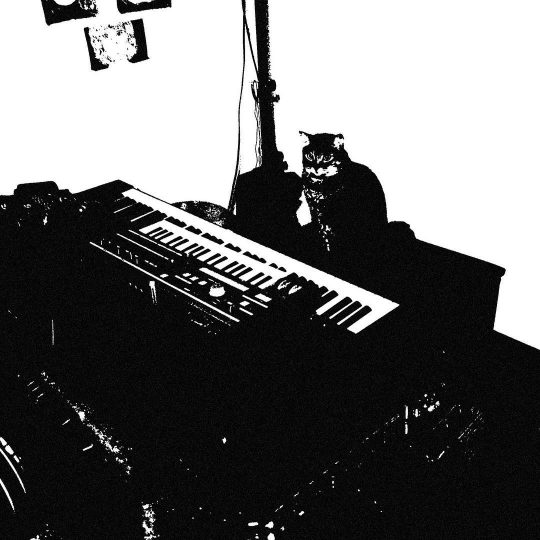
A black-and-white photo of a cat purrfectly posed in front of stacked keyboards. By davidpettymusic via Instagram.
davidpettymusic
This fucking guy. If he had a debut album, what would it be called? #catsynth #pets #music #notmycat
The high contrast renders the synths unidentifiable to us, but maybe an intrepid reader is up to the challenge…

Loki poses with a Waldorf Streichfett synthesizer in a beautifully composed photo. From Nicky Skolagava via the Facebook group Synthesizer Freaks.
The angle makes the Streichfett look large, but it’s a rather compact little box with an interesting story. From the Waldorf website:
Streichfett combines the best of the previously extinct species of String Synthesizers of the 70s and early 80s. Its dual sound engine features a fully polyphonic strings section and an eight voice solo section, which is essential for recreating classic movie sounds from the 70s and 80s. The Ensemble Effect provides depth and movement to the String Section, while the Effects section adds adjustable Phaser and Reverb. Additionally, the Animate Effect can be used to modulate the strings registration, allowing spectacular sound morphs.
We at CatSynth have long been interested in the intersection of art, technology and conceptual process. Programmed: Rules, Codes, and Choreographies in Art, 1965–2018 surveys over 50 years of video, computational and conceptual art, cleverly weaving them together into a single narrative whole. The three disciplines are united by the concept of a “program” or set of instructions through which the work of art unfolds, whether a computer program, instructions for a performance, or strict concept on a visual object. Video and lights abound, but there is also painting, dance, and more.
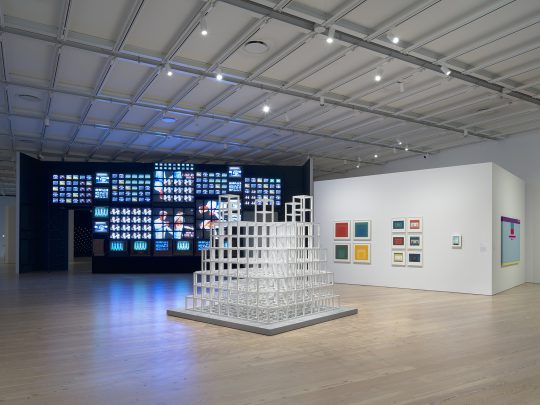
One of the artists who
At the opposite end of the video spectrum is his 1965 piece Magnet TV. A black-and-white CRT television set is disrupted by a large magnet, creating a unique but sometimes unpredictable pattern that is in its way rather spare and graceful.
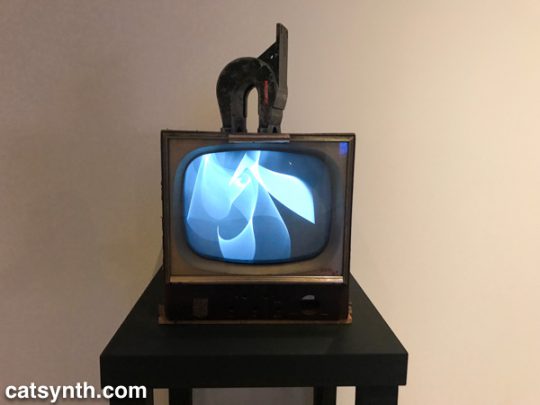
In the first piece, the process is in the composition, arrangement, and looping of the various video clips. In the latter, it is the physics of the magnet and the CRT.
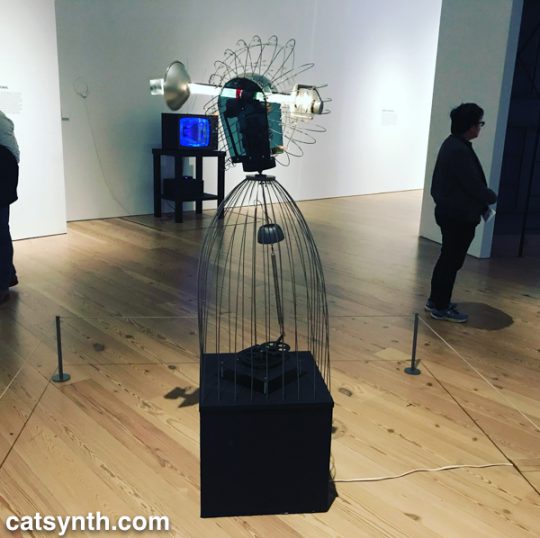
Motion and experiments with electronics are also at the heart of James L. Seawright’s contemporaneous piece, Searcher, which features gradual motion and changes in light. The shadows it casts are also part of the experience of the piece.
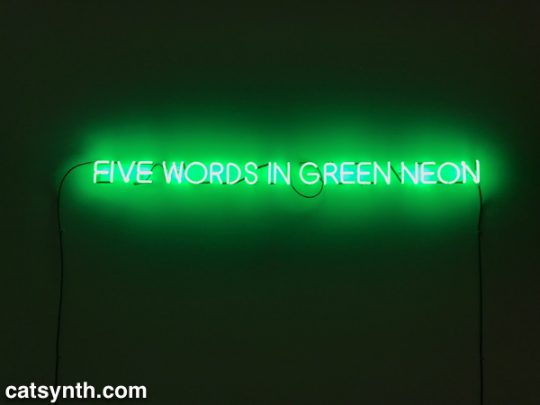
There is an interesting juxtaposition of one Joseph Kosuth’s classic neon text pieces, Five Words in Green Neon, and W. Bradford Paley’s Code Profiles, a Java program that generates images. They bring together the concepts of “text as art” and “code as art” – the message is the medium.
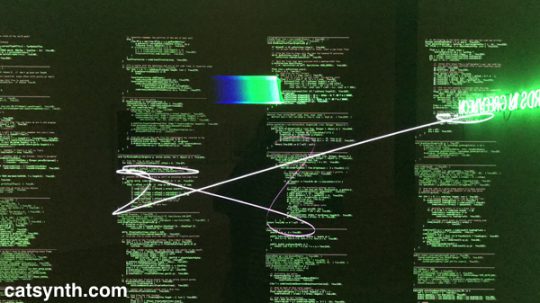
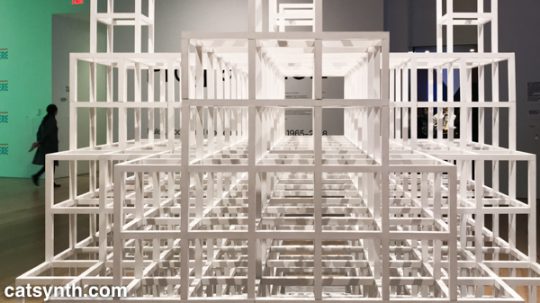
Paley’s code may be one of the most literal examples of the exhibition’s theme, but code need not be computer code as we think of it today. Many works from earlier periods were based on a series of instructions, where the instructions are the work and the performance or visual object are the expressions of said work. One such example is Sol Le Witt’s sculpture Five Towers. The three-dimension grids are assembled by a program with various combinations into a simple but beautiful result. I particularly enjoyed looking through it.
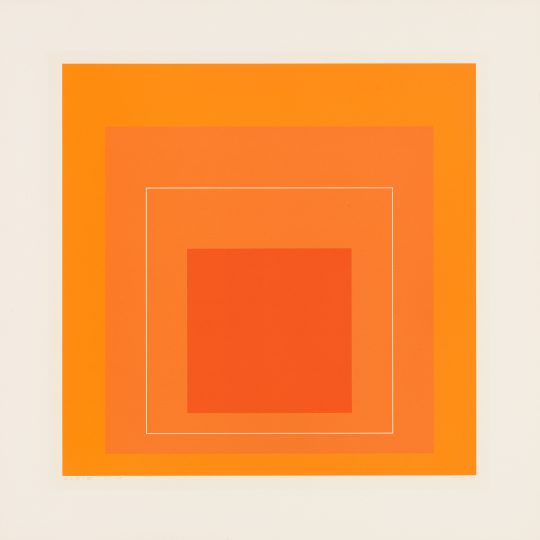
Josef Albers’ color-field rectangles can similarly be generated from a “program”. Like Le Witt’s piece, one could conceive of doing something like this with a computer, but neither artist chose to do so, instead being themselves the interpreters for the code.
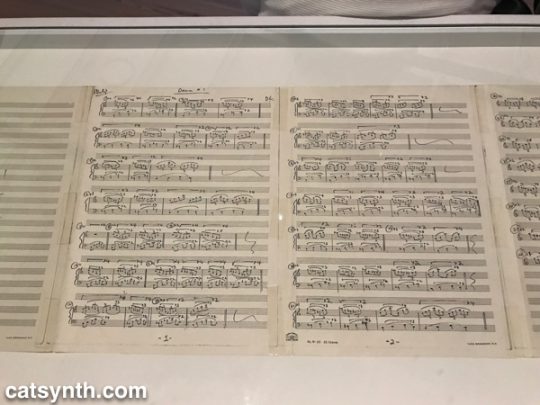
The performing arts have long been linked to programs, whether the traditional score or choreography, or more modern uses of algorithms or conceptual instructions.
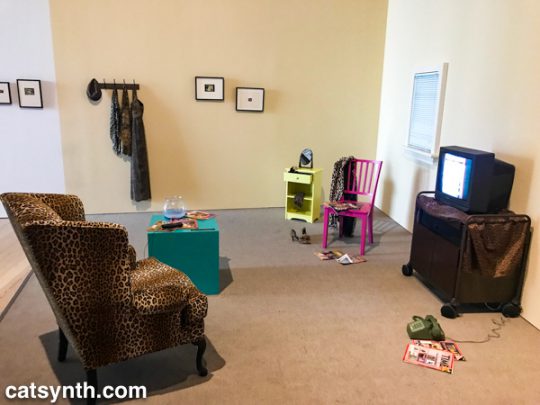
Program, object, video and performance also come together Lynn Hershman Leeson’s Lorna. Lorna is an interactive video story on a laser disc (anyone else remember laser discs?). Users can determine how the story unfolds through one of three endings via a remote control. The screen and control are placed within a simulated apartment decked out entirely in leopard print, and the viewer is invited to sit in a comfy chair while the controlling the story. This self-guided performance is at once programmed, but also immersive in that the viewer becomes part of the piece, both in space and in terms of control.
Video permeates the entire exhibition, popping up directly and indirectly in at least half of the pieces, or not more. But
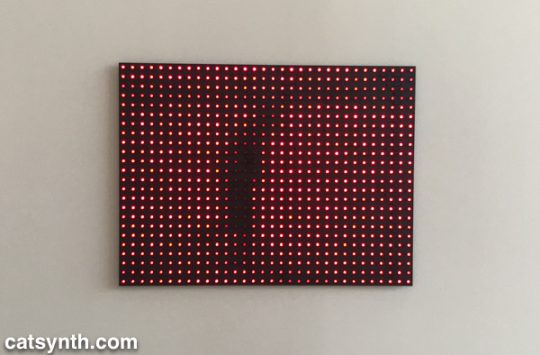
We conclude this survey with a new site-specific commission by Tamiko Thiel. She created an augmented-reality mobile app (in collaboration with developer /p) that overlays organic forms on the angular, geometric space of the museum’s outdoor terrace.
Thiel’s organic growths are beautiful and playful, but also have a darker aspect. Some resemble plastic refuse, and others coral formations. Both are emblematic of the crises facing our seas due to pollution and climate change. At the same time, the algorithmic process she uses, a formal grammar developed in 1968 by the Hungarian biologist and botanist Aristid Lindenmayer, is fascinating.

There were many more works in this exhibition that we can discuss in a single article. Each one had something compelling and different about it. For anyone interested in or curious about these forms of art, I highly recommend checking out this exhibit!
Programmed: Rules, Codes, and Choreographies in Art, 1965–2018 will be on display at the Whitney Museum of American Art through April 14, 2019.

This cat is interrupting the unboxing of a new Modulus 002 synthesizer from Modal Electronics. By Godric Wilkie via Facebook.
When the little thug isn’t swearing at Sascha, he’s sitting on my synths…
The “little thug” has stumbled upon an interesting instrument that we at CatSynth don’t know much about, but learning more here. Now called a Modal 002, it’s a rather massive beast.

Syd struts down a Roland Juno 60 with maximum floof effect. From Moustafa Ismail via the Facebook group Synthesizer Freaks.
A bit more on the Roland Juno 60, one of the classics:
Among the first in Roland’s amazing Juno family! Six analog voices of polyphony and patch memory storage!! The Juno-60 sounds great, however, like the Juno-6 it lacks MIDI control. The Juno-60 includes 56 patches of memory storage. The Juno-60 is still popular due in part to opinions that it sounds better (punchier) than the Juno-106. The Juno-6 and 60 are very rich sounding synthesizers and are great analog machines as long as you can withstand the absence of MIDI control.
http://www.vintagesynth.com/roland/juno60.php
We at CatSynth are admirers of brutalism, as anyone who follows us on Twitter can attest. We love the geometric forms, how it screams “modern”, and how it makes such an intense break with tradition. And I will admit, I also have a little fun using it to poke fun at the architectural conservatism prevalent in places like San Francisco. But above all, it provides a singular beauty to built spaces.
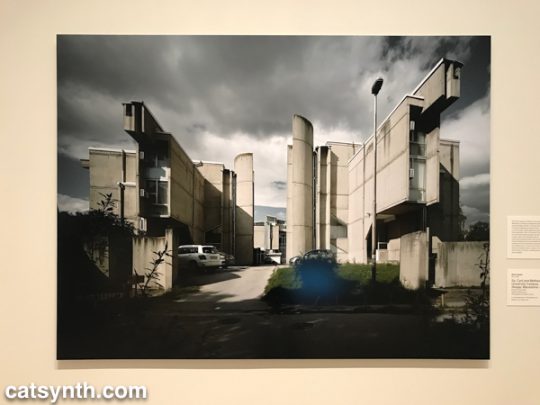
Brutalism perhaps reached its zenith in the former Yugoslavia during the period between the end of World War II and 1980, a period that is highlighted in a current exhibition at the MoMA, Toward a Concrete Utopia: Architecture in Yugoslavia, 1948–1980. It highlights the work of several Yugoslavian architects in the period and pieces ranging from prosaic apartments to public arenas to monuments. The buildings themselves are, of course, not on display in the museum, but their stories are told through models, photographs, and examples of interior objects.
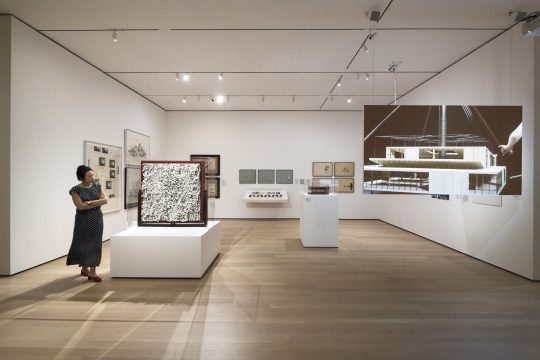
A convergence of factors came together which allowed these modernist experiments to flourish. Yugoslavia broke away from the Soviet bloc in 1948 and began to forge its own socialist path and identity. It constituted itself as six republics in a federation in which traditional regional identities were subordinate to a new and modern whole. At the same time, the country was devastated by World War II and needed massive rebuilding. Finally, new ideas in architecture were emerging along with new materials, notably advances in concrete, steel, and glass allowed a new built environment to take shape.
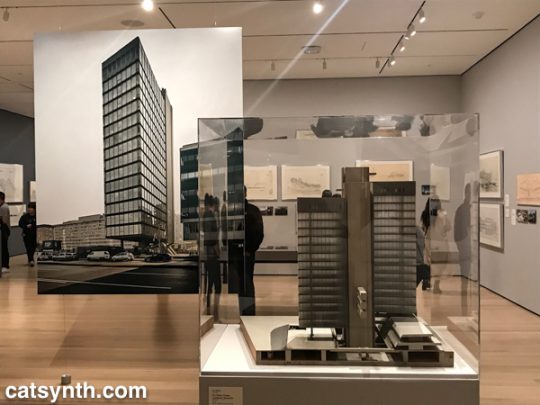
The simple forms and surfaces were used for everyday buildings, such as apartment complexes, schools, and medical facilities. But rather than just one-offs, they become part of a unified cityscape, a grand plan. This was perhaps no more so than in Skopje, the capital of Macedonia, which was devasted by an earthquake in 1963 and largely rebuild using modernist design and principals.
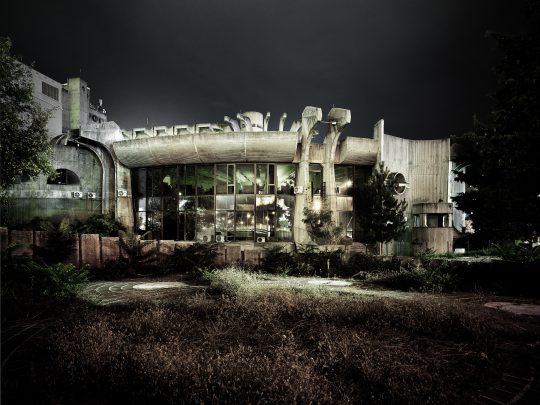
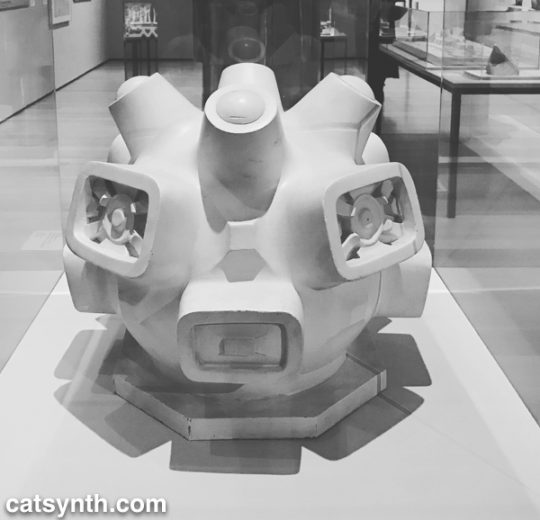
There are, of course, numerous rectilinear designs, sometimes in steel and glass, and sometimes dominated by concrete. But concrete also allowed for the exploration of curved structures and organic shapes. We see this in many of the large civic arenas, but also in the brutalist monuments built in the post-war period. This “cell-like” structure in Macedonia takes it to the extreme, looking at once like an organic organism and a spaceship.
Wandering through the exhibition, one cannot help but imagine being the real spaces. For me, the modernist, severe style brings a sense of calm and welcome that more traditional styles don’t always provide.
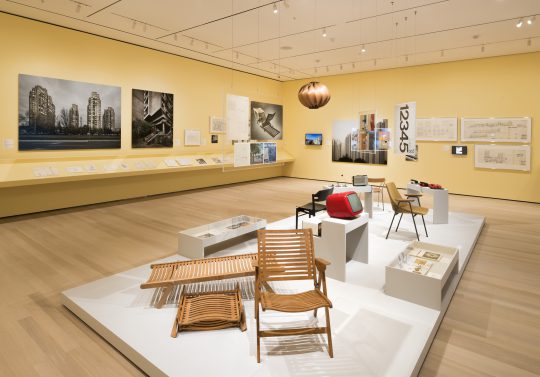
Sadly, the Yugoslavian experiment ultimately failed, with country breaking apart and the entire region plunging into extreme nationalism and devastating wars in the 1990s. This is a cautionary tale as we watch the plague of nationalism rising around the world, including in the United States. Many of the architectural works in this exhibition did survive the wars. But they do face continued challenges to their survival, including maintenance and a push to return to more “traditional” forms. The “Skopje 2014” initiative, for example, is both farcical and tragic. Despite these challenges, I hope the countries of the region will recognize and preserve the legacy of their modernist period for years to come.
This article only scratches the rough, hardened surface of the wealth in this exhibition. It was truly a wonderful experience, even if so much was in my imagination through the artifacts. Toward a Concrete Utopia: Architecture in Yugoslavia, 1948–1980 will be on display at the Museum of Modern Art in New York through January 13, 2019.