Visiting the 9/11 Memorial in New York

My trip to New York included a visit to the to 9/11 Memorial. As stated on the website, the memorial is “A national tribute of remembrance and honor to the men, women and children killed in the terror attacks of September 11, 2001 and February 26, 1993.” At its most essential level, it is a space rooted in tragedy and loss and remembrance. But it also is a positive space, in harmony with the modern urban landscape, the changes happening as the area is rebuilt, and a prototype for ways to think about public urban spaces for the future.

The memorial is located on the World Trade Center complex, and occupies a large portion of the original site. It is anchored by two large square waterfalls and reflecting pools, each approximately the size and location of the footprints of the original twin towers.

In this photo, one can see how the pools are situated with respect to the other architectural features of the landscape. Behind this pool on the footprint of the original south tower are (from left to right), the existing buildings from the World Financial Center in Battery Park City, the new One World Trade Center building still under construction, and the September 11 Museum (also still under construction).

At the center of each reflecting pool is a dark square hole whose bottom cannot be seen from the sides and into which water from the pool falls.

The trees visible in the above photo are swamp oaks, and form an important part of the memorial. Although orange and rather spare in late November, they form a green canopy that will shade much of the space during the spring and summer and add a sense of life to the space. They are also an integral part of the green design, with the shade helping to reduce stress and energy on the underground parts of the complex (including the major transit hub at the site). Conversely, the paved walkways are designed in such a way as to support the trees and not put undue stress on them or their roots (visit the website for more detail on how that works).

The sides of pools are lined with bronze onto which are inscribed the names of all the people who died in the attacks on September 11, 2001, as well as the six people who died in an earlier attack on the World Trade Center in 1993.

It is somewhat reminiscent of the names on the Vietnam Memorial in Washington, DC, and indeed I did see some people making rubbings of particular names.

The architecture of the pools, with the concentric squares and footprints, grounds the memorial in the architecture of the original site. The museum facade also takes on elements from the long lines of glass and steel structure of the original towers. Even the cascading water into the pools seems to have been designed to reflect the original architecture. The pattern of the water as it cascades over the edge strongly reminds me of the two-story lobbies of the original towers.

Visits to the memorial is still very controlled, and one has to book passes for a particular date and time well in advance. But we were able to get a good time during what is presumably a busy week. I am glad I had a chance to visit at this time, with the overall site still in progress. I would like to see it again in the future as the buildings and the museum move forward.

Weekend Cat Blogging: Pallas Cat

What do you see in this picture?

Well, since it is Weekend Cat Blogging, one would expect to see a cat. And indeed there is a wild cat sleeping well camouflaged amongst the rocks. This is Pallas’ Cat, native to the high-altitude grasslands of Central Asia including Mongolia, western China, and parts of Russia and Afghanistan.

This particular individual was not in Central Asia, but rather at the zoo in Prospect Park in Brooklyn.

Pallas’ cat has a nice thick fur coat and, unlike the writer of this article, is well suited to colder climates.

They are similar in size to larger domestic cats, and of course have many of the same characteristics. They hunt, tend to be solitary, and spend a decent amount of time sleeping. But despite the similar appearance, there is a lot of question about how closely they are related to other cats. They are currently not part of the genus Felis with domestic cats and related wild cats, but part of the separate Otocolobus (though this is subject to discussion).

Pallas’ Cat is not on the endangered list at this time, but is listed as “near threatened” primarily due to habitat loss and illicit hunting and trade (one can only imagine that an animal with such a fur coat could be easily threatened by illegal hunting). There are efforts underway to help preserve these cats in their native territories, including programs in Russia and Mongolia. Follow the links for information on these efforts.

For more general information on Pallas’ cats and their current status, visit the Feline Conversation Federation (FCF) and our friends at the International Society for Endangered Cats (ISEC)

Chakras and Homebrews at Performa 11

During my visit to New York, I had the opportunity to check out a few events from the Performa 11 biennial. I had a great experience, too years ago, and wanted to check out the final weekend. My time this year was quite limited, but I did have a chance to attend a few events.

The artistic highlight of my brief visit was a piece by Mika Rottenberg and Jon Kessler called SEVEN, which took place at Nicole Klagbrun Project in Chelsea. It was described as “a chakra sauna channeling chromatic body fluids from New York to Cradle of Humankind in Africa.” There are seven chakras, which correspond to areas of the bodies and states of being in Hindu and Buddhist traditions (you can look up tons of information on this if you’re curious), with an addition of colors of the spectrum in some recent practices, particularly in Western societies. The installation consisted of a full scale urban spa, with exercise area, working sauna and a lab with a bizarre combination of equipment and a technician who appeared to be running the show:

At the same time, the installation featured a video from an arid landscape in Africa. It is the combination of both the live installation and the video that becomes interesting. In the video, a succession of people in the African landscape extract cylindrical cores of mud from the parched ground. These are given to a local man in a small hut, which he then places into a bizarre looking contraption. When he turns it on, the core suddenly appears in the local lab in a similar looking piece of equipment. These are then placed in the sauna. Meanwhile, in New York, people take turns on an exercise bike, which both powers the sauna and helps the participant work up a sweat as they take turns moving from the bike to the sauna. The participants are assigned colors from the chakras/spectrum in succession, and their perspiration from the sauna generates a vial of “chakra juice” of that color, which is then collected.

This process repeats slowly for each of chakras, with the participants in Africa bringing the mud to the machine and the local participants generating the colored vials in the sauna. The synchronization between the installation, live performance and video is very well done, and does give the illusion that these events are happening together in real time through some process we don’t quite understand.

When all seven chakras are filled, the set is then sent back through the device to its counterpart in Africa in the video. At this point, the video completely takes over and we see the purpose of this ritual. If anything, the conclusion was perhaps the least convincing part of the piece, as it seemed a bit forced compared to the surrealism and illusion created by the synchronizing the video and live performance. But overall, it was a strong piece and I’m glad I made the trip over to the west side to see it.

Back at the Performa Hub in SOHO, I spent some time at the brew pub, where a variety of beers from local homebrewers were on tap.

I particularly liked a couple of spicy brews featuring chili, but there were also some great seasonal beers with pumpkin and cinnamon. In addition to the beer itself, it was an opportunity to interact with artists, the brewers and other visitors. Attending art events in New York can sometimes be a lonely affair, so it was a nice change of pace. In my haste to get to the next event, I misplaced my list of the beers (along with my copy of the Occupied Wall Street Journal I picked up earlier in Zuccotti Park), so I don’t have exact info to share with readers. If I find something online, I will update.

Overall, I did not get to see as much as I did in 2009, and it did not have the same abstract/modernist/future-retro vibe that it did two years ago, but overall it was a good experience and a good start to my week in New York.

AvantElectroExpectroExtravaganza. Experimental Music Brooklyn, New York

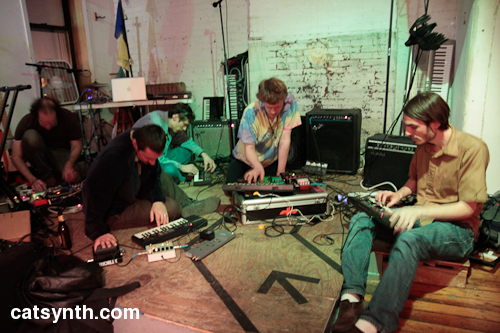
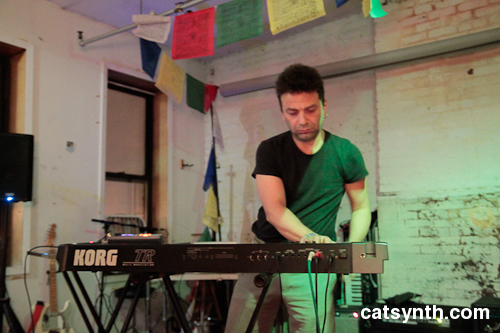
Today we look back at the first of my two performances in New York, the appropriately named “AvantElectroExpectroExtravaganza” with a diverse collection of experimental electronic musicians. It was a small an intimate space nestled in a building in an industrial section of Brooklyn, east of Williamsburg. But we had a decently large stage and good sound reinforcement, and a small but attentive audience. And the industrial setting was one conducive to both my playing and enjoyment of art and music.

The performance began with a procession by members of the SK Orchestra improvising to sampled phrases “Hi” and “How are you doing”. For those who are not familiar with the Casia SK-1, it was a small sampling keyboard from the mid 1980s which allowed users to record and manipulate live sounds in addition to standard consumer keyboard features. The low fidelity and ease of use now makes them coveted items for many experimental electronic musicians. There were no fewer than five of them in the ensemble this evening.


[SK Orchestra. (Click image to enlarge.)]

As they sat down for the main part of the set, the sampled sounds grew more fragmented and processed, mixed with lots of dynamic swells and analog-filter-like sounds. Combined with a wide array of effects, the sounds were quick thick ranging from harmonic pads to noise to moments that could be best described as “space jam music.” I was particularly watching articulation with a Morley pedal and how it timbrally and rhythmically informed the sound. Taking advantage of the live-sampling capabilities of the SK-1, they resampled the output from the amps and PA and fed that back into the performance for a slow motion feedback loop that grew ever noisier and more forceful. The rhythms got more steady over time, with a driving beat set against the phrase “Holy Jesus!”, and eventually moved into a steady bass rhythm and pattern.

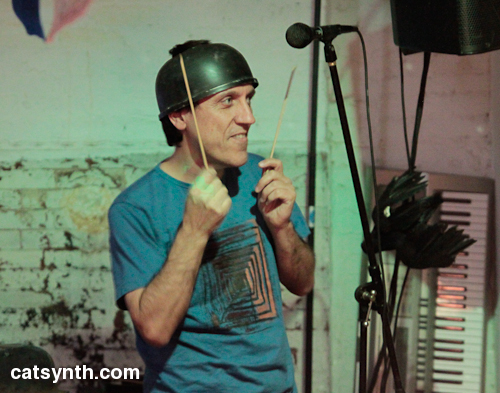
Rhythm was the main theme of the next set featuring Loop B. His theatrical and technically adept performance featured tight rhythmic patterns on found metal objects with playful choreography and beat-based electronic accompaniment. In the first piece, he performed on a large piece of metal salvaged from a vehicle with syncopated rhythms set against an electronic track. This was followed by a piece in which he donned a metal helmet, which he played against more Latin accompaniment.


[Loop B. (Click image to enlarge.)]

Other metal instruments included a wearable tube, as featured in this video clip.

And a return to the original car metal, but with a power drill.

The rhythmic character of the different pieces seemed to alternate between driving electronica and Latin elements, but this was secondary to the spectacle of the live playing. It was a unique and well-executed performance, and fun to witness. It would be interesting to hear what he could do in an ensemble setting with musicians with an equally tight sense of rhythm.

Loop B’s energetic and dynamic performance was followed by a very contrasting set by Badmitten (aka Damien Olsen). It began with eerie, ambient sounds that soon coalesced around watery elements. It gave me the sense of sitting near an alien sea shore. Pitch-bent tones were layered on top of this, and eventually noises and glitches that deliberately interrupted the ambience. A low-frequeny rhythm emerged along with a slow bass line. It seemed that music was moving from the sea to a forest.


[Badmitten. (Click image to enlarge.)]

The sounds were quite full and luscious, with guitar chords and synth pads. Over time it became darker, with modulated filter sounds and strong hits. Seemingly out of nowhere, a voice speaking in French emerged (which amused French speakers in the audience). The various sounds coalesced into a more steady monotone rhythm with minor harmonies, which started to come apart and become more chaotic. The set concluded with an electric piano solo.

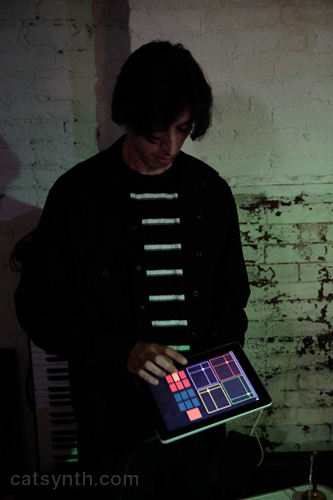
It was then time to take the stage. Fortunately, we had quite a bit of time and space to set up before the show, so most everything was in place and I was able to get underway quickly after checking that the local wi-fi network between the iPad and the MacBook Pro (running Open Sound World) was working. I opened with a new version of the piece Spin Cycle / Control Freak that used the iPad in lieu of the Wacom Tablet from the original version 11 years prior. It worked quite well considering the limitations of the interface – and indeed the more rhythmic elements were easier to do in this case. This was then followed by a stereo version of the piece I composed for eight-channel surround and the dodecahedron speaker at CNMAT back in March. The timbres and expression still worked well, but I think it loses something without the advanced sound spatialization.


[Click image to enlarge.]

Perhaps the best piece of the set was the one with the simplest technology: I connected the output of the Wicks Looper to the input of the Korg Monotron for a pocket-sized but sonically intense improvisation, which you can see in the video below:

I concluded with a performance of Charmer:Firmament from my 2005 CD Aquatic.

The final set of the evening was Doom Trumpet, which did not feature a trumpet. Rather, artist David Smith performed improvised music with guitar and effects set against a video compiled from obscure science-fiction movies. I found myself focused on the visuals, and particularly liked how he opened many of the clips with a highly-processed version of the MGM lion. Musically, he layered samples and loops with live guitar performance through a variety of effects. The combination of the music and visuals (which seemed to be dated from the late 1960s through early 1980s based on costumes and hairstyles) kept things appropriately dislocated from the source material and more abstract.


[Doom Trumpet. (Click image to enlarge).]

Overall, it was a great night of music, which I was glad to be a part of. A few participants will be part of my next New York show at TheatreLab this coming Saturday, but I certainly hope to cross paths with everyone at concerts in the future.

Occupy Wall Street (Zuccotti Park)

Being in New York in the third month of Occupy Wall Street, I of course had to visit Zuccotti Park, the symbolic and initial geographical center of the movement. And I did visit for a while on Saturday.

This is of course coming a little less than a week after the major raid on Zuccotti Park, so things were a bit sparse, indeed less active than some of the events I have attended in San Francisco. The ban on tents was in full force, with not a single tent in sight. I had also heard about a ban on musical instruments. So here I am playing the Smule Magic Piano on the iPhone in defiance.

Zuccotti park is in fact not much of a park at all. It’s a paved plaza with lights in between some of the stones. A few of the planted trees in the space were festooned with holiday lights. It’s the sort of modern public space one often sees near commercial buildings. If it wasn’t a protest site and rather cold, it would be a perfectly nice spot for lunch. I did of course get to see the “weird red thing”, aka Joie de Vivre by Mark di Suvero.

At the time I arrived, many of the leaflets and signs were in fact not about the core issues of the Occupy movement, such as income inequality and accountability of the financial institutions and their leaders, but rather a mix of 9-11 conspiracy theories (though I should not be surprised as we were just over a block from the World Trade Center site). I was disappointed to see that, as I place very little credence in such conspiracies and think of it as a detraction. But fortunately, a large march of people came back from the direction of the actual Wall Street and seemed to be more on message. I was even able to get from them a copy of the “Occupy Wall Street Journal”:

There was one tense moment when there were rumblings about police entering into the main area of the plaza. A quick look around confirmed this to be the case. As one speaker got up to address the crowd and remind everyone to be civil and not to repeat the mistakes of previous encounters, the police suddenly swooped in on one person, whom the arrested and carried out of the perimeter. It was all over quite quickly, and without any confrontations – there were additional calls to those assembled not to do anything provocative. But there was a lot of confusion, and no one seemed to know exactly why this one person was arrested. But it seemed to be connected to disrupting the putting up of holiday lights by the park’s owners.

Other than that, it was relatively calm and quiet visit to Occupy Wall Street…and a very cold one. The sparseness in comparison to recent west-coast events and the cold further suggests that the movement has to morph into something else beyond camps and marches.

CatSynth in New York

As I do ever year at around this time, I will be spending a week in New York.  This promises to be a rather busy trip, visiting with family and friends, seeing art exhibits, partaking in various New York rituals, and playing in two music performances.  For those in the NYC area (or who have friends in the NYC area), here is the information on the shows:

November 20, 2011. 8PM. AvantElectroExpectroExtravaganza

13 Thames St., 3rd Floor, Brooklyn, NY.
SK Orchestra, Doom Trumpet, Amar Chaudhary, Loop B, Badmitten (damien olsen)

November 26, 2011. PAS presents Experi-MENTAL Night at Theaterlab. 7PM.

Theaterlab: 137 West 14th Street, New York.
A night of Experi-MENTAL music featuring: PAS, Richard Lainhart and Lucio Menegon, Koning’s Blauw, Amar Chaudhary, ‘History of the Future’ live film score directed by Richard Lainhart with ‘The Orchestra of the Future’.

Many of these names should be familiar from past shows, including last year’s Omega Sound Fix, the now defunct Ivy Room Hootenanny here in the Bay Area, and others.

I will try and post sporadically while I am there, but I do expect to continue with live updates of NY adventures via Twitter @catsynth.

Fun with Highways: The Bay Bridge Turns 75

This past Saturday, November 12, marked the 75th anniversary of the opening of the San Francisco – Oakland Bay Bridge, known conventionally as “The Bay Bridge.” It is a regular part of life for many of us here, one of our main connections to the communities across the bay and a principal landmark during walks in my part of the city. It has been featured in many previous articles here on CatSynth.

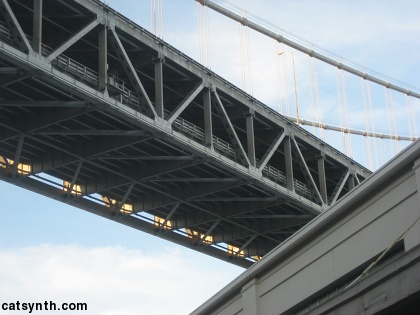
The Bay Bridge is a workhorse, spanning over 4 miles and carrying an estimated 270,000 vehicles a day, making it second busiest in the U.S. after the George Washington Bridge in New York. But the western double-span is quite a beautiful structure, both as seen from the hills of San Francisco and from up close.


[Click to enlarge]

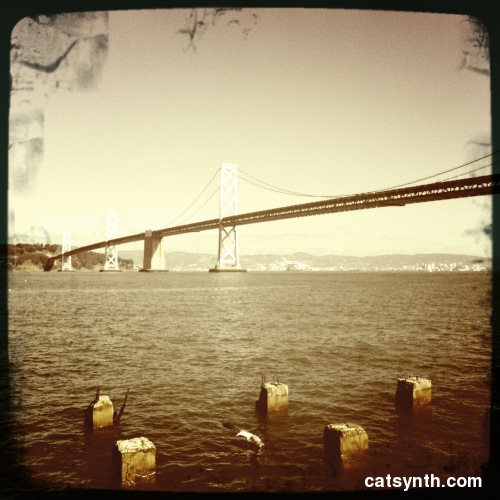
[Click to enlarge.]

Don’t let that last photograph fool you. Even though it may look like it was taken 75 years ago, it was actually taken yesterday using the iPhone Hipstamatic app during an early afternoon walk by the bridge.

It was quite an engineering feat when it was built, the longest bridge of its time and built in challenging geography of the bay.

[Image from Wikimedia Commons.]

This video (as seen on the official Bay Bridge info site) captures both the era and the engineering:

Much like the Brooklyn bridge when it was first built, the Bay Bridge towered over the surrounding architecture of the cities it connected. It is anchored in the middle to Yerba Buena island with tunnels connecting the two spans of the bridges. On the the San Francisco side, it is anchored to Rincon Hill, once an upscale neighborhood in the late 1800s that fell into rapid decline and largely destroyed in the 1906 quake. The eastern bridge was built resting on mud rather than bedrock. It was the most expensive bridge built to date.

The idea of a bridge crossing the bay has been around since the 1800s. Indeed, such a bridge was proposed by Emperor Norton in the 1870s (I think this even made it into Gino Robair’s opera I Norton). But unlike his other proclamations, this one seemed like a good idea. After that, there were many proposals, such as this one that in some ways resembles the bridge that was actually built.

The bridge proposed in this drawing connected to Telegraph Hill rather than Rincon Hill, and has suspension bridges on both sides of Yerba Buena island.  The spires also make it look like some of the older suspension bridges on the East River in New York.

When bridge first opened, it carried US Highways 40 and 50 as well as the trains from the Key System in the East Bay. The upper deck had longer ramps leading to Harrison and Bryant Streets at 5th, roughly the same as the rather long ramps at those streets today. On the Oakland side, the bridge had viaducts from Cypress Street (Highway 17) as well as San Pablo Avenue and the Eastshore Highway (US 40). The bridge now carries Interstate 80 across the bay. The railway is long gone. Gone also are the connections to the old Transbay Terminal and Embarcadero Freeway, both of which have been demolished. The area under the bridge on the San Francisco side, once a gritty industrial waterfront, is now a picturesque boulevard that is great for walking. Through all of the changes, the bridge itself has not changed very much at all…

[Bay Bridge approach, 1940s]

[Bay Bridge and Embarcadero, 1970s and 1980s. Photos from Wikimedia Commons.]

[Present day, Bay Bridge and southern Embarcadero. Photo by CatSynth]

…until now. The eastern truss span, which was badly damaged in the 1989 earthquake, is now being replaced with a new more graceful cable-stayed span. The construction has progressed to the point where the tower is in place and the cables are being hung. It is indeed a bit distracting when traveling the bridge. But I am looking forward to seeing it completed, probably around the 77th anniversary in 2013.