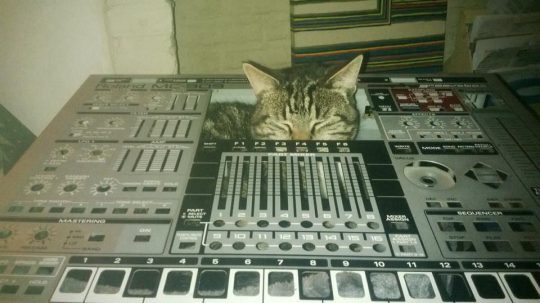
Cat peeking out from a Roland MC-909 sampling groove box, or at least the shell of one. It appears to have been stripped of its display and surface controls – and probably the internal electronics as well – making it great for sits!
It’s been a slow recovery from our latest bout of this year’s influenza and “NAMMthrax,” but we are getting there slowly. Indeed, I have been well enough to spend more time working in the studio again. Of course, if I am in the studio there is a good chance Sam Sam will be there, too.
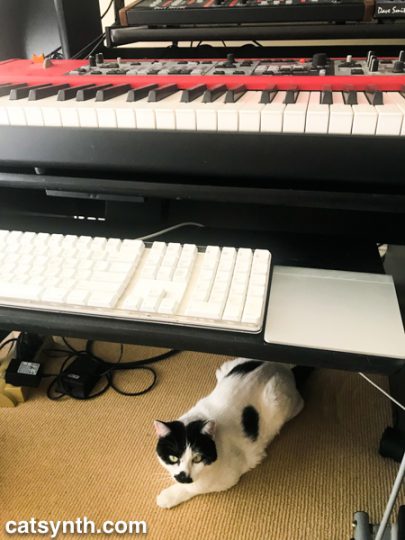
It’s always a delight to have her around. I think she is getting used to all the weird electronic sounds just as Luna did. As a more social cat, I think she mostly just enjoys being near the action. I do sometimes feel guilty when she gets comfy under the main console and I want to use the Nord. It’s a studio musician’s version of the cat-in-lap dilemma.
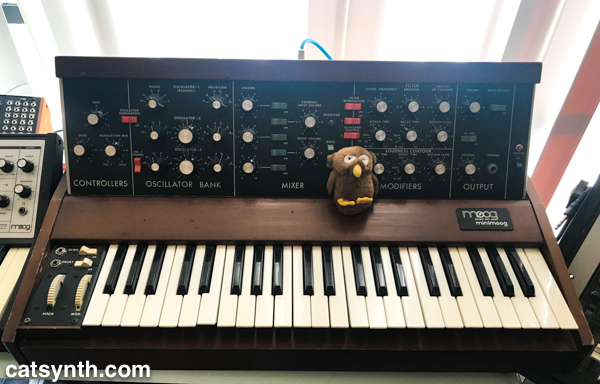
We are going to move forward with some video and music work today, as body and energy permit. We are also doing our part for today’s mass ritual here in the United States with our Superb Owl.
We hope you all have an enjoyable day, however you chose to fill it!
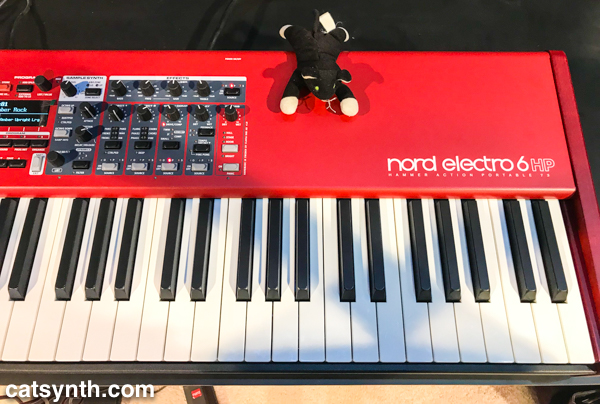
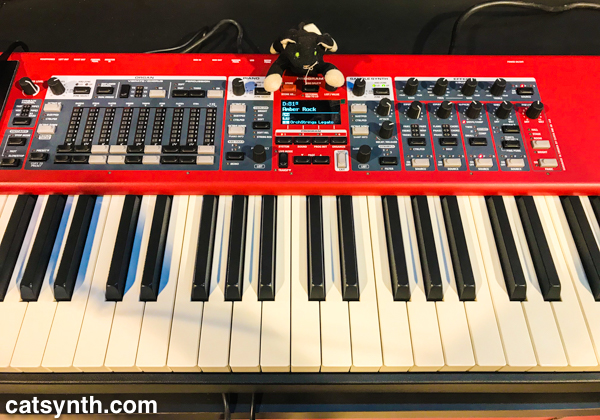
We resume of coverage of the 2018 NAMM Show after a few days break – and a nasty bout of “NAMMthrax” – with the latest spin on an old favorite: the Nord Electro 6.
Longtime readers know that I have been a user of Nord keyboards since I got my trusty Nord Stage EX back in 2010. It has served me well, but have sometimes been envious of the features in subsequent generations, notably the expandable Piano Library and Sample Library (the original Stage does not support the sample library at all). With the Electro 6, the separation from the Stage line is much more blurred, and it calls into question the need for a Stage at all for those of us who fell in love with Nord keyboards for their electric pianos. The Electro 6 supports up to 3 layers and splits (something previously limited to the Stage). The electric piano (and acoustic piano) section is enhanced with new layering features and its own filter section that allows one to dial in different tones within a particular model. And the piano library is expandable with 1GB of memory. The organ section uses the C2D engine, and a rock organ is quite handy in a variety of situations. The sample library allows for classic Mellotron sounds as well as a variety of others. The one section from the Stage that is missing is the independent A1 synth (similar to the Lead). Personally, it is the section I use the least, so I wouldn’t miss it if I moved over to the Electro. Plus, this model would be a little bit easier to schlep back and forth to gigs.
The Electro 6 comes in three models: 61-key and 73-key semi-weighted with mechanical organ drawbars; and the “HP” version with 73 fully weighted keys and LED drawbars. As a pianist, the latter would be my preference.
If you are already fortunate enough to have an Electro 4 or 5, the 6 probably won’t be a big enough change to warrant an upgrade, especially at the high prices these instruments command. But if one has been waiting eight years, it might be the time…
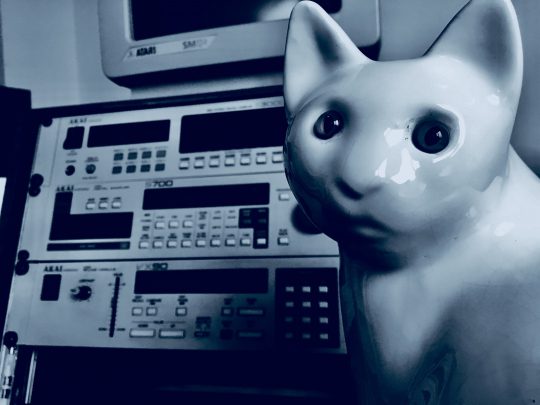
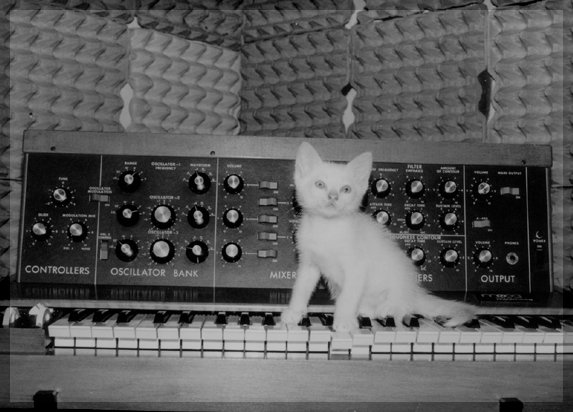
Beautiful monochromatic photo of a porcelain cat with vintage Akai synthesizers, including the S700 sampler and VX90 six-voice analog synth. By Jeroen ten Asbroek via Facebook.
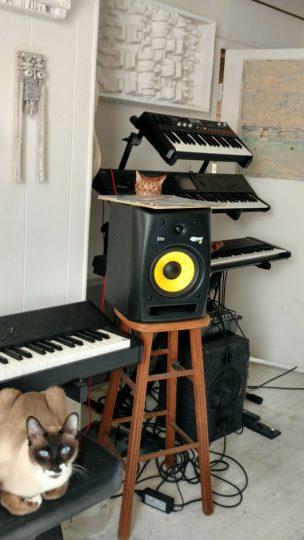
Our friend Damien Olsen back in Brooklyn presents “Cats in the Studio”, featuring two of his cats and sundry keyboards. I had the pleasure to meet these felines during my most recent trip back to New York 😺
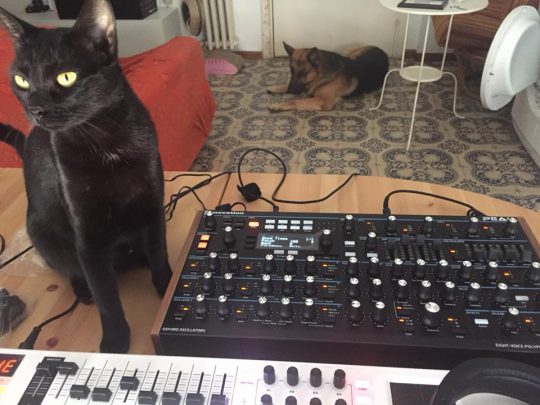
We always love seeing black cats, especially color-coordinated with their musical instruments. Here we see a beautiful black cat posing with a Novation Peak synthesizer.
By Enzo Di Michele from a thread in the Facebook group Synthesizer Freaks. Yes, the same thread that featured yesterday’s picture 😺
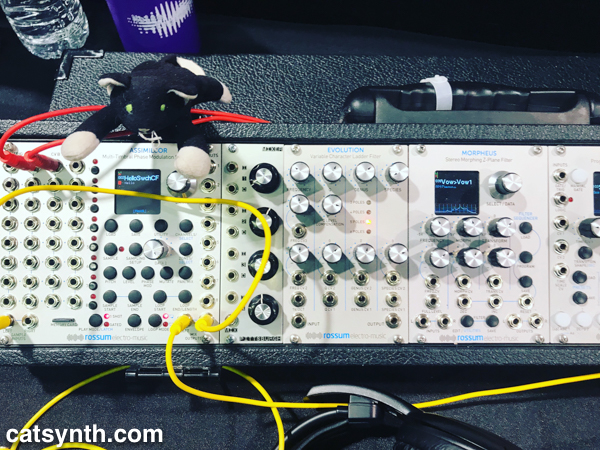
We visited our friends at Rossum Electro-Music at NAMM and were treated to an in-depth demonstration of their Assimil8or module by Marco Alpert.
We are grateful to Marco for his demonstration, not just because it made our video awesome, but because it helped better understand what is a complex module. The Assimil8or is a sample engine with many of the features one found in classic E-MU samplers, and more (Dave Rossum being the mastermind behind E-MU’s popular instruments). One particularly intriguing advance was the timed switching among samples, which allows one to move between different tracks seamlessly while remaining in time (the Cars example in the video demonstrates this quite well). There is also “virtual tape-scrubbing” of audio. Of course, everything is CV controllable.
Combining the Assimil8or with the Morpheus module (which we at CatSynth own and enjoy) and the Control Forge, one can assemble something akin to an E-MU sampler on steroids, with vastly more complex and rich control options, including at audio rate! Even the Morpheus on its own is rather overwhelming, but having seen the modules in action by the folks who made gives us ideas on how to use it better. We look forward to more experiments with these modules from Rossum Electro-Music!
More info can be found at http://www.rossum-electro.com.
(Disclosure: Amanda Chaudhary of CatSynth used to work for E-MU Systems, several of whose principals are now at Rossum Electro-Music.)