In Tandem with Max Mathews, Aaron Koblin, and Daniel Massey

Last Friday I attended a talk featuring Max Matthews and a new conceptual work by local artists as the Gray Area Foundation for the Arts (GAFFTA). GAFFTA is an intriguing new organization and space for the intersection art, design, sound, and technology. They are “dedicated to building social consciousness through digital culture.”
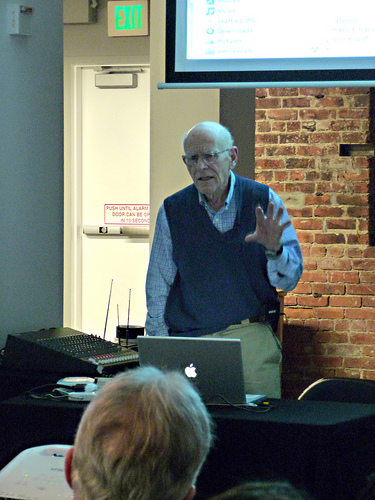
Max Mathews. Photo by Vlad Spears

I had last seen Max Mathews, considered by many to be the “father” of computer music, at an 80th birthday tribute at the Computer History Museum in 2007, and before that delivering the keynote address at ICMC 2006. It is great to see him still going strong and engaged with technology and supporting others’ creative work. His talk primarily focused on his work at Bell Labs, and in particular the history and technologies surrounding his 1962 computer rendition of the song “Daisy Bell” (aka “Bicycle Built for Two”). It was an early example of physical modeling synthesis, where sections of the vocal tract were modeled as tubes, and sound generated directly from physics equations. His version of the song was popularized in the film 2001: A Space Odyssey, although Mathews revealed that the version Kubrick used in the film was not his recording. He also presented another famous example of computer-generated vocals, a performance of the “Queen of the Night” aria from Mozart’s The Magic Flute. This piece used formant synthesis in which focus on recreating spectral characteristics of the sounds (i.e., the formants that characterize vowel sounds) without necessarily modeling the physical processes that allow humans to create those sounds. The voice is quite compelling (if a bit dated), and demonstrates that the most realistic sounds are not necessarily those generated from physical models.
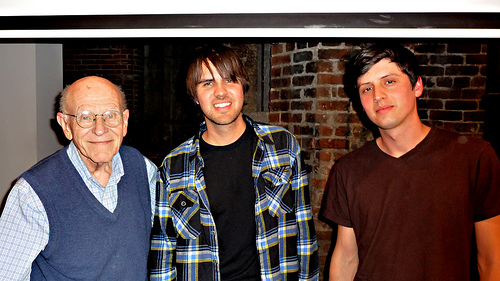
[Mathews, Koblin and Massey.  Photo by Vlad Spears.]

Mathews’ presentation of “Daisy Bell” served as an introduction for a new project “Bicycle Built for 2000” by Aaron Koblin and Daniel Massey. Koblin has been working on a series of conceptual pieces that utilize the Amazon Mechanical Turk, a framework for harnessing human intelligence to solve large problems. There are some things that humans are quite efficient at and computers are very poor at, such as recognizing distorted text (think of the CAPCHA codes that we all deal with on websites, including here at CatSynth). The Amazon Mechanical Turk, which derives its name from an 19th century hoax where a supposedly mechanical chess-playing machine turned out to be a human hidden inside a box, provides a framework and API for defining tasks to be solved by humans, recruiting people to work on them, and then compensating them for their efforts according to a fixed budget. One of Koblin’s pieces provides the instruction to “draw a sheep” for a few cents. He then collected the resulting drawings of various sheep (and non-sheep) from around the world and compiled them into a larger mosaic work, The Sheep Market. You can see the overall mosaic as well as click on individual sheep and even see an animation of how they were drawn by the individual contributors.
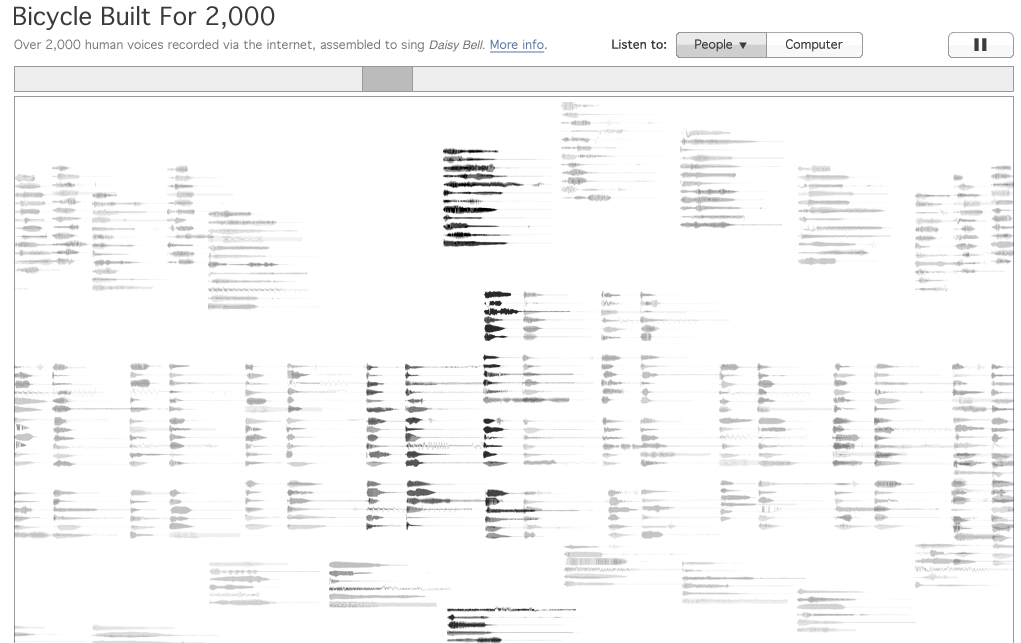
[Screenshot of Bicycle Built for 2000, by Aaron Koblin and Daniel Massey.  Click to enlarge.]

For “Bicycle Build for 2000”, Koblin collaborated with Daniel Massey on a work that focused on sound and music. The Max Matthews rendition of Daisy Bell was decomposed in a sound segments no longer than one syllable, and for each segment an Amazon Mechanical Turk task was created for someone to sing back the sound. Koblin and Massey then reassembled the sounds to re-create the song as sung by the participants. The initial version, in which only one singer was used for each component, was almost unrecognizable, though quite interesting. A larger version which included a chorus of voices on each segment better represented the original qualities of the song, and clearly recognizable. You can hear the full version at the project website, along with an interesting visualization of the assembled recordings. The fact that the larger ensemble produced a more recognizable result, essentially averaging out the various sung renditions, is perhaps an example of the oft touted “wisdom of crowds”.

There is also a slightly more ominous set of questions from these works concerning exploitation of individuals who don’t know the overall purpose of their tasks, or about hive mentality and such, but I still find it quite interesting and am inspired to try out the Mechanical Turk for a future art project.

Conduct Your Own Orchestra Night

Last Thursday, I participated in Outsound Presents Conduct Your Own Orchestra Night at the Luggage Store Gallery. During the course of the evening, several conductors took turns conducting an “orchestra” of improvising musicians for ten minutes. Each conductor took a very different approach, using a variety of gestures, instructions and symbols to guide the performers.


[Bob Marsh conducts the orchestra.]

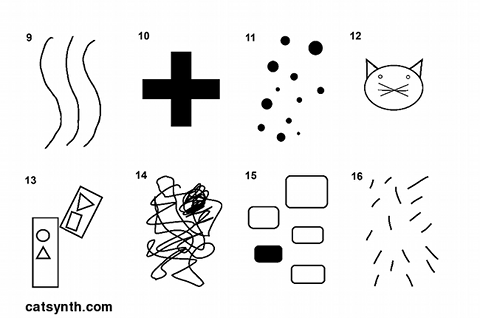
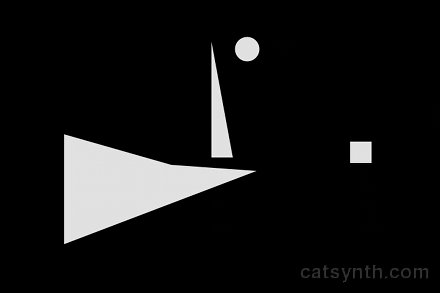
As with other recent guided-improvisation pieces, I used a graphical score for my conducting. The performers were each given a set of 16 graphical symbols. During the course of the performance, I held up large cards each containing one of the symbols, directed either at individuals, groups or the ensemble as a whole.

You can see some of the symbols below:

[Click to enlarge.]

This is the second page of the 16 available symbols, generally these were the more complex. Viewers might notice that symbol 12 is a cat. Like other symbols, I expected to be interpreted relatively freely – but by coincidence percussionist Ann O’Rourke had a cat-shaped metal CD rack as an instrument, so it became a very obvious cue for her to play the “cat.”

Ann O’Rourke’s piece was based entirely on pairings of words, such as “fearful/choppy” and “fearful/flowing” or “hesitant/slow” and “confident/fast”. The orchestra was divided in half, with one side receiving one pairing and the other side receiving the other pairing.

Brandan Landis’ conducting was more physical/body-oriented. He did not use any visual cues (textual or graphical), but instead used dramatic body movements to guide the orchestra. Some of these were rather intense and the piece ended with his collapsing on the floor.

Mark Briggs used short rhythmic patterns and cues to individual performers to build up a complex rhythmic texture. I was given a very simple repeated pattern to perform, which allowed me to remain immersed in the overall rhythm of the piece.

Tom Bickley led the orchestra in a very sparse and beautiful piece with individual sounds from cued performance set against silence. It was the sparse texture that made this among my favorite pieces of the evening, musically speaking.

Bob Marsh used his own instructional cards and gestures to conduct the orchestra, and contributed his own vocal performance on top.

Other conductors included CJ Borosque and Matt Davignon, who used a combination of instructional cards, including one that instructed a performer to make a loud sound when Matt pointed a finger gun and shot him/her.

William Leavitt, Boyce/Greenlief duo and Karl Evangelista trio

I continue to work through the backlog of art and music reviews by presenting some of the openings and performances I saw on the particularly busy and fun evening of February 19 here in San Francisco. Although the evening included both musical performances and exhibitions of visual art, music was present as a central theme throughout.

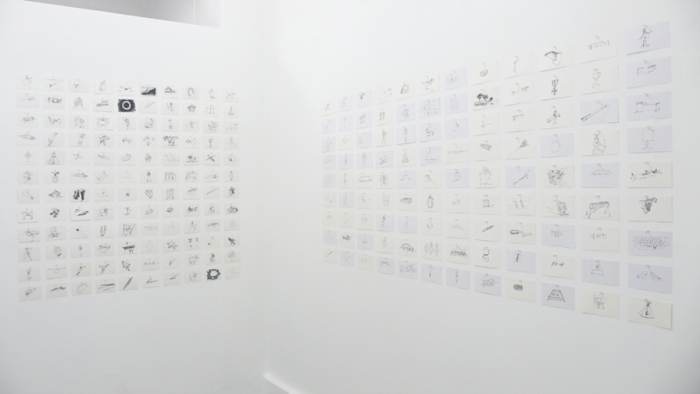
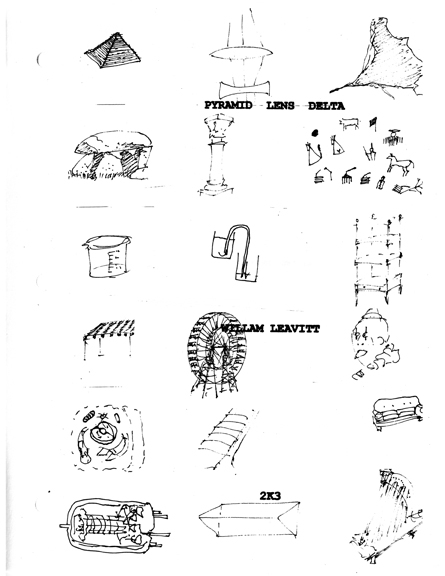
First up, we visited Jancar Jones Gallery for the opening of William Leavitt: A Show of Cards. The exhibition featured “over 300 ink drawings on index cards” (though I only counted 248) arranged in three groups on the walls of the gallery.


[William Leavitt, A Show of Cards: Installation View. Photo courtesy of Jancar Jones Gallery. (Click to enlarge.)]

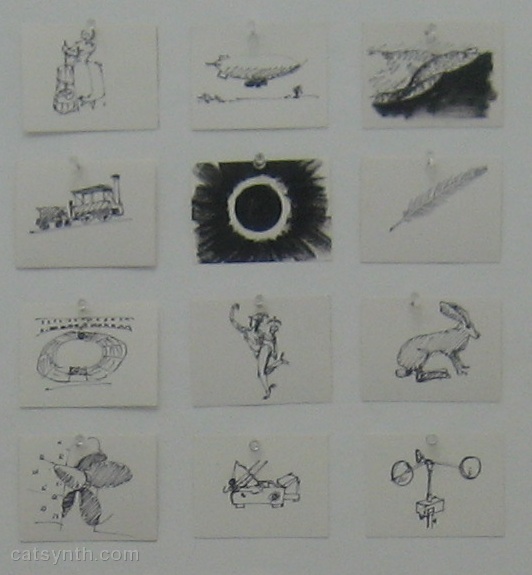
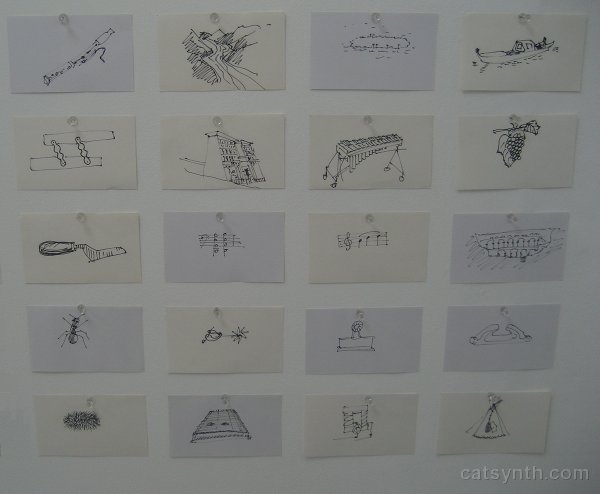
The gallery’s stark white walls presented a great surface for drawings, which were sometimes very sparse and sometimes quite detailed. Many featured musical elements, such as instruments or notes on a staff. There were also mathematical pieces (such as an x-y plot of a sine function), electronic circuit diagrams, architectural drawings, animals and abstract textures.


[Click photos to enlarge.]

It was fun to scan the rows of cards, picking out individual ones for closer inspection and comparison, particular the abstracts and the references to some of my own areas of expertise (e.g., music and electronics). It turns out Leavitt has a long-standing interest in electronic music, and was featured in this article at GetLoFi alongside circuit-bending godfather Reed Ghazala.

William Leavitt, Pyramid Lens Delta. Image courtesy of Jancar Jones Gallery. (Click to enlarge.)

In addition to being works of art in their own right, the cards serve as a source material for chance procedures that Leavitt uses in other works. In particular, a random subset of cards were used to generate a narrative that was incorporated into the text for his play “Pyramid Lens Delta” (the title came from the first three cards in the set). The script for the play was part of the exhibition. The back of the script contained the card set, and glancing through the text one could see where portions of the dialogue seemed to be drawn from the cards, particularly dialogue associated with Ivan, one of the characters in the play.

Leavitt has used chance processes for past works, including a theater piece The Radio which premiered in 2002. This piece includes not only dialogue but also an original score that included musique concrete. I would have liked to have seen this.


After Jancar Jones, we made a brief detour into that ambiguously defined area at the base of Potrero Hill to Project One for The Art of Noise, a visual exhibition coincident with the Noise Pop Festival. It featured large artistically altered portraits of well known musicians, as well as some installations, such Ted Riederer’s piece featuring drums covered in rose petals.


We finally ended up in the Mission District, and after a brief stop for tacos arrived at Bluesix for a pair of musical performances.

The saxophone duo of David Boyce and Phillip Greenlief. As noted in previous reviews, Greenlief’s virtuosic saxophone performances cover a wide variety of instrumental techniques. The duo weaved effortlessly between idiomatic jazz riffs and more free-form sections featuring multiphonics, noise production and vocals. The change between sections was both sudden and subtle; I was immersed in a jazz riff with long up-and-down lines or rhythmic patterns and only later would realize that we had moved to a more non-tonal (i.e., “noisy”) and arhythmic section. They demonstrate that these modes of music making need not be at odds (as they are sometimes portrayed on musician discussion lists) and can be part of a single piece of music. The performance did, however, inspire a short discussion with a friend about what is “experimental music” and why the performances this evening did or did not qualify as “experimental”.

Boyce and Greenlief were followed by the Karl Evangelista Spaceman Explorer Trio, featuring Karl Evangelista on guitar, Cory Wright on baritone sax, and Jordan Glenn on drums. Evangelista in his various groups blends jazz traditions with elements of late-20th-century experimental music. This of course led back to the question of whether or not this performance was “experimental”, particularly given strong jazz foundations on the pieces that we heard. The trio opened with loud driving rhythms and Evangelista and Wright trading long fast melodic runs. The piece “Hurdles” on Evangelista’s MySpace is quite representative. Another piece a somewhat slower groove with strong quarter notes (one might say a little bit “funkier”, more 1970s). Within this context, the melodies, riffs and one-off notes were often atonal, which helps to keep things moving forward. Overall, it was a fast-paced and virtuosic performance.

Another show this weekend

No sooner have I finished what was a really successful show this Thursday at the Luggage Store than I find myself with another gig this weekend at the Meridian Gallery here in San Francisco. Full info:

Meridian Gallery
535 Powell St, San Francisco.
10PM
$10 donation at the door.

More info can be found here.

I will be performing a 30-minute electronic set, including some of the pieces of this past Thursday. A combination of electronics and folk instruments from India and China.

No decision yet on whether Luna will be making another video appearance.

Preparing for Thursday’s performance: Luna’s video

Over the last few days, I have largely been absorbed by preparations for my next performance. This one includes a more ambitious element, a 10-minute video entitled 月神1 featuring clips of Luna as well as abstract elements reminiscent of experimental filmmakers such as Stanley Brakhage or Gerhard Richter. The video will serve as a backdrop for live electronic improvisation – it is mostly silent, though I did include some sound at various points so the audience could hear Luna’s voice.

Here are a few example frames from the video:


Some of the video clips of Luna were featured here on CatSynth in the past, including her chattering video, or playing with her blue fish toy. The abstract elements were done is a software package called Processing, a programming language for images, animation and interactions.

Musically, I will plan to focus on a mixture of the Evolver and the Octave CAT synthesizers, along with software on the iPhone and laptop. Indeed, this is the first time I will be using the CAT live, mostly because I am reluctant to move it too often.

Of course, this will only cover about one third of the full performance, so I will be drawing from my repertoire of electroacoustic improvisation to round out the remainder of the time. Although I reuse elements, there is always something new to discover in them.

For those in the Bay Area who may be interested in checking it out, the full information is below:

Full Moon Concert Series: Quickening Moon
Thursday, February 25, 8PM
Luggage Store Gallery, 1007 Market Street @ 6th Street, San Francisco.

The Full Moon Concert Series is an experimental music series offered by Outsound Presents, in partnership with the Luggage Store Gallery. Each concert explores the traditional lore of the Full Moon, and in January, the second annual “Quickening Moon” will feature new music springing to life. First up will be Amar Chaudhary in a solo electronica set (collaborating with his wonder-cat, Luna), followed by the world premiere of a new work for twelve improvisers by Polly Moller, entitled Genesis.

Reconnaissance Fly at Studio 1510, Oakland

A few photos and thoughts from last Friday’s Reconnaissance Fly performance at Studio 1510 in Oakland.

I knew that Studio 1510 had a great acoustic piano, which I wanted to take advantage of particularly for our piece Emir Scamp Budge which features an extended jazz piano solo. But it turns that they also now have an actual Rhodes Stage Piano Mark II. I could pass up the opportunity to appropriate it for our set. Here is the Rhodes with the E-MU Proteus 2000 and Korg Kaos pad conveniently perched on top:

Together with the acoustic piano and MIDI keyboard for a rather massive keyboard setup:

Click the above picture to enlarge it and spot the cat!

Here we are getting ready to play the first note of our opening piece “Small Chinese Gong”.


[Photo by Tom Djll.]

The set went well from that point. I have not yet heard the recording, but I thought the first piece, as well as “One Should Never” (which was about as tight as I have heard us play it), “Ode to Steengo” – with the interplay of the text, the Kaos Pad, odd drum beats and Tim’s live electronic processing – and “Emir Scamp Budge” went particularly well.

Matt Davignon opened for us with a solo set featuring a live performance on drum machine and effects processors.

This was nominally a performance marking the release of his new CD Living Things, although none of the pieces in the performance were actually from the CD. But that was OK. I particularly remember the last piece in the set for a variety of reasons, including but limited to the subtle effects in the music.

Thanks to Scott Looney and Studio 1510 for hosting us!

Reconnaissance Fly at KUSF

Here is the first photo of the current Reconnaissance Fly lineup, taken after our performance on KUSF today.


[Photo by Bryan Chandler]

Thanks to our host Bryan Chandler for the photo, and of course for the opportunity to play.

Here is a photo I took at the start of the set.

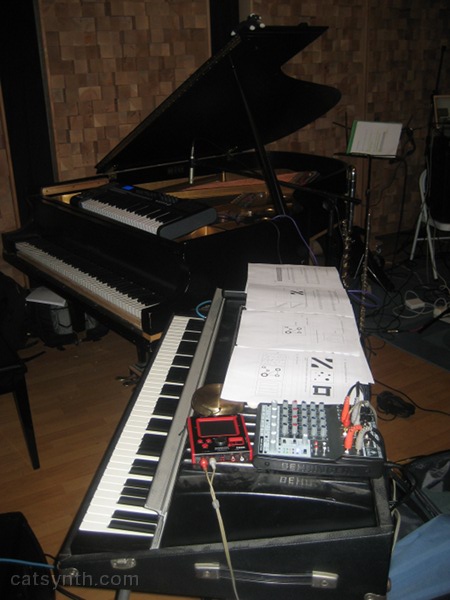
You can see the score for our opening piece “Small Chinese Gong” laid out behind the keyboard. This is one of the graphical scores that I have mentioned in a previous review. This is also the piece that fell victim to the “rebellious blue cord” that left the performance bass-less. Fortunately we were able to correct that and the rest of the set went quite smoothly.

You can listen to an audio archive of the performance. I thought the later pieces, in particular “Canada”, “Ode to Steengo” and “An Empty Rectangle” came out quite well. We are definitely looking forward to our live performance tonight at Studio 1510.

For those interested in the technological aspects: I was using my trusty Korg mini-Kaos Pad, E-MU Proteus 2000 (with Vintage Pro and Mo’Phatt), and a Voce Electric Piano module. Tim Walters was also performing live custom electronics programmed in Supercollider.