


 We begin our tour on US 1 in Coral Gables, where it is known as the South Dixie Highway. I was actually in a pub along here on Election Night 2004, watching the results with friends and colleagues from the International Computer Music Conference (ICMC). For the most part, the election was quite disappointing – and we didn’t even get to enjoy a controversial Florida result to experience first-hand. So after a night of beers and commiseration, we turned our attention back to the conference itself, and to points north. Heading up US 1 towards Miami, we come to the rather unassuming freeway ramp that marks the start of I-95, the main north-south highway along the east coast. It’s a modest beginning for a such a major road. I-95 is an elevated urban highway through downtown Miami, as is the spur I-395 which took us over the city to the MacArthur Causeway and onto Miami Beach as A1A, one of the more oddly numbered highways in the country.
In Miami Beach, A1A continues as Collins Avenue, though the Art Deco district of the South Beach neighborhood.
 [Photo by wyntuition on flickr. Attribution-ShareAlike 2.0 Generic (CC BY-SA 2.0).]
The Art Deco architecture of many of the area’s buildings dates back to the 1920s. One see a certain modernist quality in it, with the details of traditional architectural ornament reduced to simple shapes, but unlike mid-century modernism, such ornament (albeit more abstract) remains. The design of the buildings, the bright colors and the neon lighting are all part of the neighborhood’s character. This was a fun place for food and drink, and to access the beach (it is Miami Beach, after all). The most notable thing about beaches in Florida is that the water is warm, even into the evening. For someone who has lived near beaches in northern California, actually going into the water like this is a bit of a novelty.
 The next day I ventured out on my own using public transit into Miami, primarily using the elevated rail line. I stopped at Calle Ocho (8th Street) and walked its length through the heart of of Miami’s Little Havana neighborhood. The street carries the final section of US 41 towards downtown Miami. I think it was most curious to explore it because of my experience a few years earlier in “Big Havana” (i.e., in Cuba). Probably the main visual feature of the street were the frequent rooster statues along the side, including this somewhat “patriotic” specimen:

By the time I had gotten to downtown, where US 41 terminates at US 1., it had begun to rain. I did make it as far as Bayfront Park where I came upon this sculpture.

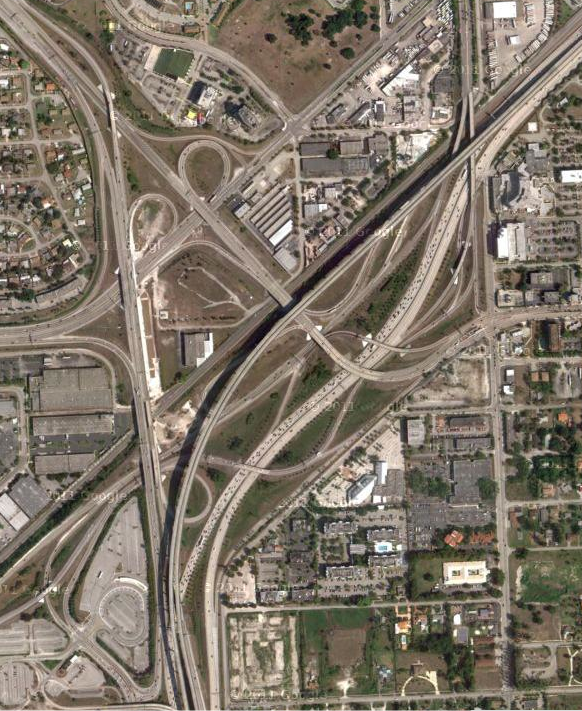
North of Miami, I-95 enters the Golden Glades Interchange along with Florida’s Turnpike, FL 826, US 441, and FL 9. As one can see in this photo, it is quite a tangled mess.

[Click to enlarge.]
From here, one can continue north on I-95 along the coast, or veer inland towards Orlando on the Turnpike. We will continue north on I-95, which brings us to Cocoa Beach. This is beach where I first experienced Florida’s atlantic coast as a child, the water, the sand, the seashells. Of course, the reason we stayed here was that it is part of Florida’s “Space Coast” and quite close to Cape Canaveral.

The epicenter of the American space program loomed large in the imagination – even though the moon landings were long over, space was still a powerful draw and the vehicles, structures and devices that made space travel possible were quite exciting to see up close and could even mask the fact that so much of this technology was on the edge and quite inaccessible to most of us. In that sense, space has never really entered into our lives the way computer technology (which also started as remote and rarified) has done so. That is a bit sad. Despite all the joking about a certain presidential candidate’s recent “moon base” proposal, I have to admit I wish we were more ambitious again about expanding into space. We never really solved the problem of efficiently getting into orbit, and thus haven’t been able to make it truly route and accessible. There are those working on this problem, on the Space Coast and elsewhere, but that is a topic for another time.

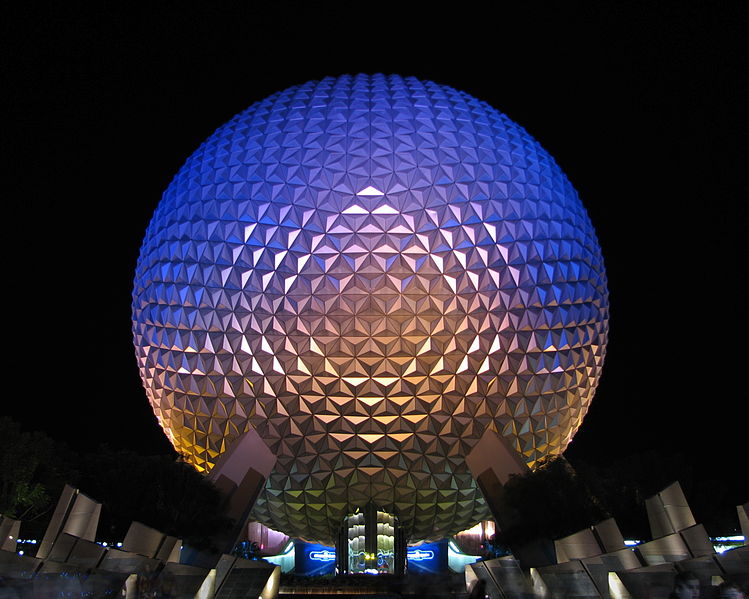
 As one continues up the coast towards Daytona Beach, I-95 meets I-4, which heads westward and southward through the center of the state. It crosses Florida’s turnpike just south of Orlando and just next to the Walt Disneyworld Resort. Everyone knows Disneyworld. I had last been there as a teenager. EPCOT center was visually interesting (in terms of the buildings and structures), although it was already quite “retro” when it was completed in the 1980s. And the rides were not particularly compelling. I can only imagine it seems very dated now, but that could add to its visual charm.

[Benjamin D. Esham / Wikimedia Commons [CC-BY-SA-3.0-us (www.creativecommons.org/licenses/by-sa/3.0/us/deed.en)], via Wikimedia Commons]
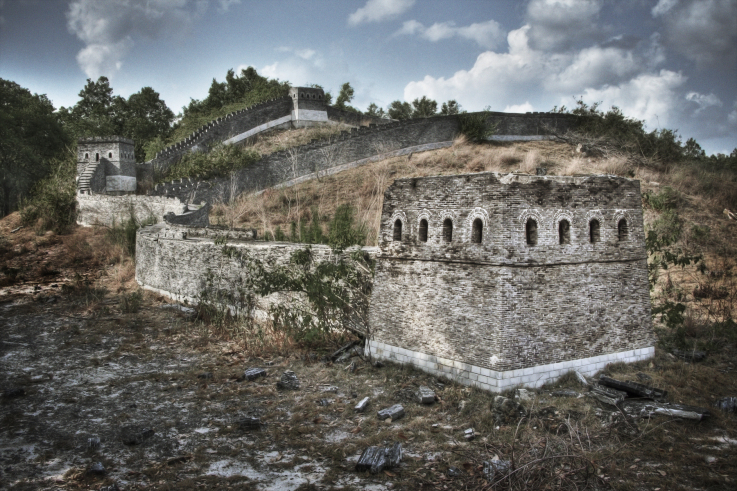
It would be interesting to photograph. But perhaps as interesting from a photography perspective is another, now defunct, theme park just down the road. Splendid China, built and sponsored by the Chinese government, was a theme park that featured scale models of famous Chinese landmarks, including among others a miniature Great Wall. The park was never popular and closed in 2003. Since then, it has fallen into disrepair and is a frequent target of vandalism. I only found out about it as a result of a 2009 exhibition in San Francisco that included photographs by Thomas Cheng documenting the decay.

[Thomas Chang. Great Wall. Splendid China Theme Park, Orlando, Florida.
Image courtesy of the CCC online gallery. Click image to enlarge.]
 I-4 continues southwest towards Tampa Bay, crossing I-75. I-75 is another major north-south national highway, and south of Tampa it largely follows along Florida’s “left coast.” It does, however, abruptly turn and become and east-west highway at the northern edge of the Everglades. This is the famous Alligator Alley. Along this section of I-75 is the Florida Panther Wildlife Refuge, home to the critically endangered Florida panther. There are perhaps around 200 left.

The highway cuts through the panther’s habitat, but the rebuilt version includes passageways underneath for panthers to travel safely. It also facilities the movement of other wildlife. Of course, one does find alligators along the highway.
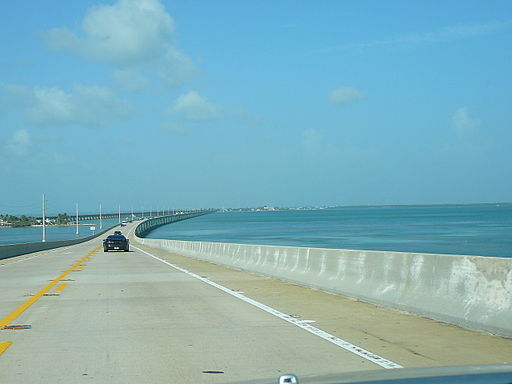
Returning to the beginning point of our virtual tour, one can travel south on US 1 to the southern tip of mainland Florida, where it becomes the Overseas Highway through the Florida Keys. The highway links together a series of bridges and causeways through the keys.

[Averette at en.wikipedia [CC-BY-3.0 (www.creativecommons.org/licenses/by/3.0)], via Wikimedia Commons]
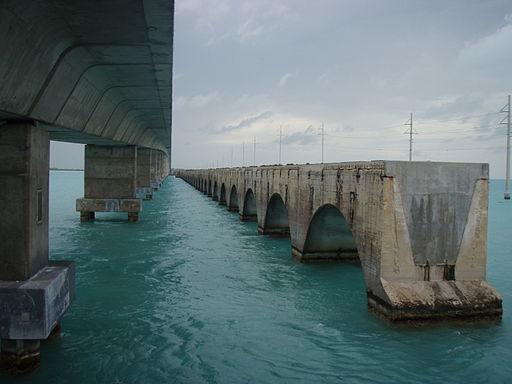
Some of the structures of this beast were part of an older railroad, and have since been replaced. But old sections remain.

[By Elkman (Own work) [GFDL (www.gnu.org/copyleft/fdl.html) or CC-BY-SA-3.0-2.5-2.0-1.0 (www.creativecommons.org/licenses/by-sa/3.0)], via Wikimedia Commons]
US 1 eventually comes into Key West. It makes a final right turn onto Whitehead Street, passing by the Ernest Hemingway Home and Museum. Among the current residents of the home and museum are “Hemingway’s Cats”, who are descended from the author’s cats and many of whom are polydactyl with extra toes in their paws.

[Averette at en.wikipedia [CC-BY-3.0 (www.creativecommons.org/licenses/by/3.0)], from Wikimedia Commons. Click to enlarge.]
Hemingway was quite fond of these cats, and the museum has become a permanent home for them – we of course hope it stays that way.
Only a few blocks away, US 1 ends. This “end” assembly with Mile 0 marker is probably one of the more photographed ones in existence.

[Photo by CedarBendDrive on flickr. Attribution 2.0 Generic (CC BY 2.0)]
It probably gets stolen quite a bit, too.



 If instead of going west from airport to Ann Arbor on I-94 we had instead gone east, we would have arrived in Detroit. I have yet to visit Detroit, and as such the city has taken on a mythical quality. I-94 enters the city as the Edsel Ford Freeway, mostly staying to the north of the city center. We can turn south onto I-75, the Chrysler Freeway to head downtown. One would expect the “motor city” to have an impressive network of freeways. I-75 runs along the edge of downtown as the Fisher Freeway, and together with I-375 and Michigan Highway M-10 form a loop around downtown, anchored by some large interchanges on either end.


 But it is time to get back on the road. We can head northwest from Detroit on I-96 to Lansing, the state capital. For those like me who are amused by highway trivia, in Lansing, I-96 and I-69 meet, and even run concurrently for a brief period of time. I think this only place where there is such a mirror-image concurrency (as I-87 and I-78 in New York actually never meet). A spur I-496 turns off into the center of Lansing, with the state capital building to one side.


 North of the bridge, we can switch to US 2 which hugs the shore of Lake Michigan on the southern side of the peninsula. But we can also head inward on M-28, from which we can approach the northern shore along Lake Superior, traveling by many picturesque parks such as Tahquamenon Falls and Pictured Rocks.


 We begin where we left of in
 The shapes and textures of the rock formations and the sparseness of the landscape are what attract me to the southwest. The unique combinations of climate, water and rock composition lead to this landscape, and individual varieties of rock (many of which are different types of sandstone) lead to the distinctive shapes in different locations. Sometimes the most interesting can simply be found on the side of the road. But that does not detract from the many iconic parks in this state. Indeed, if we continue on US 160 west to its terminus at US 89, and then further west along State Highway 64, we come to the most iconic of all, the Grand Canyon.


 We head south from the Grand Canyon on US 180 to I-40 near Flagstaff. We take I-40 east to another of Arizona’s iconic locations, the Petrified Forest National Park. The eponymous petrified trees were created by combination of trees and minerals that were deposited over long periods of time and the gradual replacement of the organic matter with minerals. The relatively soft and easily eroded sandstone have left a surprisingly large number of these artifacts in one location. The extreme erosion patterns of the area also gave rise to the colorful formations of the Painted Desert.

 Leaving the park, we turn back west on I-40 to Flagstaff, and then head southward on I-17 towards the Phoenix metropolitan area and a very different Arizona. But along the way, we pass by


 The rather complex tangle above is the interchange of I-10 (the Papago Freeway coming from downtown Phoenix), Arizona Loop 202 and Arizona State Highway 51, which is supposedly the busiest interchange in the state. A more elegant one (which I have in fact seen in a museum piece) can be found further east where AZ 202 meets US 60.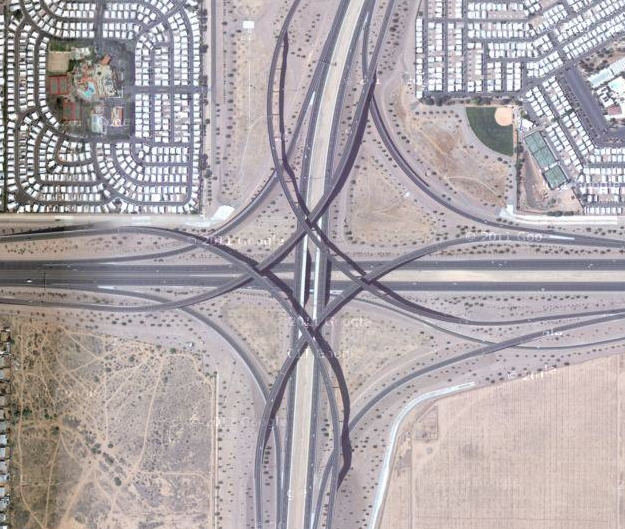


 Heading back west on I-10, we switch to I-8 through the southwest corner of this southwestern state. We turn south on State Highway 85 through relatively empty but rocky landscape. Highway 85 intersects with 86 at the small town of Why, named for the “Y” shape of the original intersection of the two highways. Because Arizona law required location names to have at least three letters, the name “Why” was used instead of “Y”. Continuing south on 85, we eventually reach Organ Pipe Cactus National Monument.





 We initially entered from the northeast on I-76. The road was relatively straight here amidst softly rolling hills of the High Plains. The landscape is dotted with farms amidst open grassland. The Rocky Mountains appear to rise from the plains quite suddenly, as does the city of Denver.

 On that original family trip, we did not actually stop in Denver, but here we will do so. We turn south on I-25 along the edge of downtown Denver, passing through the interchange with I-70 known as “The Mousetrap.” We exit with US 6 which is surprisingly enough Sixth Avenue in Denver. Actually, it’s a freeway, the “Sixth Avenue Freeway.” Heading east in the freeway, it empties out onto city streets near the Santa Fe Arts District. A quick look at the websites for the galleries along the corridor suggests a relatively conservative selection, though I did see some interesting things from Sparks. Further north we find the
 We leave Denver on I-70 and head into the mountains, on one of the most spectacular stretches of interstate highway in the country. At the Continental Divide, there are two options. One can stay on I-70 through the Eisenhower Tunnel, or take a detour on US 6 up through Loveland Pass. We opted for the latter on that original trip, with spectacular views of mountains in all directions, and a chance to walk on a patch of hardened snow and ice…in August. Not surprisingly, it was quite cold. I don’t have any pictures from that trip, but here is what the pass looks like today:


 I-70 and US 6 descend from the Rocky Mountains into the town of Grand Junction, where they meet US 50. One can exit the interstate here and travel on State Highway 340 through Grand Junction and Fruita to Colorado National Monument.


 The trip along I-80 is one made by many of us in the Bay Area, particularly at the end of August as part of the pilgrimage to Burning Man. We take the interstate past Reno to the town of Fernley, and then head north on State Highway 447 towards the Black Rock Desert. Arriving at “Black Rock City” at night is an impressive sight, with the electrical glow of a small city visible from miles away. And indeed, at the hight of the festival each year, Black Rock City is one of the largest cities in the state. Here is one of my favorite photographs from a Burning Man trip too many years ago:


 From Reno, one can travel south on US 395 towards Carson City, the state capital – one of only a few state capitals not connected to an interstate highway. From here we can either continue south on 395 back into California along the eastern Sierra, or turn onto US 50 into the interior of Nevada.
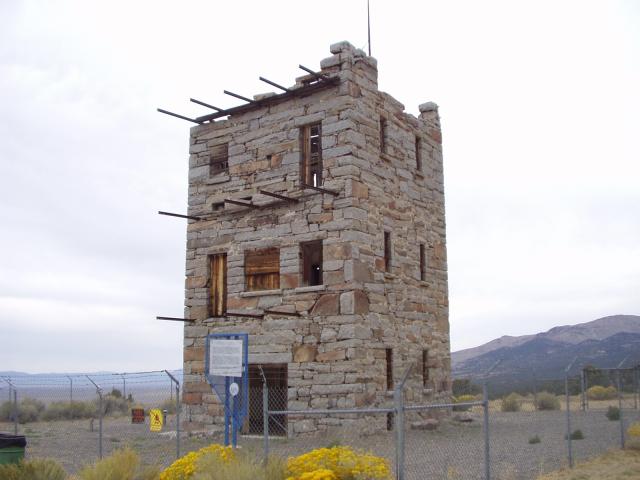
 I would love to travel US 50 through Nevada sometime, and of course do photography along the way. I am certainly not alone in this regard, which begs the question of how “lonely” the road really is. Another strong runner up for the title would be US 6, which intersects US 50 (and US 93) in the eastern town of Ely. Heading back west on US 6 from Ely, one travels a narrow two-lane road and does not encounter another town until Tonopah, 168 miles later. Tonopah is an old mining town, with old structures as seen is this photo: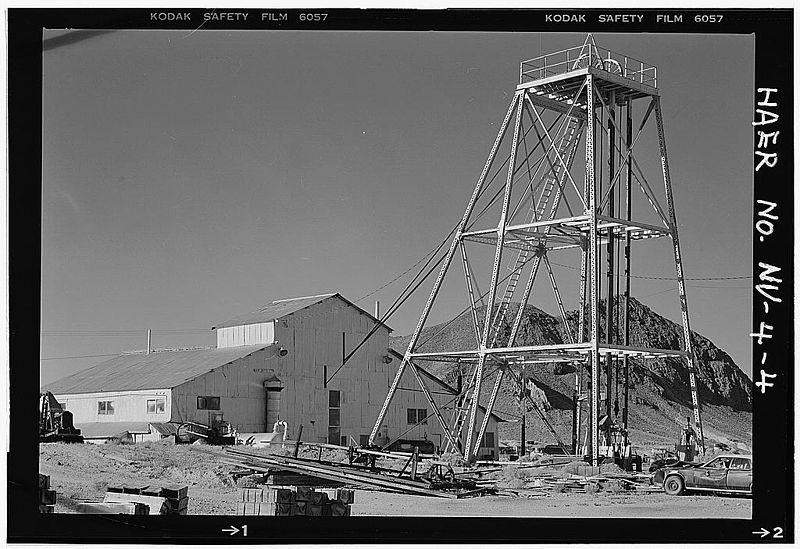
 US 6 is also the northern terminus of State Highway 375, otherwise known as the Extraterrestrial Highway. It derives its name from its proximity to Area 51 and popularly with UFO seekers, but it covers a much longer distance, parts of which are just as straight and empty as some of the others we have explored in this article:

 Highway 375 ends at the ghost town of Crystal Springs. This sounds like it would be interesting if some of the original buildings are still there, though I cannot find any photos of this. Nearby, one can pick of US 93 and head south towards Las Vegas. Our quiet journey through the interior of Nevada comes to an end as US 93 merges with I-15 and form a major freeway heading into the sprawling Las Vegas metropolitan area. The highway cuts into the city itself, and parallels “The Strip”, aka South Las Vegas Boulevard.




.jpg)


