Submitted by Aais Plex via our Facebook page.
“Mimine ‘the drummer’ taking a short nap on her favourite spot: the Axiom 25 keyboard. Favourite instrument: the TR-909 drumkit”

Submitted by Aais Plex via our Facebook page.
“Mimine ‘the drummer’ taking a short nap on her favourite spot: the Axiom 25 keyboard. Favourite instrument: the TR-909 drumkit”

Submitted by Christy Purrrlington via Twitter.
“how can I play properly when mom leaves her rubbish all over the keys?”

Submitted by Piotr Majewski via our Facebook page. If you can identify the red device next to the handsome black cat, please leave a comment below. Of course, if you can’t identify it, feel free to leave a comment as well 🙂
The visit the Analogue Haven booth is another of the annual pilgrimages at the NAMM show. The highlight of my visit this year was a performance by Richard Devine on a system consisting exclusively of Make Noise modules.
This virtuosic performance showed what these modules are truly capable of with practice. The music moved between rhythmic staccato textures and longer resonant tones in multiple layers. It was also a showcase for the DPO, Make Noise’s oscillator, which was the only tone generator in this system. I have a Make Noise Maths and an Ecophon, and the performance inspired me to practice these along with the other modules to get more complex musical results.
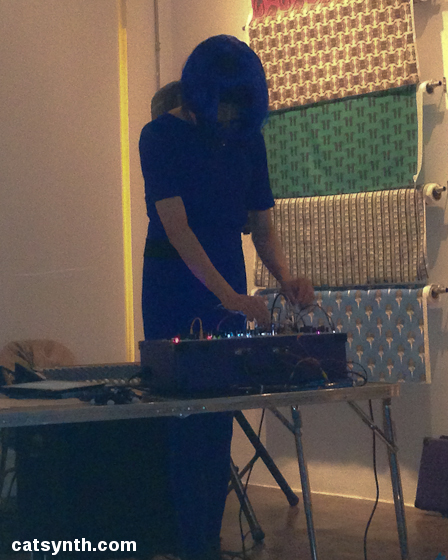
Analog video is looking like a potential area of creative expansion, and LZX Industries was prominently demonstrating their video modules. Here we see our mascot being processed live.

One thing I would like to see more in video synthesis is interaction between analog audio, video and control signals.
On the opposite end from the modules was the massive Schmidt Eightvoice Polyphonic Synthesizer. A beautiful looking instrument with an interesting set of filters inspired be Moog and Oberheim:

This synthesizer is truly a labor of love by its creator Stefan Schmidt, who spent many years on this project. It remains to be seen if it will sell.
Other quick views from around the Analogue Haven booth included this demo of modules from Snazzy FX:
Percussion modules and a novel sequencer from Delptronics:

And the distinctive orange controls of the Harvestman modules.

There were three new releases from Harvestman, including a new Hertz Donut.
And the distinctive clean white design of Koma Elektronik, including the SVF-201 Vactrol Filter module and their infrared controller.

It is great to see the popularity of the analog instruments and new designs coming each year. If there are any drawbacks, it is that the field of available modules and effects boxes has become quite bewildering, and that the Analogue Haven booth is always quite crowded.
There are analog synthesizers, and then there are instruments that are even more analog than analog. The Wheelharp from Antiquity Music falls in this category.
The Wheelharp is an electromechanical instrument in which a performer accesses 61 bowed strings via the keyboard. There is a cylindrical version, as illustrated in the photograph below, as well as a standard linear-keyboard version:

The instrument evokes the Baroque era in its appearance, both the reversed coloring of the keys and the details of the construction and wood finish. The sound of the bowed strings in response to pressing the keys is quite eerie.
This video shows part of the mechanical system that drives the Wheelharp as it is being played.
A very unusual and specialized instrument indeed.
Oakland-based Visionary Instruments presented their new guitar-based MIDI controller at NAMM. Guitar-controllers are nothing new, but one is quite advanced, going beyond simple conversion of basic guitar fingering to include a wide variety of modern controls, including accelerometers and pressure sensitive pads in addition to an array of knobs, sliders and buttons.

Here we see Moldover demonstrating the basic version of the guitar. (We have reviewed Moldover’s performances in San Francisco in past articles.) You can see a little bit of the guitar in action in this video:
There was also a model with twelve strings and a more traditional finish. That one also had a built-in “e-bow”, which was a nice feature.
In addition to the controller, Visionary Instruments makes “video guitars” with embedded video screens. The main model has a stylized, curving shape, but I particularly liked this metallic retro model:

For those who look at such details, the video is Nigel Tufnel from Spinal Tap.
In addition to the quality of the instruments, it nice to see an innovative company from the Bay Area (and Oakland in particular) represented here.
MIDI (Musical Instrument Digital Interface), the protocol that we use to connect musical instruments together, has officially been around for 30 years now, and the occasion was being marked with an exhibit at NAMM:

There were some of the earliest instruments as well as those demonstrating how it is being used today. The Yamaha Disklavier series was quite prominent, as an instrument that is both acoustic and a MIDI device at the same time. There was also the Prophet 600, a forerunner to the Prophet 12 we reviewed yesterday and the first commercially available instrument to implement MIDI.
In the middle, between “1983” and “2013”, were a few of the devices I remember from the mid-1980s.

I had a Yamaha box (a sequencer) with the same beveled shape as the TX7 pictured here. And I was quite interested in the Atari ST computer, though was never able to get one. Both devices seem quite primitive today. Unlike the analog synthesizers that we have been reviewing, earlier digital devices don’t seem to hold up as well. Nonetheless, the MIDI protocol itself is still vital for much electronic music-making, despite its well-documented limitations in speed and resolution.
Moog Music introduced its latest synthesizer, the Sub Phatty at NAMM this year. Like the Korg MS-20 mini, this was a much discussed instrument in the weeks leading up to the show. And here it is:

As a basic bass analog synth with sub-octaves, it reminded me a bit of my classic Octave Cat, although the filter sound was unmistakably Moog. The feature that made this synth different was the “Multidrive”, which added a timbrally rich but harsher sound that worked well with resonance. It’s definitely grittier than the usually smooth Moog sound.
I did get a video demo of the instrument while at the booth, but unfortunately my video recorder was having issues, but you can find some video demos at MATRIXSYNTH’s NAMM coverage. The MSRP for the Sub Phatty is $999 USD, which isn’t bad.
This was also the 10th anniversary of the flagship Moog Voyager Synth, and for the occasion they had a couple of special editions, including this one with crystal and gold controls:

Of course, I did not get to play this one.
One of the most anticipated synthesizers of this year’s NAMM show is the Korg MS-20 Mini. And here it is:

This is basically a classic MS-20, including the analog circuitry, but in a modern replica of the case that is 86% of the original size. It also has MIDI and USB for external control. But of course it is really about the analog synthesis, and especially the filters. After getting my bearings on the device, I shut off the VCOs and set up both the hi-pass and low-pass filters to self-oscillate. This us the signature sound of the original instrument, and while it’s difficult to tune self-oscillating filters they did seem playable for arpeggios or lines.
The street price appears to by $599, although it is not shipping yet. Korg has been good at reintroducing its classic technologies at affordable prices. And it is certainly a lower price tag than the other covetable instruments I reviewed yesterday.