Submitted by Julian on facebook:

“i can’t believe there’s a page dedicated to cats and synth. finally.”

Submitted by Julian on facebook:
“i can’t believe there’s a page dedicated to cats and synth. finally.”
Once again, the Outsound Music Summit opened with Touch The Gear Night this past Sunday, in which the public is invited to come and, well, “touch the gear” and interact directly with many of the festival artists who use technology in their music. “Technology” included software, electronic devices, DIY projects, and mechanical and sculptural instruments.
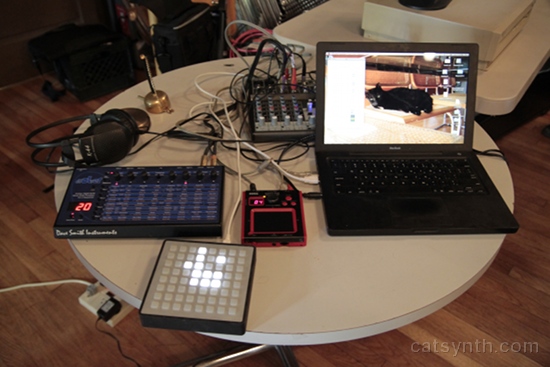
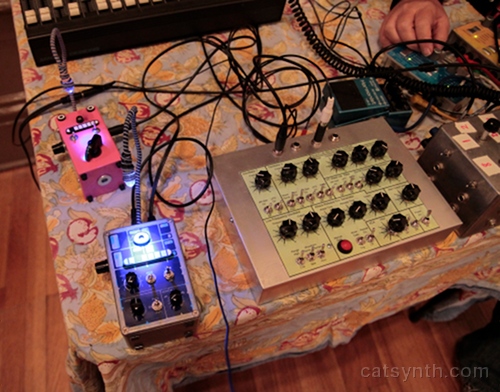
I attempted to both cover the event for CatSynth and demo some of my own gear, which made for a hectic but fun evening. I kept my demonstration relatively minimal, with my Monome 8×8, the Korg Kaoss Pad and the Dave Smith Evolver:
[click to enlarge]
Basically, this was a subset of the gear I used at the Quickening Moon Concert (which was part of Outsound’s regular Thursday series at the Luggage Store Gallery). The monome was driving a simple software synthesizer, which along with the Evolver was being processed by the Kaos pad. The monome in particular attracted a lot of attention with its clean geometry and texture, and mysterious nature. It’s just an array of lighting buttons with no marking whatsoever, which invites curiosity.
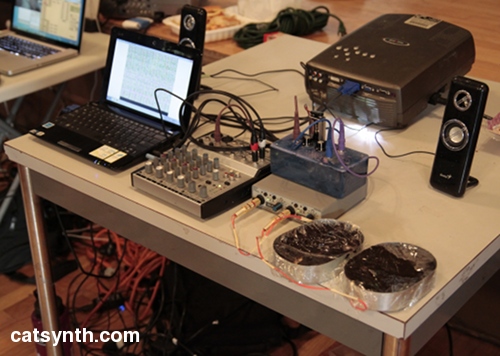
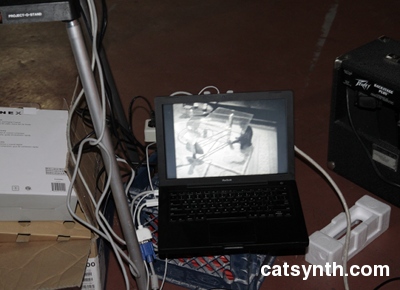
Travis Johns brought a highly portable version of his worms in compost, this time attached to an analog ring modulator and open-source software the implements Slow Scan Television.
[click to enlarge]
One could hear the noise generated by the worms (which was a low-level rumbling static sound) and see the corresponding image generated by the SSTV software projected onto a screen.
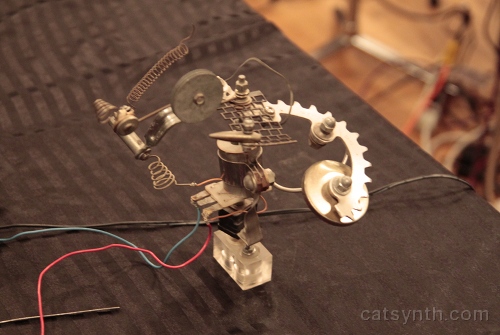
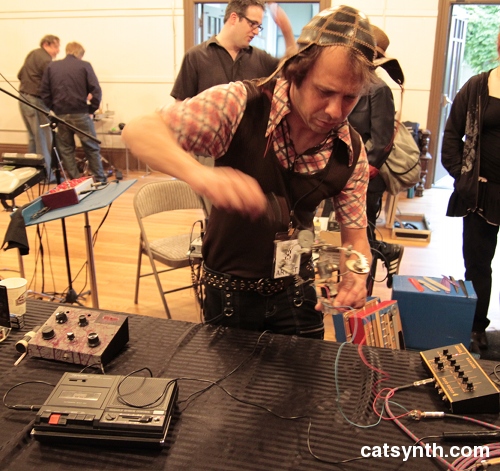
Walter Funk presented a variety of instruments and objects, including Phoenix, a metal music object created by Fred the Spaceman. It was attached via contacts to an effect processor and a speaker, and could be struck or shaken to produce a variety of sounds.
[click images to enlarge]
He also had an old Realistic (remember that brand?) variable-speed tape recorder that included a bucket-brigade (BBD) chip which could be used for a variety of pitch and time shift effects. It would be interesting to modify the unit to take live input in addition to recorded tape input, although the use of tape is part of the charm of such a device. Additionally, he had a small custom analog synthesizer made from inexpensive breadboards made by Elemco that were originally designed for test equipment.
Tom Duff demonstrated the Sound Labs Mini-Synth, a DIY synthesizer kit designed by Ray Wilson. It’s a basic subtractive analog synthesizer, a la a Minimoog. More intriguing were the two generations of Bleep Labs Thingamagoop and Thingamagoop 2. The Thingamagoop 2 includes the photocell-and-light control and analog sound-generation from the original, plus an Arduino for digital sound and control. I want one of these! It was also fun to put the two generations of Thingamagoops together to control one another.
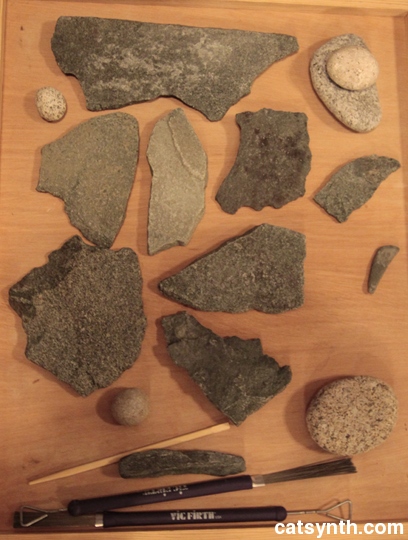
Cheryl Leonard brought some musical objects from Antarctica, including flat stones, bones and limpet shells. The stones had a high but short sound when struck or rubbed against one another. These were used in her Antarctica: Music from the Ice project.
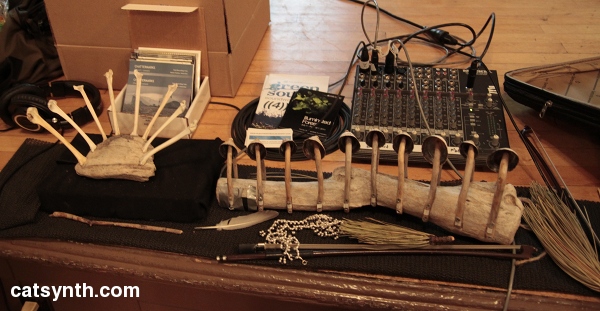
The limpet shells had a resonant sound with well defined pitches. I found myself playing a subset of three shells that together produced an interesting set of harmonies and intervals.
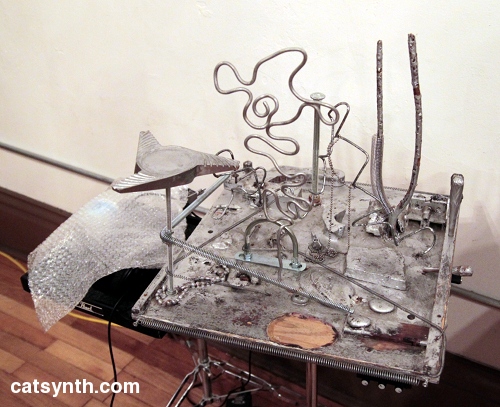
Bob Marsh demonstrated Silver Park, a beautiful instrument that started as a proposal for a park in Detroit with metal sculptures and structures.
[click to enlarge]
Marsh sometimes performs with Silver Park as part of his Mr. Mercury project. The instrument version features springs in addition to the original metal objects, which add to its timbre. In a quiet room (unlike the room we were in) it can be played acoustically, but it can also be played with microphones and electronic effects. Whenever I see pieces like this, I am inspired to create one of my own, but also reminded how much work it is to create sculptures with metal, adhesives, etc. I did get some tips on some “baby steps” to work with similar sounds without necessarily committing to a sculptural artifact.
Another visually powerful instrument was Dan Ake’s 12×13, a large box with 1/4″ metal rods and washers. When the box is spun, the washers slide and shake along the rods producing a metallic cacophony of sound and visual motion.
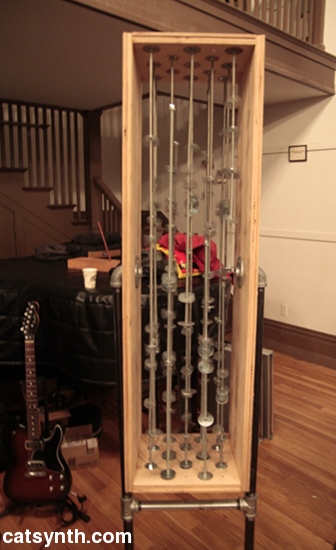
By spinning the box, or leaving it tilted at various angles, one can get the full effect of the falling washers, or freeze them in mid-fall to cut off the sound.
Philip Evert performed with an auto-harp processed by a large series of effects boxes. The control and sound of the effects chain was largely indeterminate, though the demo that I heard began with ring modulation before becoming a more complex mix.
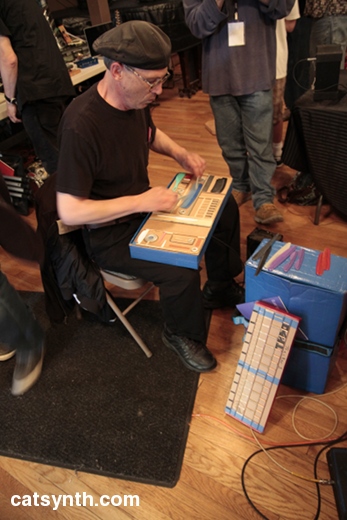
Tom Nunn brought his Skatchboxes for visitors to try out. Here were see T.D. Skatchit demonstrating the main Skatchbox.
[click to enlarge]
He is a virtuoso on this instrument, and we have reviewed his collaborations with Nunn in previous performances. The Outsound Summit included a demonstration and class on building your own Skatchbox, which sadly I was not able to attend.
Mark Soden (of phog masheeen) demonstrated a chain of effects processors including a Electrix Filter Queen that produced chaotic oscillations when driven with an appropriate sound source. He had a Roland SP-555 to drive the effects, but the more interesting demo was using a trumpet with contact microphones on its body. One could generate sound by blowing, tapping, or otherwise exciting the body of the trumpet which then drove the chaotic effects processing.
Amy X Neuburg demonstrated the two instruments I have seen her use in her live sets. The Blippo Box produces chaotic signals that are compelling and very easy to play – the effect of turning knobs on the sound, even if it was unpredictable, was very smooth. Of course, the challenge is that the instrument is so chaotic that is very difficult to reproduce the same exact sound twice. She also showed her looping setup, which included a drum pad and an Echoplex.
Rick Walker demonstrated his new “Walker Manual Glitch pedal”. It featured both built-in sound generators and live input, and the ability to “glitch” or reply snippets of sound from any of the sources. This seems like it will be a powerful instrument, especially when combined with loops as input or a live improvised performance.
Thanks to Matt Davignon for organizing this event! He was also a presenter and showed off his drum machines and effects boxes that he has used in many previous live shows.
From AMagicWhistle on YouTube, via matrixsynth:
Kitten, DIY analog synthesizer, and spring reverb.
Here is another featuring the kitten:
and one featuring just the synthesizer:
“10 Step sequencer, seven audio oscillators, filter, LFO, blinky lights”
Some sad news from this weekend, via matrixsynth. Tali, the feline companion of carbon111 passed away over the weekend:

We featured Tali’s CatSynth pics many times over the past couple of years, and she will be missed. I send carbon111 my deepest sympathies.
You can read kind words for Tali (aka “Circle Cat”) at Harmony Central and matrixsynth.
I did not know before reading carbon111’s post that Tali was named for Taliesin.
From scienceclubmusic on YouTube, via matrixsynth:
On the floor… This version is cut in many places to fit YouTube’s 10 minute limit. A full-length version is available here: http://vimeo.com/13060686
Equipment used: Roland MC-202, Acidlab Miami, DSI Mopho Keyboard, DSI Evolver Desktop, Roland TR-505
I like the cat inspecting things as the music starts 🙂
From kennykeyboard on YouTube, via matrixsynth:
The virtual analog synthesizer is largely preset in live use but quite programmable with the computer thanks to familiar GUI. I just play sounds from the ARP Odyssey model and a smaller riff from the tonewheel organ model. My cat sits on the patio table listening, purring, and sometimes getting in the way.
Last Friday, I participated in the Expanded Strangelet Minus One ensemble at the Oakland Underground Film Festival’s Summer Salon.
The event took place in the cavernous space that used to be a Barnes and Noble in Jack London Square in Oakland. There was a large screening area as well as several installations arranged around the space. The most captivating installation was Tracey Snelling’s Bordertown. She created a series of models at different scales that one might see in a small town in rural California. The scales range from life size in the “Maria” ice cream cart to a miniature commercial strip with detailed buildings. The entire model fits on a large table, but when photographed up close, one loses the sense of scale and the town seems like it could be a life-size model. One could spend quite a bit of time examining all the details, the buildings, the objects inside of them, and signs on the sides.
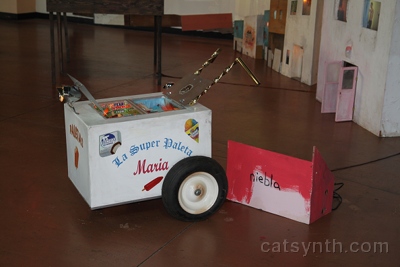
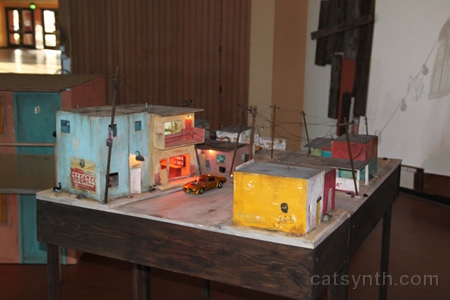
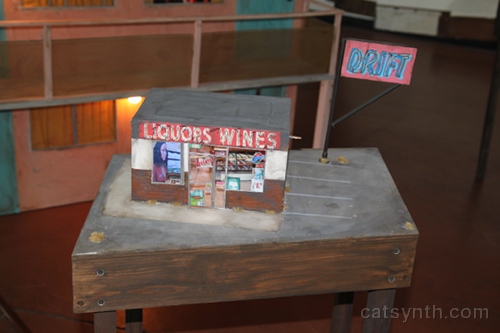
[Tracey Snelling, installation views. Photos by CatSynth (click to enlarge)]
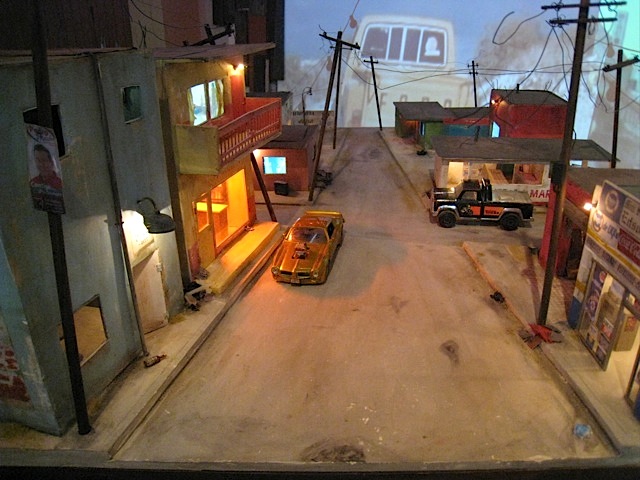
[Tracey Snelling, installation view. Photo by Michael Zelner (click to enlarge).]
Several of the pieces incorporate video, such as the “El Diablo Inn” with videos playing in each of the rooms. The larger apartment building had movies playing in each of the windows, and videos of scenes from U.S.-Mexican border were projected onto a full-size screen behind the installation.
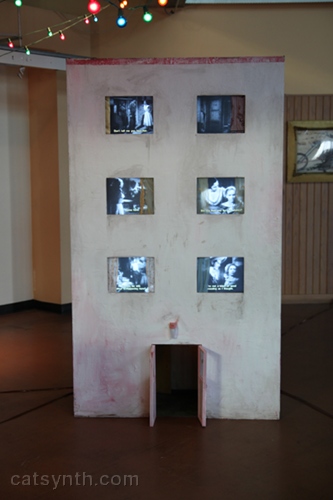
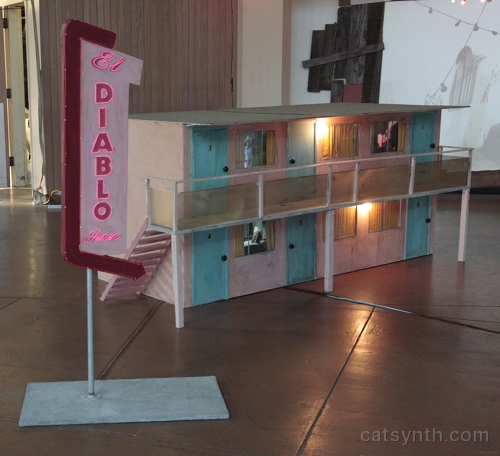
Although Snelling’s installation captures a small border town rather than a large urban area, some of the elements that she focuses on, such as industrial buildings and somewhat seedy spaces are similar to those that drive my current interests in urban photography. Urban photography was, however, the central focus of Idan Levin’s photography, which included scenes of colorful city buildings in Japan, industral lots and highway overpasses. As he states, “I prowl the streets at night, seeking a unique vantage point from which I can capture an alternate view of the world…”. He describes this view “prying, mysterious, lonely, and sometimes resembling a sci-fi post-apocalyptic cinematic scene.”

[Idan Levin, Tokyo Scape #1]
Only a few of his images were on display, but I encourage readers to visit his online portfolio.
Michelle Lewis-King’s installation featured projected video onto two cut-outs of female figures.
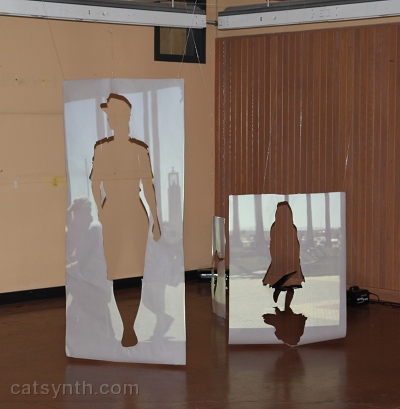
[Michelle Lewis-King, installation view. Photo by CatSynth (click to enlarge).]
The combination of the video and the empty space of each figure made it seem like both the adult woman on the left and the young girl on the right were present in the environment of the video.
The Expanded Strangelet is an electronic improvisation group founded by Lucio Menagon. He was not with us for this performance, hence the “minus one.” But we did have myself, Matt Davignon, Wayne Grimm, John Hanes, Suki O’Kane, Jonathan Segel, and Michael Zelner. I have played with them before at last year’s Oakland Underground Film Festival, and once again I had my minimal setup if iPhone and Korg Kaoss Pad.
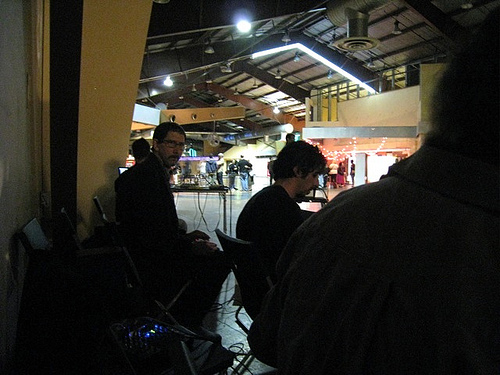
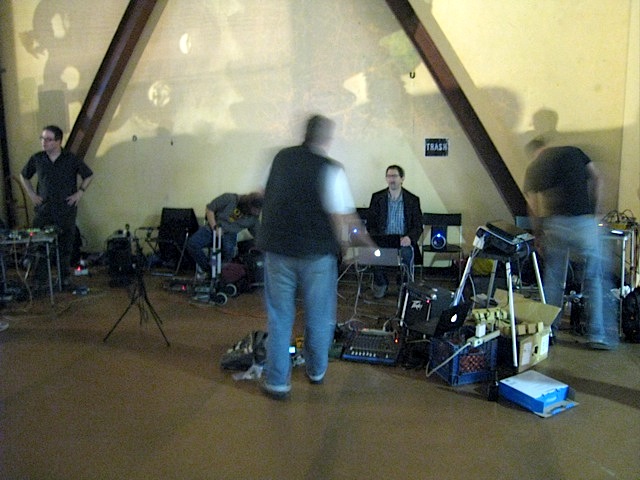
[Expanded Strangelet Minus One. Photos by Michael Zelner (click to enlarge).]
With Suko O’Kane conducting, we performed an improvised set of exactly 45 minutes, with various duos and solos, and sections with low drones and high staccato elements to provide some texture and an arc.
During the performance, we also projected videos onto the wall, and floor, and even onto people who walked by. We projected my video of Luna from the Quickening Moon Concert onto the floor, and at times it was appeared on the clothes of people nearby:
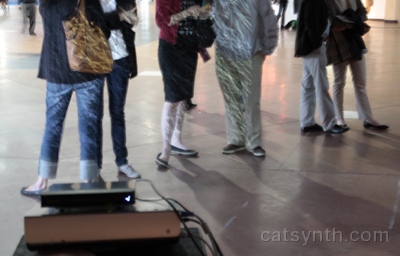
[Click images to enlarge.]
Our performance was preceded by a pair of bands from Bay Area Girls Rock Camp, including the band Poison Apple Pie. The local nonprofit program “aims to empower girls through music education, promoting an environment that fosters self-confidence, creativity and teamwork.”
There were numerous short firms and videos shown as well, including work by the Cinepimps and others.
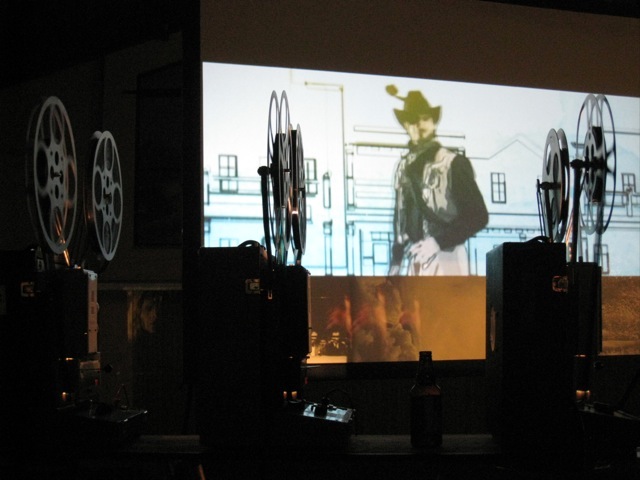
[Cinepimps. Photo by Michael Zelner (click to enlarge).]
Please visit the event site for a full rundown.
via FFFFOUND! via theStapleton…via matrixsynth:

“Korg microKORG”
This is a good time to remind everyone that you can contribute your own “CatSynth pics” using our submission form, via facebook or twitter, or by emailing us.

