From softestthing on flickr, via matrixsynth

The synth is a “compu-trainer”, one that I am not familiar with.

From softestthing on flickr, via matrixsynth
The synth is a “compu-trainer”, one that I am not familiar with.
This is the first of two articles about the Outsound New Music Summit, which took place last week here in San Francisco.
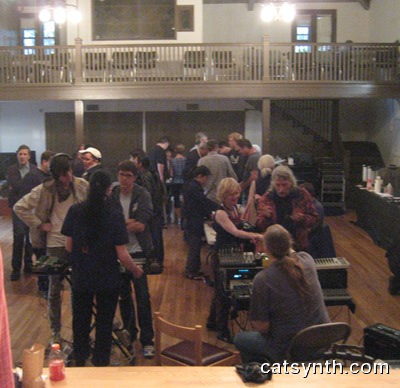
The first night was the Touch the Gear Expo in which the public is invited to try out the musical instruments and equipment of a number of artists from the festival as well as other Outsound events. It was a respectably sized turnout, with a large number of visitors.
[Click to enlarge]
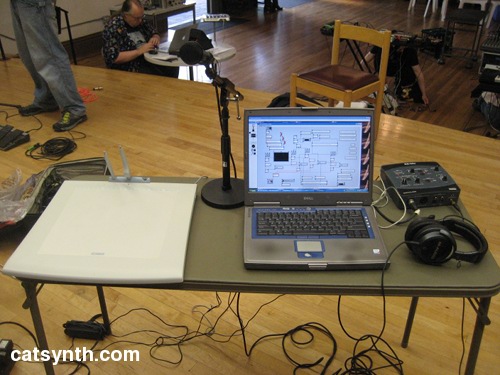
I brought the venerable Wacom Graphics Tablet and PC laptop running Open Sound World for people to play.
[click to enlarge]
It often gets attention during performances, and did so at this hands-on event as well. Because it uses familiar gestures in a visually intuitive way, many people were able to start right away experimenting with it making music with phrasing and articulation. I provided a simple example using FM synthesis as well as chance for people to play a phrase from my piece Charmer:Firmament (which uses additive synthesis).
Tom Duff also demonstrated his own custom software in combination with a controller, in this case an M-Audio drum-pad array. One thing we observed in his demo was how much computing power is available on a contemporary machine, like a Macbook Pro, and that for many live electronic-music applications there is more than enough. But somehow, many applications seem to grow to fit the available space, especially in our domain.
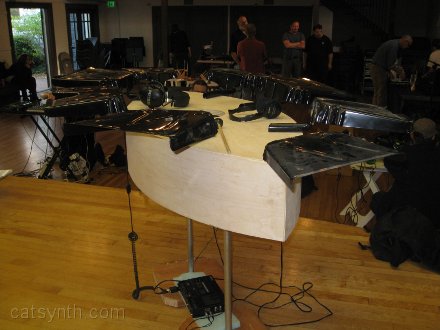
There were several demonstrations that were decidedly more low-tech, involving minimal or in some cases no electronics. Steven Baker presented a collection of resonant dustbins with contact microphones.
[Photograph by Jennifer Chu. Click to enlarge.]
The dustbins were arranged in such a way as to allow two performers to face each other for interactive performance.
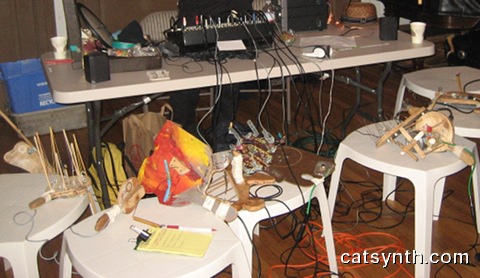
I enjoyed getting to try out the hand-cranked instruments of the Crank Ensemble:
[Click to enlarge]
Basically, one turns the crank which creates a mechanical loop of sounds based on the particular instrument’s materials. I have seen the Crank Ensemble perform on a few occasions, but never got to play one of the instruments myself.
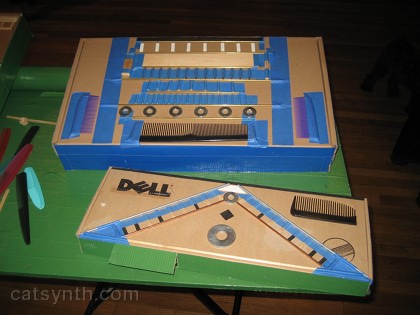
I also finally got to try out Tom Nunn’s skatch boxes, which I had seen at the Skronkathon as well as “Tuesdays at Toms”.
[Click to enlarge]
The body of the instrument is a cardboard box, and one plays it by running a comb over the various metal and plastic elements attached to the box. I spent a few minutes exploring the sounds and textures running different combs over the elements, including other combs. It was very playable and expressive, I could definitely make use of one of these!
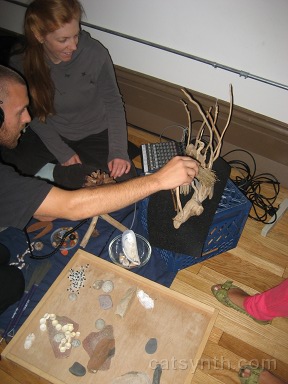
Another variation on the theme of amplified acoustic objects was Cheryl Leonard’s demonstration in which one could play sand, water, wood, and other natural elements:
Returning now to electronics, and a different kind of “elemental music.” CJ Borosque presented her use of analog effects boxes with no formal input. Analog circuits do have some low-level noise, which is what she is using as a source for feedback, resonance, distortion and other effects. Ferrara Brain Pan demonstrated an analog oscillator than can handle very low frequencies (i.e., less than 1Hz!).
There are also several other live-performance electronics demonstrations. Bob Marsh presented the Alesis Air Synth (no longer in production). Performers pass their hand over the domed surface to manipulate sounds. Similar to the tablet, this is a very intuitive and rich interface. Rick Walker demonstrated a new powerful instrument for recording and controlling multiple live loops, with the ability to manipulate rhythm and meter. I look forward to hearing him use it in a full performance soon. Thomas Dimuzio showed a full rig for live electronics performance, that I believe he used at the electronics-oriented concert the following week.
From Davide, via matrixsynth:

The synth under the cat is a pretty rare 12DCO Italian polysynth from the eighties [Solton Project 100]…. The cat is Pallina (little ball).
The blue details on the synth and in the background fit perfectly with the site theme of CatSynth, do they not?
From the same post, I also noticed this model from MFB:

The Kraftzwerg from MFB, a pre-patched but completely re-patchable mono analog beast (3 osc, a beautiful double LFO and a very nice sounding 24db VCF). The Kraftzwerg is REALLY the assembly of the modules from MFB so you are not going to loose any of the modulation possibilities.
From an auction, via matrixsynth:
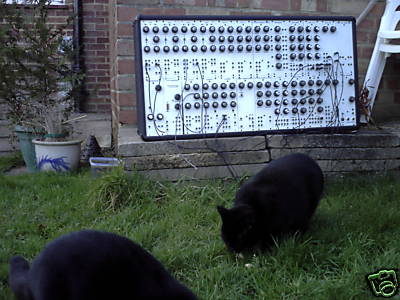
(The original post has a larger pic of the synth)
This ETI Synthesizer project was built around 1979 by my father, the modules all worked when I powered them up recently (the original keyboard and power supply is not available due to someone connecting the mains to a +/- 12Volt input!) The modules consist of :
4 x VCOs
2 x VCFs
2 x VC Variable state filters
1 x Reverb unit
1 x VCLFO
2 x VC Mixers
1 x Noise/Sample & Hold module
1 x DRF
1 x Ring Modulator
2 x Dual ADSR modules
2 x Dual VCAs
1 x Dual Envelope Generator
1 x VC Envelope Generator
1 x D-A Convertor
1 PA (not tested)
I have been remiss in writing about the many art and music events from this past month. And especially in regards to the first week. I found myself attending events every night between September 4 and September 7, each of which had at least some personal connection. This was a coincidence, but it was also a great antidote to the just-concluded McCain-fest and the parade of speeches proclaiming “Small Town Good, City Bad.” What better response than to step outside for an evening walk in search of friends, art, music, food and drink.
The night of the 4th was the opening of a photo exibition by Luxe at Hotel Biron. It is not in fact a hotel, but a wine bar in the Hayes Valley neighborhood that features monthly art exhibits. It is a small, darkly lit and intimate space, with dark wines in huge glasses, and brick walls that provided quite a contrast to the photographs on display.

 The exhibition was titled “Her Being and Nothingness” and featured a series of self portraits. In each image, the focus is on “the body.” The face is either absent or obscured, and the poses and attire vary in each. We of course know they are self portraits (itself an interesting concept in photography), but without the usual cues for identity. In this case, we draw the conclusion directly from the bodies.
Of course, the recognition is easier if the artist happens to also be a personal friend. Multiple of Luxe’s prints are on display at CatSynth HQ, so I can definitely be considered a “fan.” A more in-depth review can be found SFGallery143.com.
On Friday, I attended the second night of the San Francisco Electronic Music Festival at the Project Artaud Theatre.
The performance opened with two works by Richard Teitelbaum, professor of composition and electronic music at Bard College. His first piece, Serenissima, featured two wind performers and a laptop computer running Max/MSP. The computer was performing spectral processing on samples and the live instruments, which could themselves control the sound. The wind instruments included several clarinets, including a contra-bass clarinet (which one does not see every day), performed by Matt Ingalls. The second piece was Piano Tree, for piano and computer, and was in part a tribute to Teitelbaum’s father, David and to “some musical forbears whose work has influenced me greatly.” The piano part, which included many extended and “prepared piano” techniques (a nod to John Cage), was performed by Hiroko Sakurazawa.
The next set was from Myrmyr, the local duo of Agnes Szelag and Marielle Jakobson. The combine experimental recording and live computer-based processing with a variety of acoustic instruments, including cello, violin and voice. The result is still very much “electronic music,” but it has a more traditional sound as well, especially in the parts that feature voice and songs. Myrmyr was accompanied by members of the sfSound ensemble during part of their performance, primarily with undulating long notes and “drones”. Again, the effect was both experimental and more “familiar” at the same time.
The final was from Ata “Sote” Ebtekar. He calls his music “a new form of Persian Art Music,” which I was very interested in hearing. However, the performance was so overpoweringly loud that I really was not able to appreciate it. I wish more electronic musicians would take care not to do that. Certainly, some music will be quite loud, I have come to expect that, but it should not remain so an extended period of time.
The following night was my performance with Polly Moller and Company at El Mundo Bueno Studios in Oakland. Polly Moller and Company in Oakland. We had a great set that combined elements from different past performances. And, as Polly relates, it was a “good crowd of nice people most of whom had not heard us before.” And it was interesting contrast to the other performances, which included folk music, traditional Celtic singing, and belly dancing.
On Sunday, it was back the SFEMF for the final night. This performance featured a collaboration of ]Pauline Oliveros and Carl Stone. Oliveros is of course on the giants in modern American music, the founder of the music practice Deep Listening and one of the founders of the original San Francisco Tape Music Center. History aside, this performance was quite contemporary, laptop-based, and very much in keeping with the other performances of the festival.
The second performance, Barpieces was a duo of Charles Engstrom and Christopher Fleeger. However, to those of us in the audience it appeared as a solo performance event though it was actually a “remote duo.” This was a bit of logistical improvisation in the wake of Hurricane Gustav.
The final performance of the festival was by Hans Fjellestad, a Los Angeles-based musician and filmaker, whom some readers of CatSynth may know from his documentary Moog. His performance featured analog electronics and custom instruments that were a contrast to the previous performances of evening, both sonically and visually:

In addition custom electronics in the transparent boxes with blue lights, he also had a Moogerfooger and one of the infamous tube-effects boxes from Metasonix. The performance consisted long evolving analog sounds, noise bursts and other effects. And it provided a conclusion to the festival by adding another variety of “electronic music” to the mix.
From matrixsynth.

According to the image names in this anonymous post, the cat’s name is “Tweak” (great name for a “synth cat”).

The ARP 2006 has an interesting story as well:
Another story to make you feel warm and fuzzy inside.
“around may of this year in seattle, there was a electronics recycling thing going on which i helped with… it was insane piles of electronic waste, all of which would be disassembled and sold as scrap. during this event i asked the guy in charge if i could have a old ‘music keyboard’ i found (arp 2600 + 3620keys)! (no one knew what it was but me!!!!) once home i and it was taken apart for cleaning i found it had the old ‘moog filter’ and was missing 1 speaker,only thing wrong with it! plus someone had modified it (8 extra holes plus toggle switch) sorta like 70s circuit bending i suppose.” via anonymous. Not sure about the cat connection, but there it is.
If you want to connect with more cats, check out Cats on Tuesday.
From Space?Trucker at flickr, via matrixsynth:

Space?Trucker also has a great desert photo. I find such images have a very inviting quality.
From Mouldfish at flickr, via matrixsynth:

It’s a notable event here at CatSynth when we see catch a feline next to an Octave CAT.
Visit more Cats on Tuesday.
Submitted by Eddy Butler:

Jesty poses with a Moog Little Phatty.
We at CatSynth would like to wish Jesty a happy half birthday!
You can more Cats on Tuesday.
