I <3 SF (I Love SF), Driftwood Salon

The show I <3 SF (where “<3” is the the common emoticon for heart that may or may not appear properly in this print) is closing today at Driftwood Salon, but we take a little time today to look back on my visit to the opening of the show. It would have hard to not attend a show that features on the compact but diverse city we call home. It was scheduled to coincide with the 155th anniversary of the founding of the City and County of San Francisco on June 11, 1856, and features several artists’ interpretations of life in the city as a general concept but details and subject matter unique to San Francisco. There are street scenes, architectural details, references to cultural history, and some that are simply “tributes”.

The “centerpiece” of the exhibition was a large painted cardboard origami piece by Joe Spear with the show title “I <3 SF” emblazoned on the side, about where the US emblem might go on a fighter jet.


[Joe Spear’s metal origami in foreground. Rebecca Kerlin in background.]

On the wall behind the origami one can see several pieces by Rebecca Kerlin, whose works featuring the highways and other infrastructure of our region and my own neighborhood in particular have often been featured on this site. The three selections on the wall are from her “Constructions” series, with the large “Underpass Under Construction in Blue” pieces and the smaller “Underpass Under Construction in Orange” depicting the freeway approaching the Bay Bridge over 4th Street.


[Detail of Rebecca Kerlin’s Underpass Under Construction in Orange.]

Driftwood Salon is itself in an interesting location on a side street in SOMA near the Central Freeway, so it seems appropriate that Kerlin’s work has been featured in multiple shows here.

Jun Han Kim’s pieces, including the photorealistic A View of Sunset, SF #4 also take on the literal sights and neighborhoods of the city.


[Jun Han Kim]

Here we see the edge of the quieter and often grayer Sunset District from the Great Highway on the Pacific coast. It is an interesting part of the city that feels quite distant from the downtown. It was placed in the exhibition next to a very contrasting painting by Mei-Ying Dell’Aquila.


[Mei-Ying Dell’Aquila.]

Here we see a more surreal image of the downtown financial district, with a figure who is at once the Statue of Liberty, a cartoon superhero and a fashionably dressed urban denizen crossing the street.

Two very different pieces by Greg PNUT Galinsky reference music and architecture of the city without specific locations.


[Greg PNUT Galinsky]

This first piece suggests jazz and brings to mind the frequent jam sessions around the city – but the image also has a very iconic and industrial quality with its sparse clean lines. The clean black lines are used quite differently in this piece which is painted on glass. The reference to the city here is a bit less clear, though the use of weathered wood in the frame reflects the older architecture in the city and a recent trend in local art.


[Greg PNUT Galinsky]

The direct reference in these pieces by Lady Millard are also a bit more obscure, except for the title “Fog City”.


[Lady Millard.]

But they do pay homage to street art, and to the cartoon-like elements that seem be part of international urban art and culture. Such images could be at home in a gallery in large cities in Asia as there are in San Francisco, and perhaps represent the city’s place in a larger “Pacific urban” cultural landscape.

Indeed, part of what made this exhibition interesting is that the collection of different views on the city reflect my own interests in infrastrcture, urban landscape, music, fashion, etc – but each taken in more specialized ways by the individual artists.

The exhibition will remain on display for today (July 9) at Driftwood Salon (39 Isis Street) with a closing reception this evening.

Weekend Cat Blogging #318

For Weekend Cat Blogging #318, a few interesting photos of Luna from multiple cameras. First a high-contrast picture in the window:

And here is Luna today, once again napping in her favorite beanbag chair:

This was done with the impulse-acquired Roboto Glitter lens for the Hipstamatic iPhone app. The first photo was with done with the conventional camera.

Like Luna, I am looking forward to a relatively quiet afternoon.

We know that several regular WCB participants are foodies, so do check out the report from the Outsound Music Summit Benefit Dinner that I posted yesterday.


Weekend Cat Blogging #318 is hosted by Jules and Vincent at Judi’s Mind over Matter.

The Carnival of the Cats will be hosted this Sunday by Samantha and Clementine at Life from a Cat’s Perspective.

And the Friday Ark is at the modulator.

Report from the Outsound Music Summit Benefit Dinner and Concert

With a little over a week to go before the Outsound Music Summit, we look back at our benefit dinner and performance.

The benefit took place at the Numi Tea Garden in Oakland, a beautiful space that blends into the industrial architecture of its surroundings. You can see this photo which I posted on a recent Wordless Wednesday. An interesting bit of trivia for music-tech geeks that I learned is that the space now occupied by Numi used to be home of Zeta Music Systems, the makers of the Zeta electronic violin.

The dinner, by chef Miles Ake was itself a piece of performance and conceptual art. It was based on the ingredients of a classic Gazpacho recipe, listed in mirroring order at the beginning and end of the menu. The description and the presentation of the food itself unfolded like a multi-movement musical composition. From Ake’s statement:

The root of the word Gazpacho is derived from a Mozarab word caspa, meaning “residue” or “fragments,” which refers to the small pieces of bread and vegetables in a Gazpacho soup. throughout the meal the gazpacho as an entity wil go through a series of fractured movements. This fracturing is not a means to disconnect, but rather as a process of extraction, distillation and isolation of distinct parts. The structure of the menu is an anagrammatical game or a rewinding (moving backwards in time to replay a track) while simultaneously moving forward without redundancy in form/texture/taste using to compositional terms (verse, refrain, notes, scale, etc….) to build a lexicon of culinary elements.

The dinner opened with an interpretation of the soup itself, which set the tone and direction:

The panzanella and ricotta/pepper dishes were perhaps my favorites palette-wise and reflect the colors from the base ingredients:

The “bloody margaret” with gin and olive gelée served in an old-fashioned glass and the raw fluke were the most unique. The desert was an experience as well, with “three textures of olive oil”, including a very creamy foam-like texture that I have never had before.

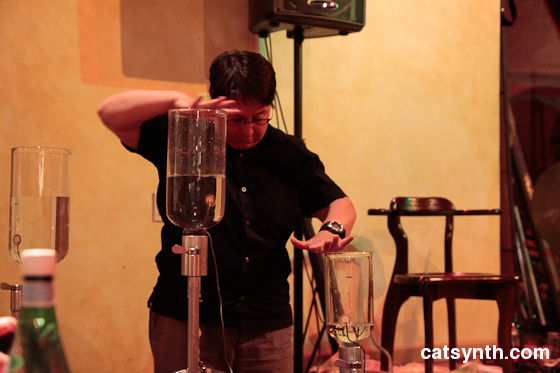
The music for the evening featured a performance by Vorticella, a quartet of Krys Bobrowski, Erin Espeland, Brenda Hutchinson and Karen Stackpole. Their improvised performances feature a wide variety of instruments, ranging from standard cello and horn, to Karen Stackpole’s array of gongs and blocks, to unique custom instruments like Bobrowski’s gliss glass:

[Click image to enlarge.]

Vorticella derive their name from the single-cell creatures. The bell-shape features prominently in the instruments, such as the gliss glass, horn, and other wind instruments. The themes of a single-cell organism functioning as a compact unit, but then breaking off new copies at any given time, permeate the direction and texture of the group’s improvised performances.

I have heard Vorticella before at the Garden of Memory events and the Flower Moon Concert in 2009. This was however an exceptional performance. Although the instrumentation is diverse and music improvised, it had a very coherent texture and direction and was well crafted. Like the single-cell organism, they seemed to function as one, with music that could have come from a master synthesizer soloist or from countless hours of careful sound design in a studio, but it was all unfolding organically in front of us. The wind and metal elements set the overall timbral environment in which the details unfold. Think of wind blowing through giant metal pipes, and then tapping on the side of the pipe or bowing it – these could be seen as basic ingredients, in a way similar to Ake’s use of the gazpacho ingredients to produce the entire meal. I found myself alternating between the rich overall timbre of the ensemble and focusing on individual details, whether Bobrowski’s visual presentation on the gliss glass, Stackpole’s constant shifting among different pieces of percussion, or Espeland’s playing the cello with two bows simultaneously. There was a good mix of long drone-like sounds and punctuated percussive elements – appropriate space was left for the latter.

So with the benefit dinner behind us, we are on to the actual summit, which begins next Sunday July 17 with the annual “Touch the Gear” night and continues with concerts the following week. You can find out more info, including tickets and passes to the concerts here. Those on Facebook are also encouraged to visit Outsound Presents’ page which features more photographs of the dinner and music.

Fun with Highways: Doylestown

Today we resume are series from towns and cities that feature prominently in our Facebook page insights. One that had been appearing for a while was “Doylestown”, which we assume to be Doylestown, Pennsylvania.

Doylestown is central Bucks County, north of Philadelphia. The area served by by “Doylestown Bypass” PA 611 and US 202, which runs through the center of town. It does appear that there is a freeway for US 202 as well, south of the town that currently ends at an interchange with 611. One can see half of the interchange and the roadway beyond are dirt, which I thought was interesting.

It turns out this is part of a large project to build a US 202 Parkway. It is scheduled to open in mid-2012. Follow the link to find out more about the project.

The downtown is northeast of the highways. Like many downtown areas, it has had its past ups and downs with changing economic times and competition from large shopping centers, but is now doing well as a regional cultural center and attraction, with small downtown shops and institutions like the Mercer Museum, a large concrete structure built by Henry Chapman Mercer. The museum houses Mercer’s collections of early American artifacts and collection known as “Tools of the Nation Maker”.

In addition to Mercer, Doylestown is the hometown of several other well known individuals. I had no idea of Oscar Hammerstein (of Rogers and Hammerstein fame) was from here until I did the cursory online info gathering for this article. Writers James A. Michener and Pearl S. Buck are also natives of the town.

CatSynth video: Cats and Mini Theremin 2

From widtara on YouTube:

“Adjusted to lower pitch than the first one.”

There are three cats in the video, but readers are forewarned that the sound can be a little challenging to take for the full length of time.

The “first one” actually appeared here back in 2009.

Here is another classic cat-playing-theremin video. Indeed, a reader on twitter reminded me about this video and thus led to the theme of today’s post.

An Independence Day post

In addition to fireworks, barbecues and the occasional embarrassing musical tribute, Independence Day is an opportunity to reflect on living in one of the world’s most unusual countries, even as it sometimes tries to pretend that it is a normal country. The latter comes out the imagery one sees today, with celebrations and streets lined with flags, and people and places that we try to think of as representative of the term “American”. Here I look some images and ideas from my personal and family history that are part of “American” that most readers, both in the U.S. and beyond, would not usually associate with the typical 4th of July.

You likely will not see the tenement buildings of New York’s Lower East Side, where half of my ancestors, Jews from Central and Eastern Europe (primarily Austria as well as Russia) settled at the beginning of the 20th century.

My mother’s family later settled in the central part of the Bronx – richly vital neighborhoods at the time that would later be synonymous with controversial building and demolition projects (think of the Cross Bronx Expressway) and still later with urban blight and decay.

It’s even less likely that you will see the countryside of Uttar Pradesh in India, with the other half of my ancestors came from.

My father from this part of India came to study in Minnesota, and numerous other relatives have settled in various towns and suburbs arounds the U.S over the years. Indeed, the equivalent image to the New York City tenement builds for the Indian side of my family might as well be the New Jersey Turnpike, another image you are unlikely to see in today’s celebrations, but is quintessentially American.

These are the states that I can think of immediately where relatives either currently reside or did so in the recent past:

New York
New Jersey
California
Maryland
Virginia
Georgia
Florida
Minnesota
Illinois
Wisconsin
Michigan
District of Columbia (Washington, DC)
Arizona
Texas
Indiana
Pennsylvania
Connecticut
Hawai’i

The Hawaii story is fun, actually. As it was related to me by a friend and former colleague who is from Hawai’i, he was playing with his band and a middle-aged man from New York approached them – ultimately, this led to his reciting his somewhat edgy poetry with their music in the background. It turns out that the poet is my cousin – our names are quite different, so there is no way my friend would have made the connection if I had not told him (the surprised reaction was priceless).

The family story is really a complex interplay not only of ancestral origins which get much of the attention, but of class, religious practice, geographical preferences, and the changes people experience even within a single lifetime. This complexity is another feature of American culture and history that is often hidden from our usual imagery – even the positive imagery that celebrates diversity, immigration and multiculturalism leaves out the complexity. And it is hard to think of life here without it – the idea of a homogeneous heritage in a single hometown with people who look and sound like each other seems…well, foreign.

So where does that leave things for me, now, in this story? Well, it’s complex as well. I find myself coming full circle to my Jewish ancestors in the Lower East Side – perhaps I may even live there sometime in the future. Some of my most experimental music pieces include instruments and idioms from Indian music. Some things have little to do with my ancestry, jazz which I have been returning to in the last year as a musical practice, the bits of East Asian culture I picked in both Asia and California, are all part of the mix. It’s not outside the realm of possibility that I might find myself in Hawai’i sometime doing improvised music and poetry. And like others, I am figuring out how to take all of these things make something of it in what seem to be rather challenging times. In the end, there is no conclusion, on the personal, family or national narratives – and it seems appropriate that way.

Weekend Cat Blogging and Photo Hunt: Busy

There is rarely a moment that we at CatSynth aren’t busy, thus it is an appropriate theme for this week’s combined Weekend Cat Blogging and Photo Hunt. Even going into the extended holiday weekend.

Luna poses once again with the iPad, but the app on display isn’t as exciting as the synthesizers and music controllers we usually show. It’s Toodledo, the cloud-based todo-list service that I use on iPhone/iPad and the web in a valiant attempt to keep ahead of the extreme busy-ness of the past two years. Not very exciting, but we do our best to make it at least look pretty in photos.

For those who obsessively try to do such things, the task being shown on these photos (strategically distorted via the Hipstamatic) is a daily reminder to brush Luna. There is also a weekly task for Weekend Cat Blogging. Many of the tasks on the list are about getting in touch with friends and professional contacts. I do need to catch up on those! On that note, we have been a bit remiss in visiting our WCB friends. We will try to do so this time.


Weekend Cat Blogging #317 is hosted by our friends Kashim, Othello and Salome. Even though they live in Vienna they honor us with a Fourth of July theme.

Carnival of the Cats will be up this Monday (rather than the usual Sunday) in honor of the Fourth of July as well, hosted by Nikita and Elvira at Meowsings of an Opinionated Pussycat.

Photo Hunt #272 is hosted by tnchick. This week’s theme is BUSY.

And the Friday Ark is at the modulator.

Fun with Highways: Livingston (?)

Every so often we like to have fun with the cities and towns that appear in our Facebook Insights and Google Analytics. One town that has been appearing prominently in our Facebook page stats recently is Livingston. However, we have no idea which place called “Livingston” this actually is, so we will explore a few possibilities.

Based on the demographics of our readers and Facebook fans, it’s probably in the U.S., and it is most likely Livingston, NJ, a town east of Newark along I-280, not far from New York City.

Livingston is a medium-sized suburban town. Though its history dates back a long time (about 300 years), it was relatively sparse until automobiles and highways arrived in the 1920s. Notably, it is named for William Livingston, the first Governor of New Jersey. It is also near the Riker Hill fossil site, also known as Walter Kidde Dinosaur Park, a major paleontological site – I remember hearing about the “major dinosaur fossil site in New Jersey” a few times while growing up across the river in New York.

It could be Livingston, California, a town along the Highway 99 corridor in the Central Valley, between Modesto and Merced.

Like much of this part of the Central Valley, it is primarily an agricultural town.

It could also be Livingston, Montana, a picturesque town along I-90 and US 191 north of Yellowstone National Park.

[Image by Jonathan Haeber (http://www.terrastories.com/bearings/) via Wikimedia CommonsClick image to enlarge.]

It has that classic “old US downtown” look with mountain ranges in the background. It also seems like a relatively prosperous town (much of its economy is related to tourism). As of this writing, however, it sounds like they are at the edge of this year’s intense flooding along rivers in the U.S. and the Yellowstone River is again above flood stage as of the writing of this article. We hope they stay safe and dry! In late May, flooding on the Yellowstone River closed parts of I-90 near Livingston.

Livingston, NY is in the Hudson Valley and quite a ways north of New York City. It is considerably smaller than its counterparts in New Jersey, California and Montana.

In the strange way that I remember such things, I am pretty sure I have been through the junction of US 9, NY 9H and NY 82 (and NY 23).

Smaller yet is Livingston, Louisiana.

It is along I-12 east of Baton Rouge. I mention it because it has a gravitational wave observatory. That is cool. Gravitational waves are theoretical ripples in the curvature of spacetime that propagate as a wave – a phenomenon predicted by Einstein’s theory of general relativity but never directly detected.