
CCRMA Modulations at SOMArts

A few weeks I go, I attended CCRMA Modulations 2011, an evening of live electronic music and sound installations by CCRMA (the Center for Computer Research in Music and Acoustics at Stanford) and special guests at SOMArts in San Francisco. The event was an eight-hour marathon, though I only stayed for about half the time, seeing many of the installations and most of the live-music performances.

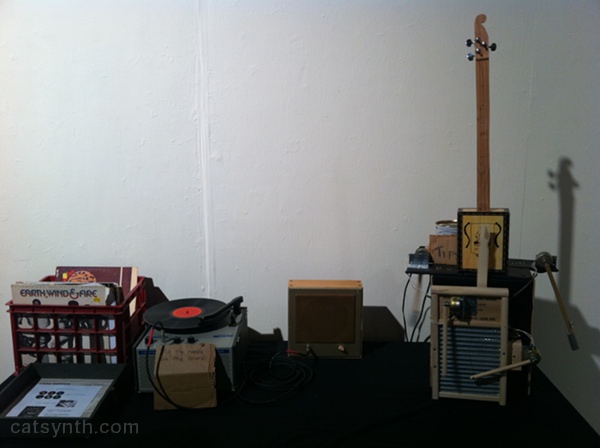
The first part of the evening featured sound sculptures from Trimpin and his students at CCRMA. This particular project, the “Boom Boom Record Player” by Jiffer Harriman stuck with me.

The output from the record player is used to drive the electromechanical instruments on the right. I thought the instruments were well crafted – but I thought it was particularly fitting to have a classic Earth Wind and Fire LP on the record player.

[Click image to enlarge.]

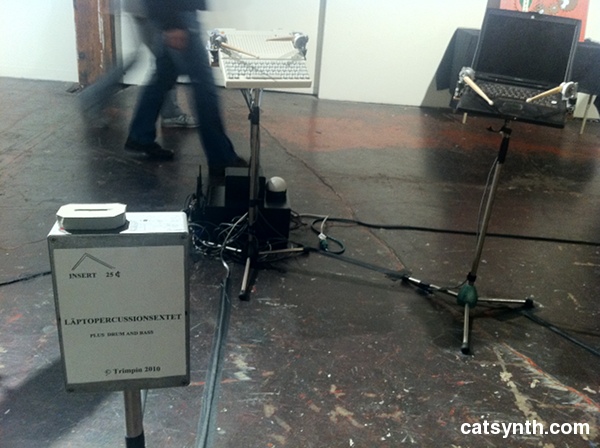
Trimpin’s offering featured coin-operated robotic percussion where the drums included just about every model of Apple notebook computer going back to an early PowerBook (and even earlier as I think I espied an Apple IIc).

[Click image to enlarge.]


The live-music portion of the evening with Tweet Dreams by Luke Dahl and Carr Wilkerson. Audience members with Twitter access were encouraged to live-tweet messages to a specific hashtag #modulations. The messages were then analyzed in real time and the data used to affect the music. As I was planning to live tweet from this event anyway via iPhone, I was ready to participate. Of course, inviting audience participation like this is a risky proposition for the artists, as one cannot control what people may say. I will freely admit I can be a bit snarky at times and it came out in some of my tweets. The music was relatively benign, with very harmonic runs of notes – and I exhorted them to “give me something harsh and noisy”. Inspired by another participant, I also quoted lines from the infamous “More Cowbell!” skit from Saturday Night Live, much to the delight of some in the audience. The main changes in the music seemed to be in density, rhythm and some melodic structure, but all within boundaries that kept the sound relatively harmonic and “pleasant.” I would have personally liked to see (as I suggested via Twitter), more complex music, with some noisy elements and more dramatic changes. But the interaction with the music and and the audience was a lot of fun.

The next piece, Sferic by Katharine Hawthorne, featured dance and electronics. It was described as “using radio and movement improvisation to explore the body as an antenna.” The dancers, dressed in black outfits with painted patterns, began the movement to a stream of radio static. The motions were relatively minimalist, and sometimes seemed strained. Gestures included outstretched arms and fingers pointing, with Hawthorne walking slowly as her dance partner Luke Taylor ran more quickly. Rich, harmonic music entered from the rear channels of the hall, and dancers moved to being flat on the ground. The static noise returned, but more crackly with other radio-tuning sounds, then it became a low rumble. The dancers seemed to be trying very hard to get up. Then they started pointing. The music became more anxious, with low percussive elements. The dance became more energetic and active as the piece came to a close.

This was followed by Fernando Lopez-Lezcano performing Dinosaur Skin (Piel de Dinosaurio) a piece for multi-channel sound diffusion, an analog synthesizer and custom computer software. The centerpiece was a custom analog synthesizer “El Dinosaur” that Lopez-Lezcano build from scratch in 1981.
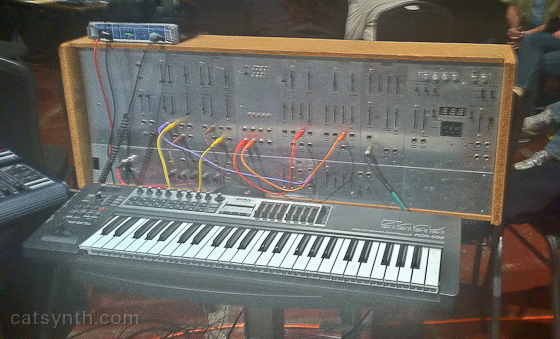
The instrument is monophonic (but like most analog synthesizers, a very rich monophonic), multiplied for the purposes of the performance by audio processing in external software and hardware. The music started very subtly, with sounds like galloping in the distance. The sounds grew high in pitch, then descended and moved across the room – the sense of space in the multichannel presentation was quite strong. More lines of sound emerged, with extreme variations in the pitch, low and high. The timbre, continually changing, grew more liquidy over time, with more complex motion and rotation of elements in the sound space. Then it became more dry and machine like. There was an exceptionally loud burst of sound followed by a series of loud whistles on top of low buzzing. The sounds slowed down and became more percussive (I was reminded as I often am with sounds like this of Stockhausen’s Kontakte (II)). Then another series of harsher whistles and bursts of sound. One sound in particular started the resonant quite strongly in the room. Overall, the sound became steady but inharmonic – the timbre becoming more filtered and “analog-like”.

The final performance in this section of the evening featured Wobbly (aka Jon Leidecker) as a guest artist presenting More Animals, a “hybrid electronic / concrete work” that combined manipulated field records of animals with synthesized sounds. As a result, the piece was filled with sounds that either were actual animals or reminiscent of animal sounds freely mixed. The piece opened with pizzicato glissandi on strings, which became more wailing and plaintive over time. I heard sounds that either were whales and cats, or models of whales and cats. Behind this sounds, pure sine tones emerged and then watery synthesized tones. A series of granular sounds emerged, some of which reminded me of human moaning. The eerie and watery soundscape that grew from these elements was rich and immersive. After a while, there was a sudden abrupt change followed by violent ripping sounds, followed by more natural elements, such as water and bird whistles. These natural elements were blended with AM modulation which sounded a bit like a helicopter. Another abrupt change led to more animal sounds with eerie howling and wind, a strange resonant forest. Gradually the sound moved from natural to more technological with “sci fi” elements, such as descending electrical noises. Another sudden change brought a rhythmic percussion pattern, slow and steady, a latin “3+2+2” with electronic flourishes. Then it stopped, and restarted and grew, with previous elements from the piece becoming part of the rhythm.


After an intermission, the seats were cleared from the hall and the music resumed in a more techno dance-club style and atmosphere, with beat-based electronic music and visuals. Guest artists Sutekh and Nate Boyce opened with Bands of Noise in Four Directions & All Combinations (after Sol LeWitt). Glitchy bursts of noise resounded from the speakers while the screens showed mesmerizing geometric animations that did indeed remind me a bit of Sol LeWitt (you can see some examples of his work in previous posts).

Later in the evening Luke Dahl returned for a solo electronic set. It began calmly with minor chords processed through rhythmic delays, backed by very urban poster-like graphics. Behind this rhythmic motif, filtered percussion and bass sounds emerged, coalescing into a steady house pattern, with stable harmony and undulating filtered timbres. At times the music seemed to reach back beyond house and invoke late 1970s and early 1980s disco elements. Just at it was easy to get lost listening to Wobbly’s environmentally-inspired soundscapes, I was able to become immersed in the rhythms and timbres of this particular style. The graphics showed close-ups of analog synthesizers – I am pretty sure at least some of the images were of a Minimoog. I did find out that these images were independent of the musical performance, and thus we were not looking at instruments being used. I liked hearing Luke’s set in the context of the pieces earlier in the evening, the transition from the multi-channel soundscapes to the glitchy noise and to the house-music and dance elements.

I was unfortunately not able to stay for the remaining sets. But overall it was a good and very full evening of music and technology.
Report from Spring Open Studios, Art Explosion

Open Studios has become a semi-annual experience for me since moving to San Francisco in 2008. Each time, I frenetically go from studio to studio in my guise as a reviewer and collector, seeing large amounts of work and interacting with artists. This time the tables were turned, as I was presenting my own photography work as part of the Spring Open Studios at Art Explosion. So rather than reviewing art, I will be reviewing the experience of presenting art, and interacting with viewers. Art Explosion is composed of two large buildings of artists’ studios in the ambiguous industrial neighborhood between the Mission and Potrero Hill. It was often one of the first stops on my Open Studio tours, and the small open studios were and supportive community were a natural choice for presenting my work.

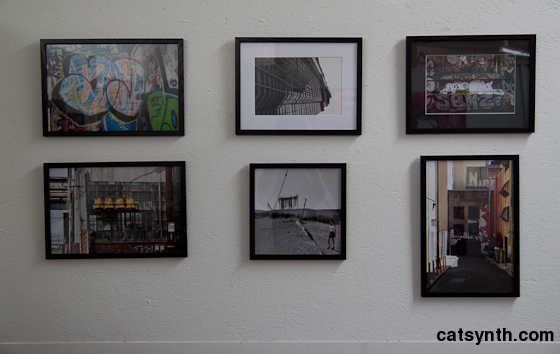
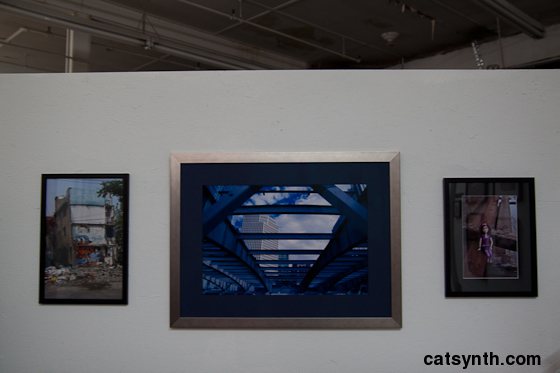
I had two walls of an open studio space, along with additional space in the main hall and one piece in the entranceway (every artist had a piece here as part of a “sampler” wall). You can see the three walls in the images below (click on the small images to enlarge).


[Click images to view full size]

In all, I had 16 pieces featured. Additionally, I made a few “mini editions” of some of the pieces (4×6 inches) and had two video presentations of works that were not physically part of the show.

Over the three main days of Open Studios (and an additional Saturday the week after), I sat and waited as people walked by and sometimes stopped to view my work, and occasionally ask questions or give feedback. Some walked through without stopping to look, others spent a couple of minutes viewing intently without saying a word, or maybe a quick “very nice work” before wandering off. But a decent number of people did ask questions or more detailed responses. The most common questions I got were about the locations of the photographs, i.e., “Where was this one taken?” All the pieces I presented were from the Bay Area, New York or Shanghai, and discussing the locations or having viewers try to guess which was which became part of the interaction. There were definitely clues in each, in particular the more exotic architecture of the Shanghai high-rises and the distinctive San Francisco “No Parking” signs. Very few people were able to recognize the half-demolished overpass from the Transbay Terminal in San Francisco featured in the largest piece, though this one was among pieces most positively received.

The other pieces that seemed to receive the most intention were Asians.com (Invisible Bike) with the big orange cat, and Dragon (Moganshan Lu) with the dragon mural, half-demolished building and garbage-strewn street. I did an experiment moving these two pieces around after the first day to see if it was the location or the content that attracted people, but they still seemed to get the most attention. I had not predicted that Dragon would get so much attention – or eventually be the first large piece to be sold! It was one of those interesting surprises when exposing the work to public viewing.

I also had an interesting conversation about the location in 5348, one of two pieces in the show featuring a model. I have used that building on multiple occasions, with its mysterious mess of hanging cables.

It turns out that someone who came through and saw the show was familiar with the building and the people who owned it, and informed me that the structure with the cables was in fact for lifting large objects, freight, etc., but had not been in use for a while. A group of viewers said that the big orange cat was part of a scavenger hunt they participated in.

]Some people seemed more drawn to the aesthetics of individual pieces rather than the subject or context – like me, the focused on lines and textures. Among these viewers, 7059 (Blue) got the most attention. A few viewers did try to look for “musical” elements within my work after learning that music was my primary art form – they noticed repeated patterns and motives in the lines.

Overall, it was a good experience. I was able to show my photographs in physical form to a large number of people and received quite a bit of positive feedback. Among those who came to see the show were a few of the artists I have reviewed here on CatSynth in the past, which was very gratifying; and many friends came by over the four days I was showing. Selling a large piece and a handful of miniatures, of course, nice as well. Interestingly, I also managed to sell some music CDs. Some things I may do differently in future shows is have a larger variety of miniatures on hand – e.g., at least one of every piece I think can be reasonably represented in a small size (some just don’t look good small). I may also experiment with different types of framing and mounting – this was probably the hardest part of preparing for the show.

One unfortunate aspect of presenting my own work is that it left me very little time to explore and see what others were doing. I did take a few breaks to see friends as well as discover new work, though not at the level of detail I would have done in previous shows.

You can see images from Open Studios at this flickr set, or visit my page at Art Explosion.

Weekend Cat Blogging #307: Wild Cats on Earth Day

Every year, we at CatSynth set aside Weekend Cat Blogging on Earth Day to look at some of the wild cat species around the world. In particular, we focus on some of the smaller wild cats, which after often less well known than the big cats such as tigers, lions and leopards, but in many cases just as endangered.

We begin with the Iriomote cat, a critically endangered wildcat found only on the remote Japanese island of Iriomote.

There are estimated to be only 100 or so left in the wild. The main threats, habit removal and non-native species (notably feral domestic cats), are exacerbated by the fact they are exclusive to one island. One third of the island has been declared a wildlife reserve with a Iriomote Wildlife Center set up to study and protect them. But with such a small population, their future remains uncertain.

With all the events and focus on the Middle East and North Africa this year, it also seems appropriate to feature the sand cat (felis margarita).

As their name implies, sand cats are found in deserts, in particular in pockets in Egypt, Tunisia and Morocco in North Africa, on the Arabian Peninsula. But there are also subspecies found in Iran and as far east as Afghanistan and Pakistan. Although not endangered overall, individual local populations are, such as Israel where it became locally extinct. A program by the Jerusalem Zoo aims to re-introduce them.

In looking up information for this article, I came across the International Society for Endangered Cats (ISEC), an organization based in Canada dedicated to “aid in the wild conservation and captive preservation of endangered and threatened small wild cat species though education, scientific observation and support for captive breeding of critically endangered species.” They have several active projects at the moment, including a study of the black-footed cat.

The black-footed cat is found in the southwest of Africa, i.e., Namibia, Botswana and parts of South Africa. They are among the smallest of wild cats, and as nocturnal creatures they are rarely seen. One thing that makes them unusual is that they don’t climb trees but instead burrow into the ground for shelter.

The ISEC is also conducting a study of the Argentine Espinal:

The Argentine Espinal is an arid grassland and shrubland mosaic that has been greatly modified since the 1600’s, when cattle became the prominent species on the landscape. Found today only in fragmented patches, the Espinal was once home to a great diversity of birds, plants and mammals, among them a unique guild of felids composed of the Pampas cat Leopardus colocolo, Geoffroy’s cat Leopardus geoffroyi, Jaguarundi Puma yagouaroundi and Puma Puma concolor.

We have discussed the Geoffroy’s cat in a previous post. They are still relatively common and have a large range in southern South America. However, they are classified as “near-threatened”, primarily because of habit fragmentation and other concerns.

We also encountered the Pampas cat before. Because there has not been much study of these cats, their conservation status is not officially listed. As one can tell from the photo, it is a somewhat heavier looking cat than many of the other species. Little is known about its diet or hunting habits. Despite being named for the Pampas, their range extends far beyond its geographical boundaries.

For more information, please visit the ISEC website.  In our back yard, the Felidae Conservation Fund is also involved in wild-cat studies around the world, as well as close to home with a study of Bay Area mountain lions. Other organizations involved in cat conservation include the Feline Conservation Federation, and the Cat Specialist Group of the World Conservation Union.


Weekend Cat Blogging #307 is hosted by Jules at Judi’s Mind Over Matter.

The Carnival of the Cats will be hosted this Sunday by Meowza.

And the Friday Ark is at the modulator.

RIP Max Mathews (1926-2011)

Yesterday morning I received the sad news that Max Mathews, considered by many of us to be the “father of computer music”, passed away.

Not only was he among the first to use general-purpose computers to make music, but his work spanned many of disciplines within the field that we know today, including sound synthesis, music-programming languages, real-time performance and musical-instrument interfaces.

He studied electrical engineering at the California Institute of Technology and the Massachusetts Institute of Technology, receiving a Sc.D. in 1954. Working at Bell Labs, Mathews wrote MUSIC, the first widely-used program for sound generation, in 1957. For the rest of the century, he continued as a leader in digital audio research, synthesis, and human-computer interaction as it pertains to music performance. [Wikipedia]

The “MUSIC-N” languages have influenced much of how we still program computers to make music. It has direct descendants such as Csound, and has also influenced many of the other languages for composer, perhaps most notably Max (later Max/MSP) that was named in his honor.

His rendition of “Daisy Bell” (aka “Bicycle Built for Two”) is one of the early examples ofphysical modeling synthesis. Sections of the vocal tract were modeled as tubes, and sound generated directly from physics equations. His work inspired the version of “Daisy Bell” sung by HAL9000 in the film 2001: A Space Odyssey (though he did real at a talk in 2010 that the version in the film was not his recording.)

Mathews continued to expand and innovate throughout his career, moving into different areas of technology. In the 1970s his focus shifted to real-time performance, with languages such as GROOVE, and then later with the Radio Baton interface, which can be seen in this video below.

I had the opportunity to see and hear Mathews at the ICMC 2006 conference and MaxFest in 2007, both events that honored his 80th birthday and five decades in music technology. At 80, it would be relatively easy and quite understandable to eschew the latest technologies in favor of earlier technologies on which he did much of his work, but there he was working with the latest MacBooks and drawing upon new research in connection to his own work.


[Max Mathews at GAFFTA in 2010. (Photo by Vlad Spears.)]

More recently, I saw him give a talk at the Gray Area Foundation For the Arts in 2010, where he introduced the work of young artists and researchers, something he continued to do all the way to the end. He was at the Jean-Claude Risset concert at CCRMA (and I later found out, gave the introduction, which I had missed.) I have also heard comments over the past day that he was still involved in email and discussions over current projects up through this week, a testament to his character and his love for this field and for the work that he pioneered.

CatSynth pic: Giuliano and Ikea Rast

Another from Alessandro featuring Giuliano, via facebook:

“Ikea Rast used as case for modular synth (cable holders, legs and desk are from Ikea too).
The cat is not.”

You can see other Ikea-based modular racks, including the Rast.

(I see Doepfer and MFB modules in the rack, and a Roland MC-505. Please feel free to provide your own identifications for the synths.)

Jean-Claude Risset at CCRMA

A few weeks ago I had the opportunity to see composer and computer-music pioneer Jean-Claude Risset present a concert of his work at CCRMA at Stanford. Risset has made numerous contributions to sound analysis and synthesis, notably his extension of Shepard Tones to continuously shifting pitches. The sound of the “Shepard-Risset glissando” where pitches ascend or descend and are replaced to give the illusion of a sound that ascends or descends forever. You can hear an example here, or via the video below.

Sadly, I arrived slightly late and missed much of the first piece Duo for one pianist (1989-1992), featuring Risset himself on a Yamaha Disklavier piano. The duo comes from the computer control of the piano simultaneous to the live human performer. It’s not a simple computer-based accompaniment part, but rather a duo in which the actions of the live performer are interpreted by a program (written in an early version of Max) and inform the computer response in real-time.

The remainder of the concert features works for multichannel tape. The first of these pieces, Nuit (2010): from the tape of Otro (L’autre) featured eight channels with meticulous sound design and spatialization. The ethereal sounds at the start of the piece sounded like either frequency-modulation (FM) or very inharmonic additive synthesis (actually, FM can be represented as inharmonic partials in additive synthesis, so hearing both techniques makes sense). Amidst these sounds there emerged the deep voice of Nicholas Isherwood speaking in French, and then later in English as well – I specifically recalled the phrase “a shadow of magnitude.” Surrounding the vocal part was a diverse palette of sounds including low machine noise, hits of percussion and wind tones, a saxophone trill, tubular bells and piano glissandi. There were examples of Shepard-Risset glissandi towards the end of the piece.

The next piece Kaleidophone (2010) for 16-channel tape begins with similar glissandi, providing an interesting sense of continuity. In this instance, they were ascending, disappearing at the top of the range and re-emerging as low tones. Above this pattern a series of high harmonics emerged, like wispy clouds. The glissandi eventually switched to both up and down motions, and subsequently followed by a series of more metallic tones. At one point, a loud swell emerged reminiscent of the distinctive THX announcement at the start of most movies; and a series of percussive tones with discrete hits but continuous pitch changes, getting slower and slower. There was a series of piano-like sounds with odd intonations played more like a harp, followed by gong-like sounds reminiscent of gamelan music but with very artificial pitches and speeds. Industrial metallic sounds gave way to a section of tense orchestral music, and the long tones that subtly and gradually became more noisy and inharmonic. A sound like crackling fire seemed to channel the early electronic pieces by Iannis Xenakis. Highly-comb filtered environmental sounds gave way to eerie harmonies. They constantly changing sounds lull the listener in a calm state before starting him or her with a burst of loud noise (perhaps the most intense moment in the entire concert). This was followed by machine noises set against a sparse pattern of wind pipes, and a large cloud of inharmonic partials concluded the piece. I had actually not looked in advance at the subtitle in the program of “Up, Keyboards, Percussion I, Percussion II, Winds, Water, Fire, Chorus, Eole” – but my experience of the piece clearly reflected the section titles from perception alone.

The final piece Five Resonant Sound Spaces for 8-channel tape began with orchestral sounds, bells and low brass, gongs (or tam tam), timpani. The sounds seemed acoustic at first, but gradually more hints of electronics emerged: filtering, stretching and timbral decomposition. A low drone overlaid with shakers and tone swells actually reminded me eerily of one of my own pieces Edge 0316 which was based on manipulations of ocean-wave recordings and a rainstick. This image was broken by a trombone swell and the emergency of higher-pitched instruments. The overall texture moved between more orchestral music and dream-like water electronics. A series of fast flute runs narrowed to a single pure-tone whistle, which then turned into something metallic and faded to silence. All at once, loud shakers emerged and granular manipulations of piano sounds – more specifically, prepared piano with manual plucking of strings inside the body and objects used to modify the sound. The sound of a large hall, perhaps a train station, with its long echoes of footsteps and bits of conversation was “swept away” by complex electronic sounds and then melded together. A series of high ethereal sounds seemed to almost but not quite be ghostly voices, but eventually resolved the clear singing voices, both male and female. The voices gave way to dark sounds like gunfire, trains and a cacophony of bells – once again, channeling the early electronic work of Xenakis. A breath sound from a flute was set against a diversity of synthesized sounds that covered a wide ground, before finally resolving to a guitar-like tone.


The concert was immediately followed by a presentation and discussion by Risset about his music. His presentation, which included material from a documentary film as well as live discussion covered a range of topics, including using Max and the Disklavier to perform humanly impossible music with multiple tempi; and marrying pure sound synthesis with the tradition of musique concrete, with nods to pioneers in electronic music including Thaddeus Cahill, Leon Theremin, Edgard Varese, and Max Matthews (who was present at the concert and talk). He also talked about the inspiration he draws from the sea and landscape near his home in Marseilles. The rocky shoreline and sounds from the water in the video did remind me a lot of coastal California and made it even less surprising that we could come up with pieces with very similar sounds. He went on to describe his 1985 piece SUD in more detail, which used recordings of the sea as a germinal motive that was copied and shifted in various ways. Percussion lines were drawn from the contours, he also made use of sounds of birds and insects, including the observation that crickets in Marseilles seem to sing on F sharp. I did have a chance to talk briefly with Risset after the reception about our common experience of composing music inspired by coastal landscapes.

Overall, this was an event I am glad I did not miss.