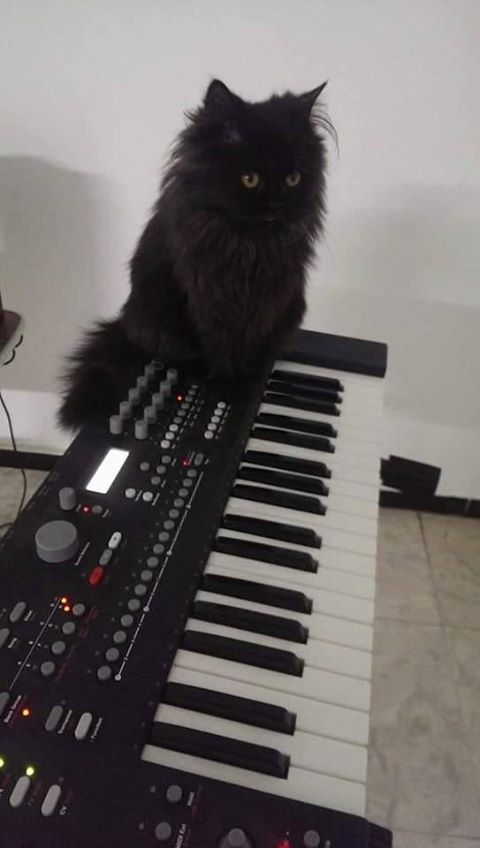
CatSynth Pic: Eggo and Korg DW8000

Eggo the cat sits atop a Korg DW8000 synthesizer. From Sam Oliver via our Facebook page.

Eggo the waffle kitty, aptly named from Stranger Things, is having a rest on my vintage 1985 Korg Dw8000 which happens to have a small piece of a much larger stranger things pop figure collection

“Stranger Things” has definitely brought some of the mid-1980s synthesizer sounds into mainstream consciousness – although those sounds and instruments have been popping up again in music for some time now. Around 1986/1987, the DW8000 was Korg’s “out-of-my-league” synth, the big flagship compared to the Poly800 v2 that I was initially looking at – and I thought the graphics for the waveforms were pretty cool. Of course, this is the time period when the Yamaha DX7 and their other FM synths were dominant. Ultimately, I went for analog/DCO and FM options in my first synths, but recently I have found myself rather curious about the DW8000 (and its rackmount version the EX8000) again.

CatSynth Pic: Yogi on a Matrix 6R

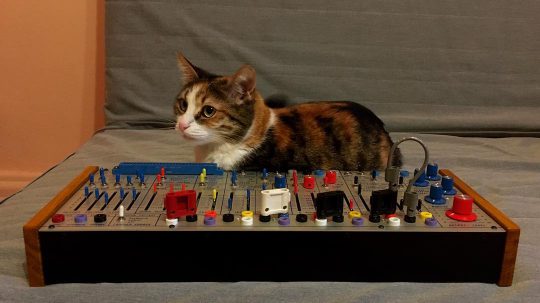
Yogi found a nice place to sit atop an Oberheim Matrix 6R rack-mount synth module. By Sayer Seely via Facebook.

The 6R is the rack-mount module version of the classic Oberheim Matrix 6 from the 1980s.

The Matrix 6 was one of the last few synthesizers from Oberheim to come out during the mid-eighties following the classic OB-series. The Matrix 6 utilized high-tech but less expensive digital and midi features and still retained a totally analog sound. It did this by using DCOs (digitally controlled oscillators) to provide stability, programmability and more. All the Matrix synthesizers featured Matrix Modulation which allows for extremely wild virtual patching for almost unlimited range of sounds and modulation capabilities!

http://www.vintagesynth.com/oberheim/mat6.php

CatSynth Video: Big Merp vs The Photo Theremin

Today’s CatSynth video features our very own Big Merp. I was trying out an old photo theremin that I bought years ago, and decided to try playing it in front of Big Merp. Hilarity ensued. Definitely watch the video all the way to the end – the look on his face is priceless.

The photo theremin consists of a simple analog oscillator that uses a light-sensitive resistor (i.e.,a photocell) to control the frequency. So you can move your hand or other objects around it to change the light and thus change the pitch. This one also as an LFO for added sonic variety, and came in a really cool translucent blue case.

Manul Override at the Garden of Memory 2019

I have attended the Garden of Memory at the Chapel of the Chimes in Oakland many a summer solstice since moving to San Francisco – and written multiple reviews on these pages and even presented a CatSynth TV showcase last hear. But 2019 is the first time I have performed at this annual event as a named artist. It’s a very different experience from the inside looking out. This article describes the adventure.

My friend and sometime collaborator Serena Toxicat and I were excited to be accepted into this years program for our project Manul Override. We joined forces once again with Melne Murphy on guitar and also invited Thea Farhadian to sit in with us on violin.

I had a rather elaborate setup, anchored as usual by my trusty Nord Stage EX. The Sequential Prophet 12 has also become a mainstay of my smaller collaborations, providing rich ambient sounds. The Arturia MiniBrute 2, Moog Theremini, and a collection of Eurorack modules rounded out the rig.

Getting everything into place in the catacombs-like building – a renowned landmark designed by Julia Morgan – was a challenge in itself. Fortunately, I found parking nearby and was able to load everything onto carts or wheeled cases, and had plenty of help getting things downstairs where we were playing.

The acoustics of the space are also quite challenging. It is a set of oddly shaped stone chambers, some large, some small, so echoes abound from both the crowds and other performers. Figuring out how to balance our sound is not easy, and I don’t pretend to have gotten it right on the first try, but it’s a learning experience. But we did get ourselves sorted out and ready to play.

Photo by Annabelle Port

The set unfolded with an invocation, a drone in D mixolydian mode set to Serena’s text Mau Bast, read first in French and then in English. It seemed a perfect piece for the occasion. We then switched things up with a more humorous piece (Let’s Hear it for) Kitties, which was a crowd favorite. You can hear a bit of it in this video from the event.

I have learned how to best follow Serena’s style of speaking and singing, with a more open quality; and Melne and I know how to work together well both in terms of timing and timbre. Thea’s violin added an interesting counterpoint to the voice and electronics. Her sound was sometimes masked by the other instruments and the acoustics but when it came through it added a distinct character and texture. The remaining two pieces were more improvised. One was a free improvisation against one of Serena’s books Consciousness is a Catfish, and another was based on a graphical score with 16 symbols that I first created in 2010 but have revised and reused over the use. The newest version included a cartoon pigeon in honor of my bird-loving co-conspirator Melne.

The performance was well received. Crowds came and went throughout the evening, but many people stayed for extended periods of time to watch us, and others came back a few times. We played two hour-long sets, and in between I had a small amount of time to check out some of the other performs. In particular, I enjoyed hearing Kevin Robinson’s trio, with whom we shared our section of the space.

His spare group and arrangements with saxophone, upright bass, and drum, provided a distinct contrast to our thick sound. The moved between long drawn-out tones and fast runs with short notes that reverberated around the space in between. Robinson’s music often has a meditative quality, even when it is more energetic, so it fit well.

Around the corner from us was the Stanford Laptop Orchestra (SLOrk). They had a quiet set featuring performs seated on meditation cushions with laptops as well as various percussive objects as sound sources.

I was particularly inspired by Anne Hege and her Tape Machine, an instrument with a free-moving magnetic tape and several heads, pickups and tiny speakers. She sang into it at various points and moved the tape, created an instrumental piece that was part DIY-punk, part futuristic, and somehow quite traditional at the same time.

Her performance gave me ideas of a future installation, perhaps even to bring to the Garden of Memory in years to come…

Thea pulled double duty during the evening, also performing as part of a duo with Dean Santomieri, sharing a space with Pamela Z. Our friends Gino Robair and Tom Djll brought the duo Unpopular Electronics to one of the darker columbariums, and IMA (Nava Dunkelman and Amma Arteria) performed on the lower level. In retrospect, our group might have been better placed sharing a space with them, as we are both electronic groups (all women) with large dynamic range.

Overall, it was a wonderful experience, and with the opportunity to play as well as listen it’s my favorite to date. Thank you Sarah Cahill, Lucy Mattingly, and the rest of the crew at New Music Bay Area as well as the Chapel of the Chimes staff for letting us be a part of this event!

CatSynth Pic: Korg Poly 800

A cute tuxedo cat shows off a Korg Poly 800 synthesizer. From Cesar Inserny via Instagram.

True meownalog synthesizer.

The Korg Poly 800 was a popular affordable polyphonic-analog synthesizer. The first synthesizer that I considered was its successor, the Poly 800 mk2, though was steered away from it because of its lack of velocity sensitivity and small keyboard range. They can still be picked up rather affordably for those interested in trying this instrument out.

CatSynth Pic: Crumar Bit 99, Roland Juno 106, Korg MS-20, Metasonix, and More

White cat with a Crumar Bit 99, Roland Juno 106, Korg MS-20, and modules from Doepfer, Metasonix, and more.

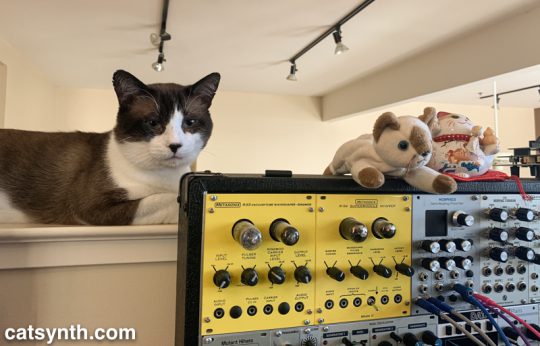
A beautiful white cat sits atop a Crumar Bit 99 synthesizer, and beneath a Roland Juno 106 and Korg MS-20. We also see some Eurorack modules, including some Doepfer and a Metasonix yellow module – most likely an R-53 like the one sitting near me as I write this.

From Suren Seneviratne via Facebook.