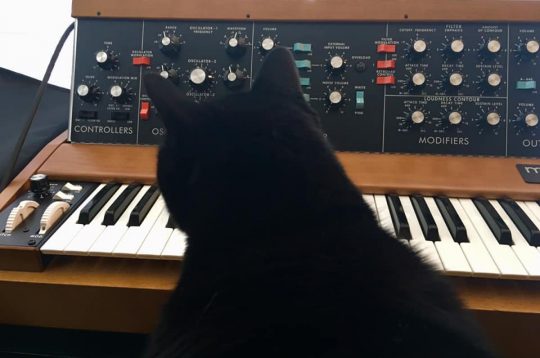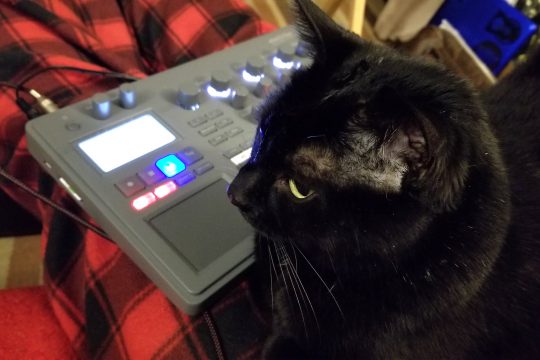
Murder (we’re sure there must be an interesting story behind her name) gets ready to perform on a Korg EMX2 Groovebox. From Jackies Fridge via our Facebook page. Part of a series of posts on our page this week celebrating black cats.

Murder (we’re sure there must be an interesting story behind her name) gets ready to perform on a Korg EMX2 Groovebox. From Jackies Fridge via our Facebook page. Part of a series of posts on our page this week celebrating black cats.
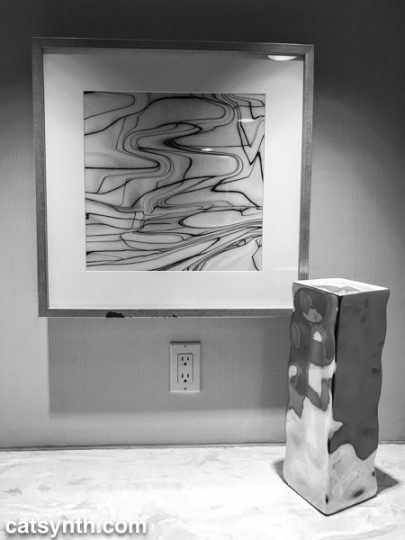
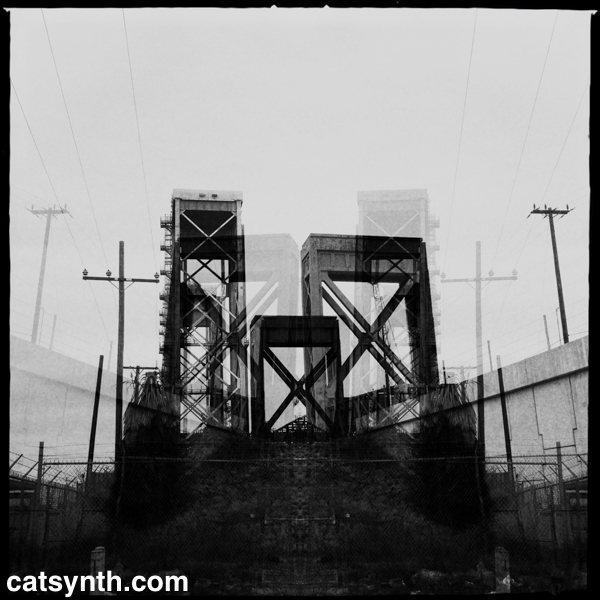
Scene featuring two art pieces in a niche at the Hilton Anaheim while running around between parties and other social gatherings on the last night of NAMM. It was a quiet and arresting tableau amidst the chaos and cacophony.
Some may be quick to deride “hotel art”, but these two pieces would look very much at home at CatSynth HQ regardless of provenance.
For more “wordless” fun, please check out our completely wordless latest video.
It’s a three-day weekend here in the U.S., and our cats demonstrate how to best enjoy it.
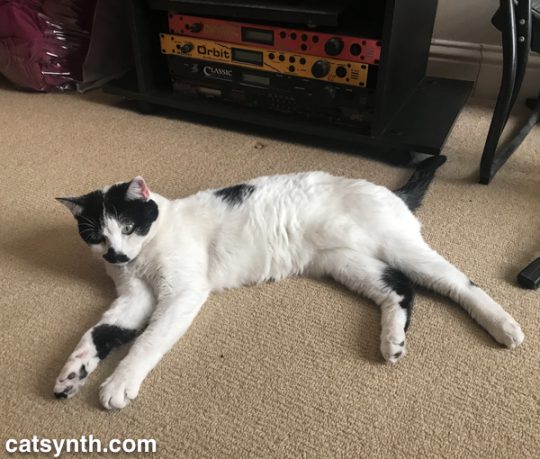
Sam Sam is a cat who knows how to relax. In addition to the blankets, one of her favorite spots of late has been the patch in front of our (mostly de-commissioned) E-MU 1U modules.
But she also knows how to have fun, as in this Instagram where she makes a game of playing with her new toy, washing, and finishing up with a scratch’n’roll.
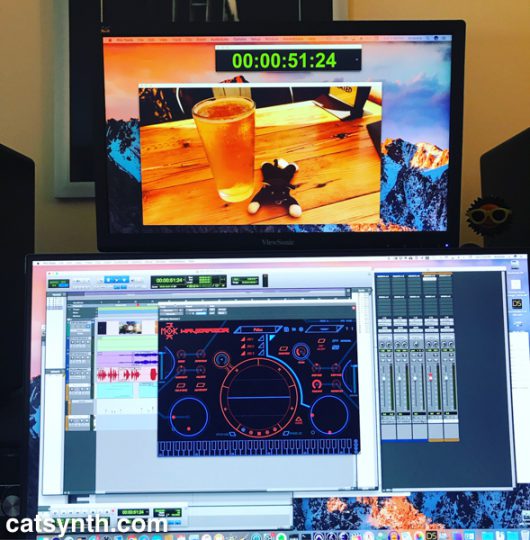
We’ve been busy, too, doing another video with an original soundtrack featuring both hardware and software synths (including the new MOK Waverazor virtual instruments). And of course our little cat buddy makes a cameo.
On the other side of the bay, Big Merp is enjoying his extended weekend, too.
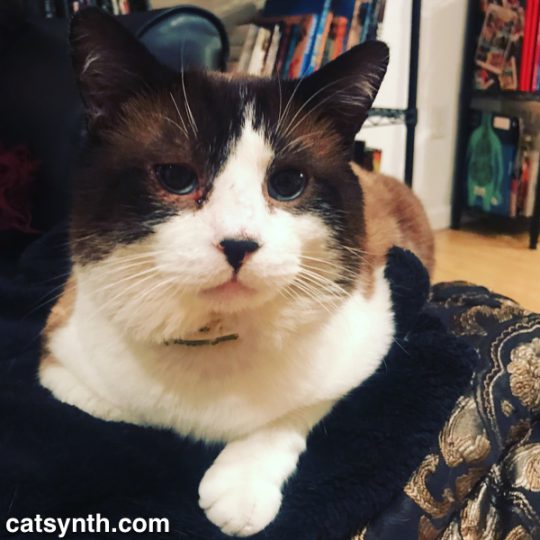
This portrait brings out the character and soul in his face. He has had a great many experiences in life. But he loves his home comforts.
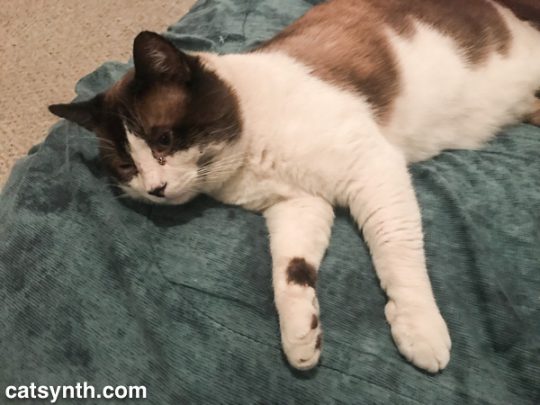
The tears around his eye seem to happen when he goes out for one of his multi-hour outdoor adventures. It clears up fairly soon after coming back indoors. We are figuring that it is some sort of allergy.
We hope you are all enjoying your three-day weekend, or your Monday wherever you are.
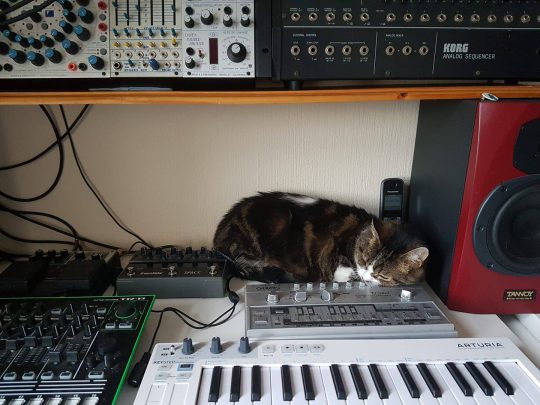
Bonnie has definitely found a nice napping spot in this studio. Submitted by David Lemur via our Facebook page.
Bonnie says: ‘More of John Cage’s 4 minutes and 33 seconds of silence please Donny’.
We see an Arturia Keystep, Roland TR-8, a TB-303 clone, a vintage Korg sequencer, and even a bit of Buchla in the upper-left corner.
One of the most talked-about releases at NAMM (at least within our circles) was the new MicroFreak from Arturia. So, of course, we at CatSynth had to check it out.
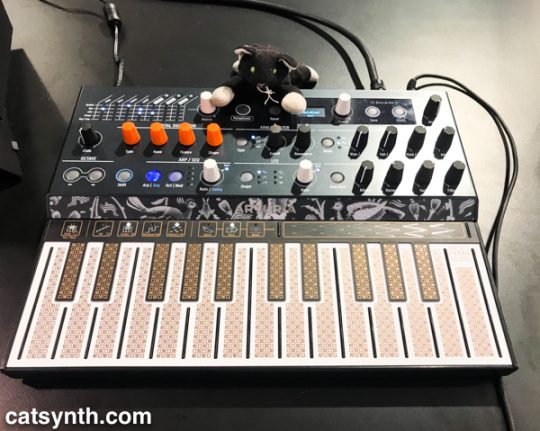
It is a unique-looking instrument. The panel is etched with a variety of iconography
Beyond its looks and keyboard, the main feature of the MicroFreak is its digital oscillator. There are several different “types” for the oscillator, including wavetable, sampling, physical modeling, virtual analog, and something called “texturizer”. Within
The digital oscillator followed in the signal chain by an analog filter, specifically an Oberheim SEM-style filter, which sounds quite good when the oscillator is set to a rich source. There also the usual array of modulators, including envelope (one-shot and cycled), LFO, and arpeggiator. The sequencer includes a bunch of compositional functions with cute names like “Spice” and “Dice” to help build and modify patterns, which then can be routed via the modulation matrix.
It is quite a powerful instrument, but attempting to play it was a bit intimidating at first. Unlike the MiniBrute (analog) or even the Sequential Prophet 12 (hybrid), the knobs weren’t quite as intuitive for someone used to a lot of subtractive or semi-modular synthesizers, especially the oscillator with its various modes and the composition functions. I suspect it was an easier first-experience for those who use beat and sample boxes like those from Elektron. Indeed, I was able to get more out of it by turning on the arpeggiator and then turning knobs. You can see a bit of my initial attempts in our recent video.
In order to really understand what this little beast has to offer, a deep dive in the studio would be required. We at CatSynth hope to be able to arrange that in the not-to-distant future, and will report back here and on CatSynth TV.
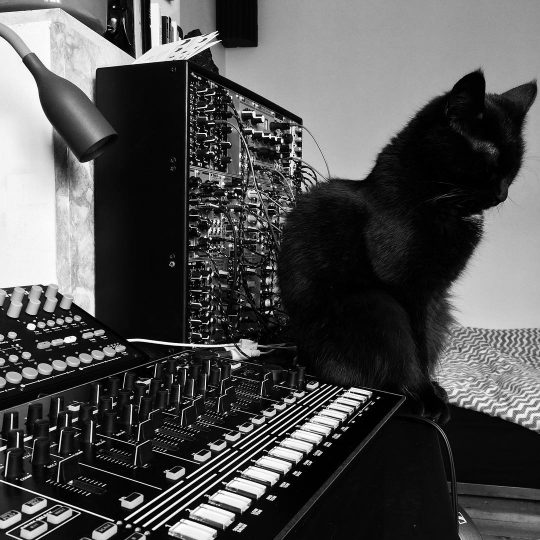
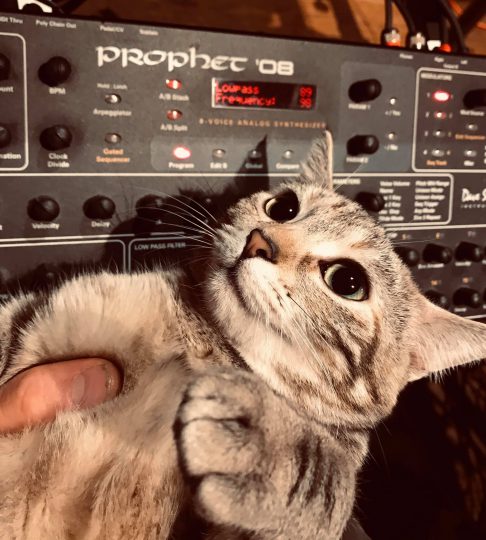
Meet Jazz the cat, who presides over a studio with Roland AIRA, Elektron, and modular synthesizers. From Border One on Instagram.
In the #studio with #jazzthecat
It’s been a little while since we last checked in with Big Merp. He had been splitting his time indoors and outdoors in the Temescal neighborhood of Oakland, but as the cold and rain started pounding the region this winter, he has gladly made the transition to being a mostly indoor cat.
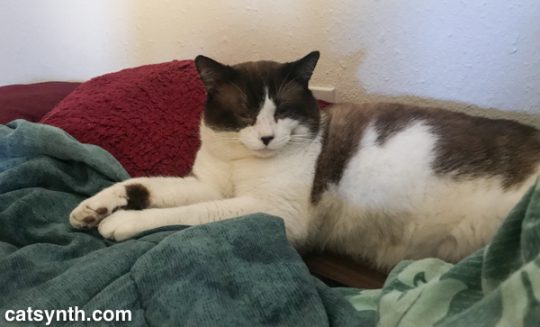
He is definitely loving the posh and comfy life in his new home.
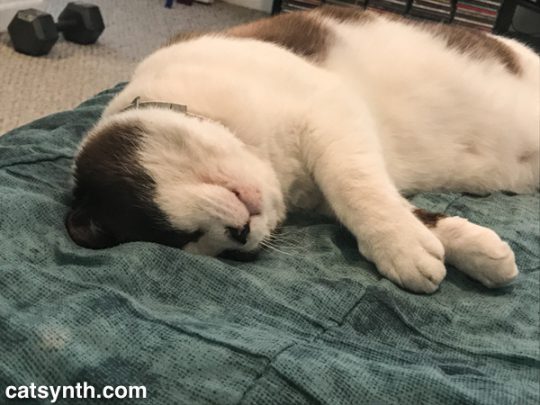
He does like to go outside now and then, to patrol the neighborhood, and to check in on his lady friend Hissy. But most of the time he is content to stay inside. Sometimes, we open the door for him to go outside, and he just stands there, thinks and goes “
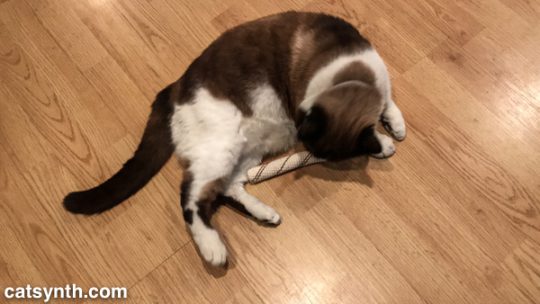
Yesterday, we got him a catnip toy from our visit to Cat Town cafe and adoption center, and he has taken to it with aplomb.
We hope you are all enjoying a happy and fulfilling Sunday, whatever you are up to.