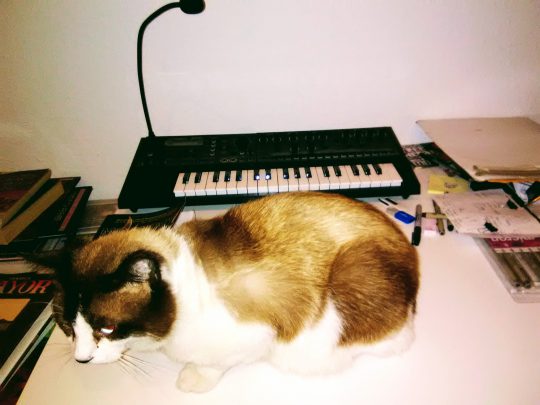
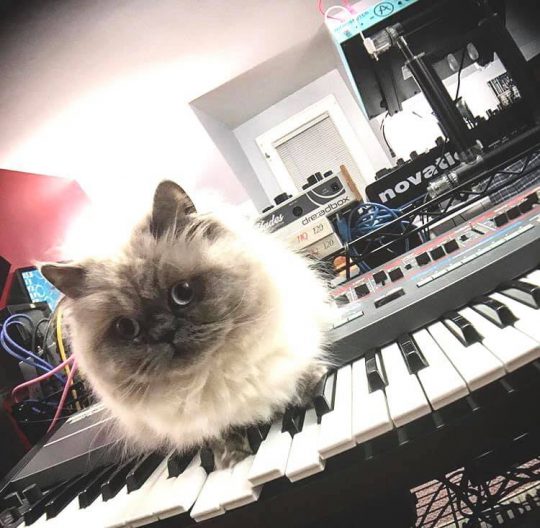
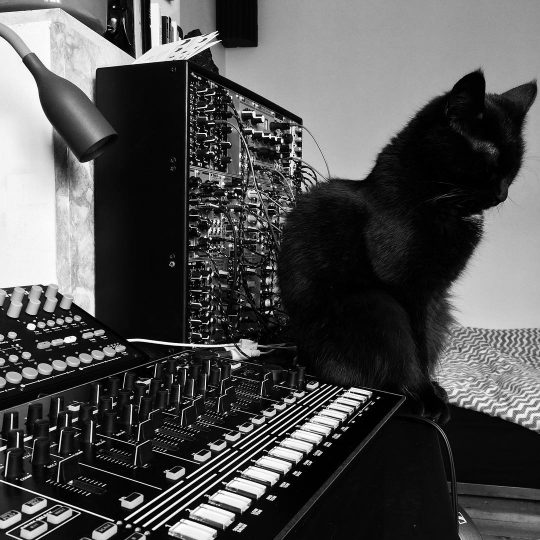
We all know and love Big Merp, but he never had a “CatSynth pic”. Until now. Here we see him sitting in front of a Roland JD-Xi synthesizer.
The JD-XI is a cool little instrument, a hybrid analog-digital synth with a built-in vocoder. I haven’t had a chance to try the vocoder yet, but I’m curious how it compares to our VP-03 (also from Roland).
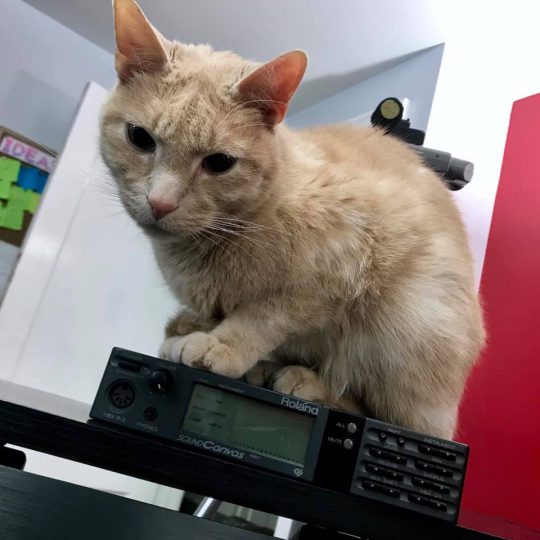
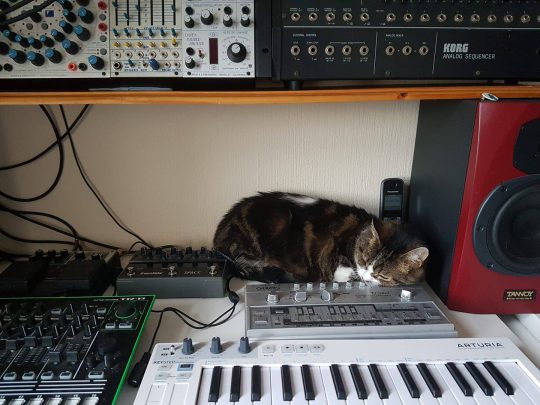
Meet Isosceles the cat, who sits atop a Roland Sound Canvas synth module. Submitted by Carl Peczynski via our Facebook page.
Roland Sound Canvas modules were pretty common in the 1990s. I had a Roland SC-7, which functioned as an outboard synth for my Windows PC at the time. It’s pretty still somewhere in storage at CatSynth HQ.
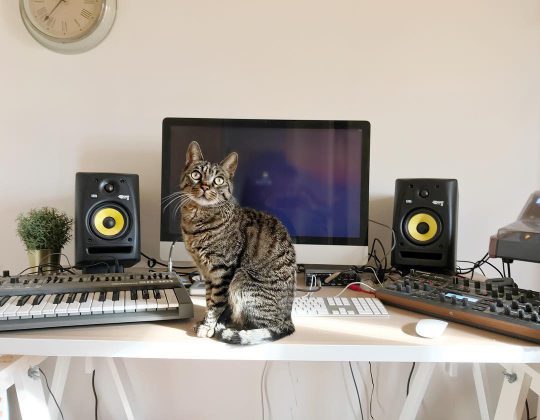
Scout sits atop a vintage Roland synthesizer. We are pretty sure it’s a Roland Juno 106. In the back, we see a Dreadbox Hades, as well as offerings from Novation and Arturia. From Carl Peczynski via our Facebook page.
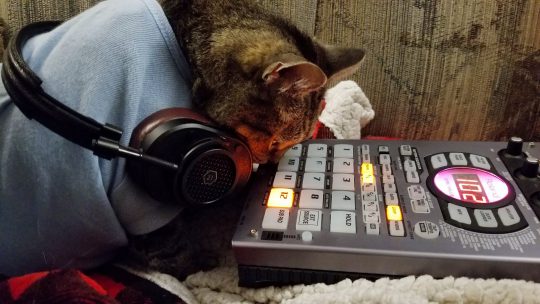
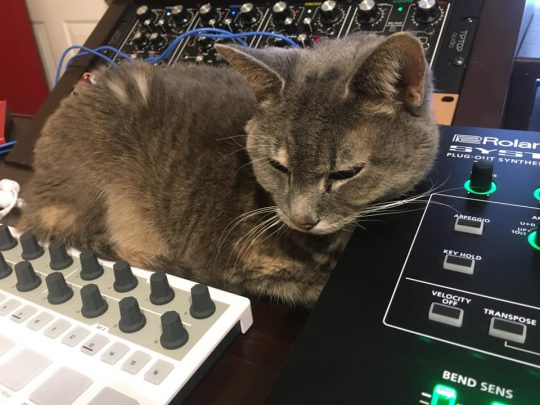
Kasey finds a comfy spot between a Roland Plug-Out system, Roland modules, and an Arturia Beatstep Pro. Submitted by Chris Bentley via our Facebook page.
Kasey the cat. Passed away at the age of 19 back in August 2017 but used to love to hang out on my desk while I was tinkering in the studio.
We are very sorry to hear of Kasey’s passing, and our hearts go out to Chris as the rest of Kasey’s family. A wonderful studio cat who lived a long and loved life 💕
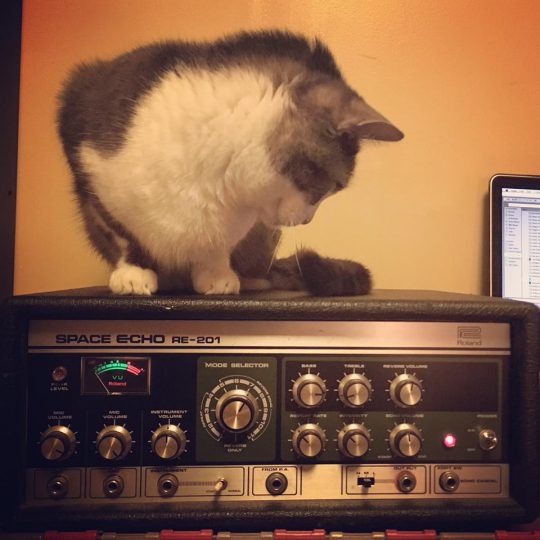
Biggie Smalls contemplates a vintage Roland Space Echo RE-201. From Brandon Fitzsimons via our Facebook page.
“What’s making that noise in there??”
The RE-201 continues to be prized by musicians for its sound. It is actually a true tape-echo machine (plus a spring reverb).
[Ikutaro] Kakehashi’s breakthrough development came in 1974 with the RE-101 and RE-201 Space Echo units, which used the standard 1/4″ tape of the open-reel variety, but made as one, continuous loop. It uses no reels of any kind; the tape is transported via a capstan drive. The tape loop is contained in a loose, constantly moving jumble in the tape chamber (also known as the tape tank) under a plastic panel which protects the tape and keeps it from getting tangled. The design resulted in lower levels of noise, wow, and flutter, and cut down on tape wear.[1] Replacement tapes were sold as well, named RT-1L.[2] There are several control dials on the device that alter such aspects as tape speed, repeat pattern (an 11-position rotary switch), one instrument and two microphone inputs, a single analog backlit VU meter for all three inputs, wet/dry mix for both echo and reverb, and intensity (number of repeats), that can be adjusted to a user’s liking; and bass/treble controls to EQ the sound of the repeats (not the dry signal), as well as dry and effected “Echo” output jacks with a switch for output setting (-10, -20, -35db levels.)
https://en.wikipedia.org/wiki/Roland_RE-201
It is interesting to read this as I have been working extensively of late with the Magneto tape-echo simulator module from Strymon. You can see our review of the echo mode in this recent video.
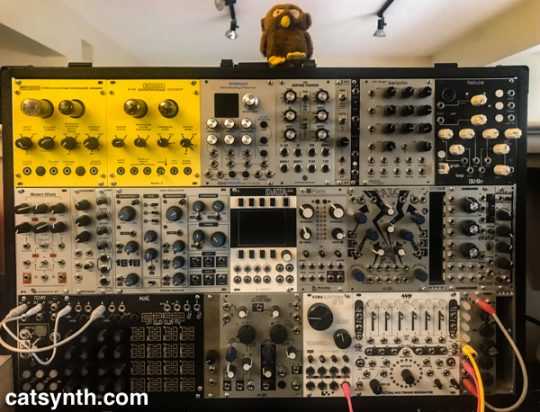
We at CatSynth feel there is no better way to celebrate Superb Owl Day than with “owlsynth pics”. Here is our stuffed owl atop our main modular system.
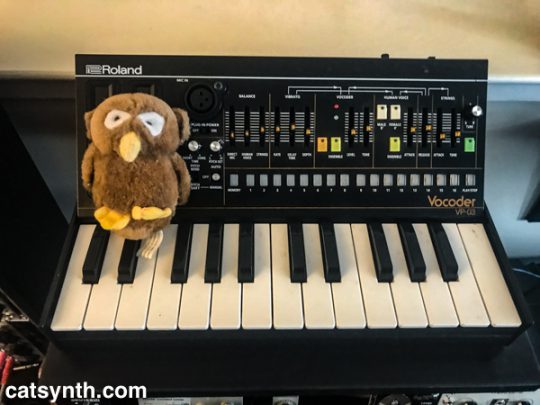
And with our trusty Roland Boutique VP-03 vocoder.
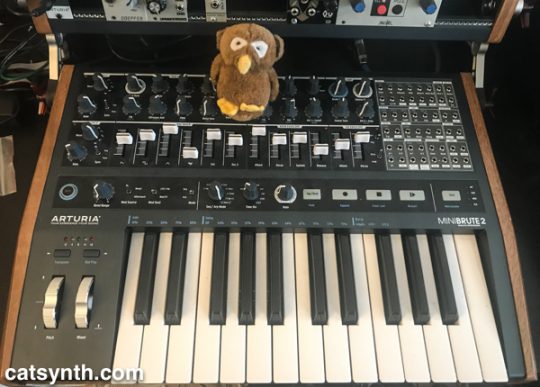
And with our Arturia MiniBrute 2.
(Definitely need to tidy up a bit there.)
Owls are quite captivating as they are so different from other birds, even from other birds of prey. We all know their unique front-facing faces and nocturnal behavior. But they also have amazing auditory capabilities.
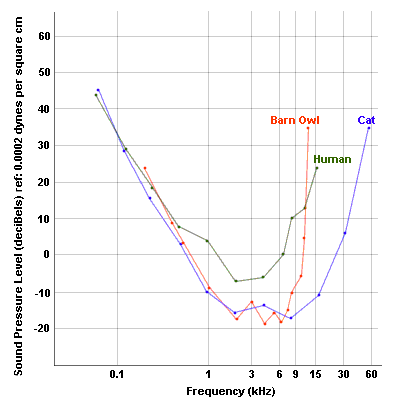
Both the cat and the Barn Owl have much more sensitive hearing than the human in the range of about 0.5 to 10 kHz. The cat and Barn Owl have a similar sensitivity up to approximately 7 kHz. Beyond this point, the cat continues to be sensitive, but the Barn Owl’s sensitivity declines sharply.
Some Owl species have asymmetrically set ear openings (i.e. one ear is higher than the other) – in particular, the strictly nocturnal species, such as the Barn Owl or the Tengmalm’s (Boreal) Owl. These species have a very pronounced facial disc, which acts like a “radar dish”, guiding sounds into the ear openings. The shape of the disc can be altered at will, using special facial muscles. Also, an Owl’s bill is pointed downward, increasing the surface area over which the sound waves are collected by the facial disc. In 4 species (Ural, Great Grey, Boreal/Tengmalm’s & Saw-whet), the ear asymmetry is actually in the temporal parts of the skull, giving it a “lop-sided” appearance.