From I Can Has Cheezburger?:

We have actually seen this picture before (with a different lolcat caption). You can see the previous version here.

From I Can Has Cheezburger?:
We have actually seen this picture before (with a different lolcat caption). You can see the previous version here.
Originally titled “Analog and digital Synths work together…Mini Moog, Synthesizers.com.” From Synthiefrau on YouTube, via matrixsynth:
Hi Folks, the night is cold and grey and I play Synthesizers. Sorry for the mistakes, I play live. My siamese cat Cleo listening, she love Synths also. Mini moog leadsound, Synton Syrinx leadsound, the sequenz is from the Modularsystem, My left Hand played the Roland V-Synth. Effects comes from the Roland Juno 60 and my little “kloiner Racker” Doepfer Dark Energie.
Synthesizers are my life!!1
Watch Cleo during the video. Like Luna, she sits quietly and puts up with her human’s weird sounds, but will make it very clear when she wants some attention for herself.
Another from Maggie Osterberg on flickr (via matrixsynth):

You can see more of Maggie Osterberg’s photos of Scooter and Bob here as well.
Via matrixsynth, a series of pictures from Yura (of practicalsenses and soundformband). “The cat’s name is Tusik.”


Some additional photos, with an Elektronika EM-25 and Korg N364 below:


From our friend Eric Pochesci at Polynominal, another picture of Mimi, this time with an Elka Synthex:

You can find out more about the Synthex here.
Last Monday, I performed again the experimental improv “Hootenanny” at the Ivy Room in Albany, CA. This is always a fun series to participate in or attend. It starts a little later at 9PM, and is set in a rather plush bar that makes a great setting for drinks and experimental music.

Free Rein. Photo by Michael Zelner
The evening opened with Free Rein, consisting of Andrew Joron (percussion, theremin), Joseph Noble (woodwinds) and Brian Lucas (guitar). They began with Joron playing a bowed metal percussion instrument and Noble on flute. The bowed instrument had discrete pitches and the music was quite tonal and repetitive, almost hypnotic. They were joined after a while by Lucas on guitar, and together weaved between pentatonic and chromic sounds that were sometimes quite lush, and other times sparse. Joron switched the theremin at some point during the set, and there was a particularly interesting duo of theremin and pennywhistle.
Free Rein gave way to The Lords of Outland with CJ “Reaven” Borosque (electronics), Philip Everett (drums), Ray Scheaffer (bass), and Rent Romus (alto saxophone). There sound was loud, fast, dramatic, with many of the standard idioms from free jazz, run of fast notes (particularly from Romus on sax), squeaks, and loud hits. It was interesting to have the electronic noises set against the jazz sounds.

Lords of Outland. Photo by Michael Zelner.
The set was very energetic and seemed to go by fast, and I had to keep track of time lest I miss the start for the set that I was curating. On cue, as they faded out, we began to fade in.

Photo by Michael Zelner
The set I curated included myself on electronics, Brandan Landis on prepared guitar, Beau Casey on violin and David Slusser on saxophone and the Slussomatic. As usual, I began by ringing one of my prayer bowls, which was answered by the metallic sounds of the prepared guitar and the violin, followed by the Kaos Pad and Evolver, and then the Slussomatic. None of us have played together as a group before, but I was happy with the way we able to play off one another. There were a couple of moments that particularly stood out for me, such as a rhythmic ostinato that emerged organically and I then reinforced; we went on with that pattern for a while, adding accents and syncopations; towards the end, the full ensemble played a series of loud and dramatic swells (anchored by a noise patch on the Evolver) that brought the set to a close…

Elizabeth Torres with Cansafis Foote. Photo by CatSynth.
…which segued to the next set featuring Elizabeth Torres on tenor sax, with Cansafis Foote on baritone sax and Mario Silva on trumpet. The set began with Torres and Foote as a duo, moving between very synchronous playing in which the two saxophones acted as one instrument, and Torres’ improvising freely against a driving but ever-changing rhythm provided by Foote. The duo was then joined by Silva, again moving back and forth between more free improvisation and rhythmic sections.
Thanks again to Lucio Menegon for hosting the series and Suki O’kane for being “virtual Lucio” on this particular night.
Another from pulsewidthmod:

In a previous post we met Plato, who apparently is quite fond of the theremin.
Submitted by pulsewidthmod via twitter:

I see a Moog Voyager, an DSI Evolver keyboard, and a korg
There are several photos in this archive, look for more to reposted here in the future.
 This September was the 10th anniversary of the San Francisco Electronic Music Festival, and I had the opportunity to attend two of the performances. To mark the occasion, many of the original participants in the first festival ten years ago came back to perform.
The festival began with a piece by Miya Masaoka (whom Pamela Z jokingly referred to as the “mother of SFEMF” in her introduction). The LED Kimono project not surprisingly featured a kimono with LEDs, worn by dancer Mariko Masaoka-Drew. The dress itself was very pretty and simple, with a large LED array on the right-hand sleeve. Throughout the performance, different patterns were featured on the LEDa, sometimes very subtle with only a few active, and at other times large oscillating rectangular patterns.

The music began with a very traditional koto performance. There some delay, sampling and pitch-shift effects in the background. The koto was mostly struck or plucked, and occasionally bowed. During the section of the performance, there was almost no dance movement. Over time, more electronics came in, initially low, dronaning, and with overtones that sounded vaguely FM or inharmonic, almost like electrical noise.
As more electronic sounds came in, the dancer began to move, very slowly and subtly. Indeed, most of the movement throughout the piece was very subtle and slow, and did not clearly map to the musical material. On the other hand, the LEDs on the dress did match the rhythms and timbral changes. The first came on during and electronic arpeggio that sounded like classic FM synthesis. There were some dramatic swells with the higher FM-like sounds. The music primarily moved between the elements described, with the long drones and then the fast arpeggiation. But the physical movement of the dancer remained slow. As a result, I found myself mostly focused on the LEDs and the dress.
And the end, I stayed to watch the process of Masaoka-Drew being “unplugged” from the dress, and to fully observe the amount of electronics (and wiring) that were required for it to function.
The second set featured Lukas Ligeti performing his own compositions on the marimba lumina. He began slowly, with very low tones, one so low that the amplitude modulation itself became and audible rhythm. He then layered other sounds over these tones, including some vocal samples that sounded like chatters or whispers. Overall , I would describe his music as a cross between classic minimalism, world music, and electronic music. He described what we was doing as using the marimba lumina to play “samples and funny synths” on his laptop, with a focus on samples were collected from his world travels. One could definitely hear some of the instruments and voices from various places around the world, particularly Africa, in his performance.
The final performance of the evening was by Amy X Neuberg. Her performance was a combination of her “electronic cabaret”, which we have heard several times before and reviewed here at CatSynth; and a new work entitled “The Dude Trilogy”, a series of abstract poems for voice and the Blippo Box. The Blippo Box employs chaotic oscillators and modulation, and can be very difficult to control in a predictable way. However, Neuberg manages to perform it in a very poetic way, and more remarkably is able to match her voice to the sounds of the synthesizer. Rapidly changing vowel sounds matched a fast chaotic filter modulation, the rhythms of spoken word material matching the sequences. At other times her high sung tones followed the unstable high electronic pitches. During the piece, a video camera recorded and projected close-ups of her hands manipulating the instrument, including its theremin-like antenna.
Several of her electronic cabaret pieces were familiar from previous programs. They always are very tight and solid, combining voice, electronics and theatre. She did close with one song I had not heard before. It began with her striking the electronic drum pad repeatedly to produce a “banging piano-chord” pattern, which was matched by her vocals. It ended with a solo and fade-out on the Blippo Box, which almost seemed like a spontaneous moment.
The location of the festival, the restored Brava Theater in the Mission District of San Francisco, was itself an attraction. Besides the large theater space and lobby, the deliberately weathered foyer housed the installation The Exchange by Dukoro, the duo of Agnes Szelag and The Normal Conquest. This installation with subtly placed speakers and sounds generated interactively by visitors, complemented the architecture.
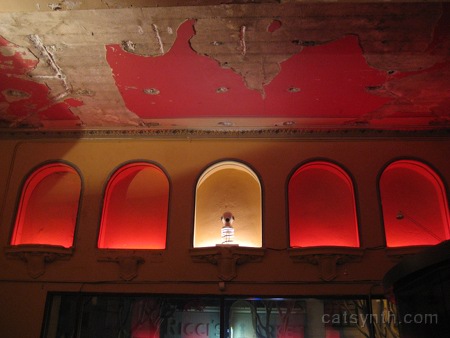
[click to enlarge.]
The Saturday performance opened with [ruidobello], aka Jorge Bachmann performing his piece Coleoptera_0909 for electronics and video. The piece centered around beetles, or scarabs, who are members of the biological order Coleoptera. Videos of scarabs were projected onto the screen. Some were crawling on skin, some were in dishes, a couple were on a corrugated cadrboard surface that resembled a Q-bert board. Initially the beetles were solitary, but then they started to appear in groups. One particular scene involved one poor scarab being madly chased and grabbed at by another (one can only speculate what was going on here). The sounds were based on recordings of natural sounds from scarabs. In the early part of the piece, the relation to the insect noises was quite transparent (i.e., it “sounded like insects”). Later on, the connection between the performed sounds and the original material became more abstract, and sounded like thick pads with delays, time-stretching and pitch-shifting effects. The piece ended with a scarab taking off in flight, and the sound following suit with an ascending glissando.
[ruidobello] was followed by an electronic performance of Gino Robair’s opera I ,Norton. It is an improvisational piece based on the writings of Norton I, “Emperor of the United States and Protector of Mexico”, and a famous character from San Francisco history. In 1859, Joshua Abraham Norton declared himself Emperor Norton I of the United States, and began to issue a series of decrees, including the dissolution of the United States Congress. The opera is based on the text from these decrees, but in an “open-ended structure [that] allows it to be assembled differently for each performance.”
In this version, Tom Duff played Norton I and read from his various edicts, while the spoken words are processed by three electronic performers Chris Brown, Kristin Miltner and Wobbly. Indeed. all the electronic sounds were based on Tom Duff’s voice. At first, the electronic manipulations kept the words intact through various delay, pitch and time effects; but over time the electronics became more complex, with delay lines or samples short enough for the snippets from the original voice to form completely different timbres, and as such became more detached from the stage performance. I found myself focusing heavily on the video work of Tim Thompson along with the theatrical performance, and the electronic sounds became part of the background. One particularly strong visual moment was when Tom Duff/Norton I built a small “city” out of colored translucent cubes and shining flashlights through them. This illuminated construction was then picked up by the video and projected onto the screen. There was a middle section in which our protagonist appeared to go to sleep (perhaps dreaming) and the electronic music became the focus, with the video playing against the sounds (which were still entirely based on previously sampled vocal material). There was an overall calm pace to the entire opera performance, punctuated by the dramatic proclamations and occasional abrupt shifts in timbre or visuals; and one simply became immersed in the whole experience.
Pamela Z concluded the festival with what she described as an “old-new sandwich” with several short pieces. The first “older” pieces included looped rhythms layered with rich vocal textures and harmonies, with one featuring a dramatic simulation of a manual typewriter complete with carriage return. There was a performance of a piece I had originally seen her perform at room: PIPES back in May. The next piece was the “new” part, a work in progress entitled Baggage Allowance. It opened with a video of a baggage carousel, with various people reciting the contents of their luggage (clothing, toiletries, books, etc.). The contents became a little more unusual over time, as people described confiscated items and even an attempt to hide a knife at LAX. A simulated x-ray of a bag included strange objects like a frog and a gun (actually, I suppose I gun isn’t all that strange). This was set against live electronic processing of vocals as well as other sounds such as the popping of bubble wrap. The final piece was another older work involving delays and dramatic harmonic vocals (it was originally done years ago with hardware effects boxes before being ported to modern laptop computers); as a representation of classic electronic music being redone with modern technology, it was a fitting conclusion to the festival.
From ChrisLody on YouTube, via matrixsynth.
Okay, so this is one of my more strange experimental ideas. The keyboard at the top of the screen (a Yamaha SY-35) is midi’d into the lower keyboard (a Novation KS-5). The KS-5 is programmed with a simple arpeggio patch I created which can be played from the SY-35. Then I covered the keys of the SY-35 with cat biscuits and let my kitten Daisy loose on it. I was then able to control some aspects of the sound with conrols on the KS-5. I think she got wise to me about half way through as she stopped standing on the keys. Damn kitty!