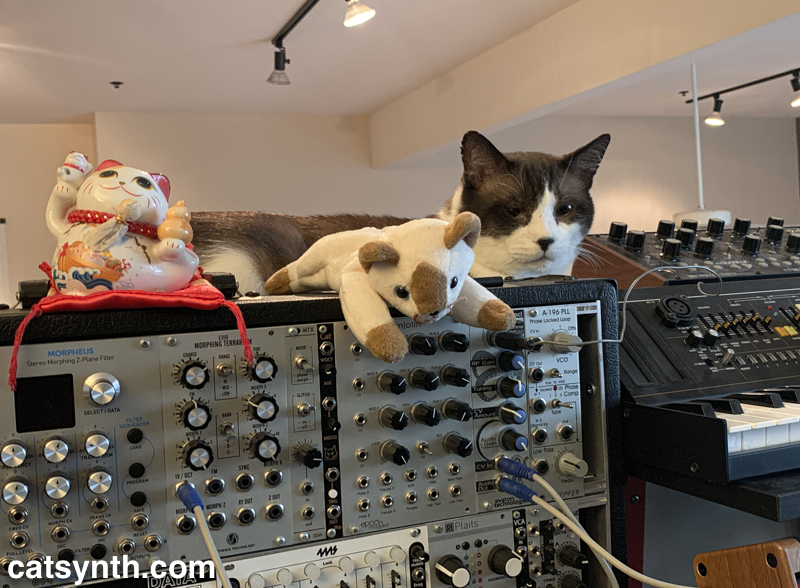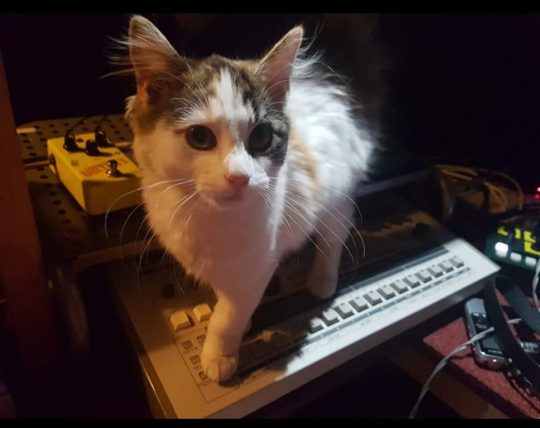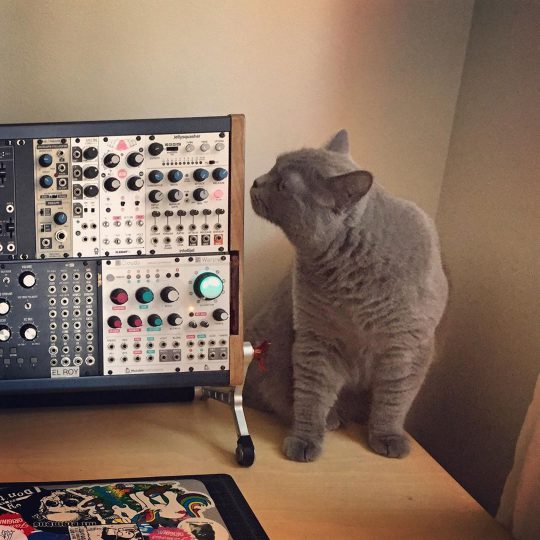
Zelda the Gray returns with a modular system featuring Mutable Instruments, Intellijel, Sputnik Modular, and more. From zeldagraymurphybrown on Instagram.

Zelda the Gray returns with a modular system featuring Mutable Instruments, Intellijel, Sputnik Modular, and more. From zeldagraymurphybrown on Instagram.
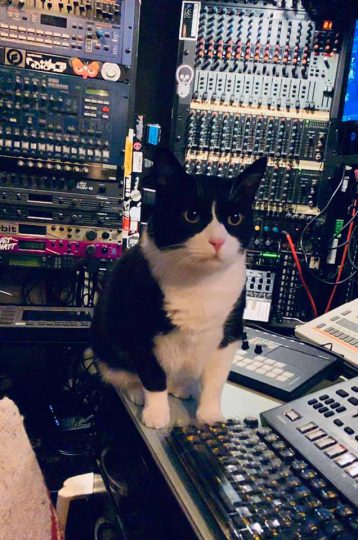
Meet Sascha, an adorable tuxedo cat in residence at Space Kitty in Seattle. Looking at their Facebook page, they have a rather impressive collection of synths. This photo only includes some of the rackmount and tabletop instruments, including several classic E-MU 1U modules and offerings from Roland and Korg.
Submitted by Neil Parker of Space Kitty via our Facebook page.
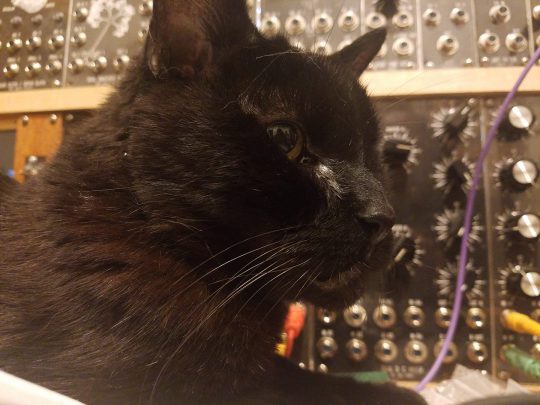
Today we feature this handsome senior house panther with a modular system. It looks it might be a Moog modular! From Teh Autowitch via our Facebook page.
The Mystery Cat! He’s around 19 years old, deaf, and very helpful.
We wish the Mystery Cat more years to come is his long life!
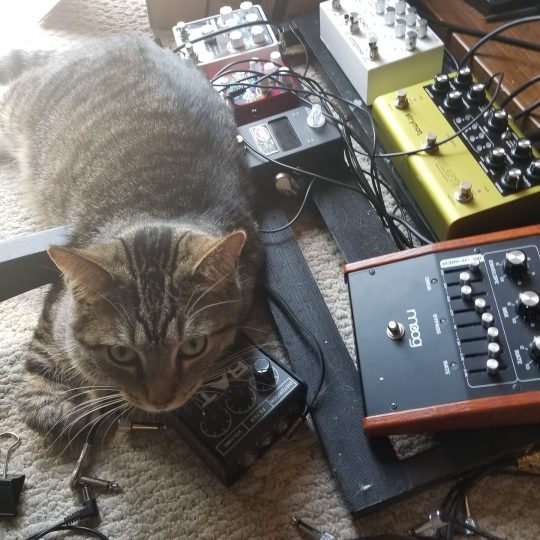
Banksy pounces on a RAT pedal alongside sundry offerings from Moog, Strymon and more. Submitted by Alberto Aldana via our Facebook page.
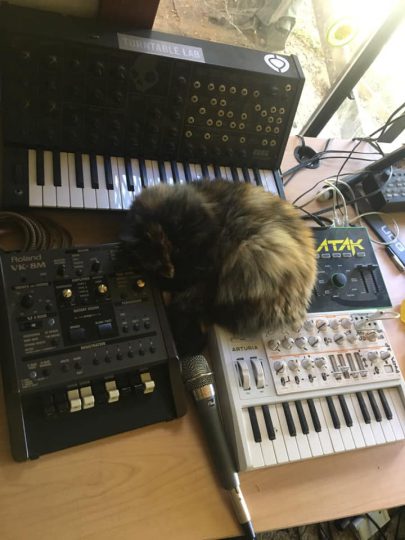
Meet Ms. Deucey, who has found a nice napping spot in between a Korg MS-20, white Arturia MicroBrute, a VK-8M from Roland, and something called “ATAK” 😸. Submitted by Elias Laughton via our Facebook page.
Here’s Ms Deucey, all of 13 years old, posing for the camera in my “pet free studio” 😬😬😬
Studios with cats are our favorite kind of “pet-free studio.”
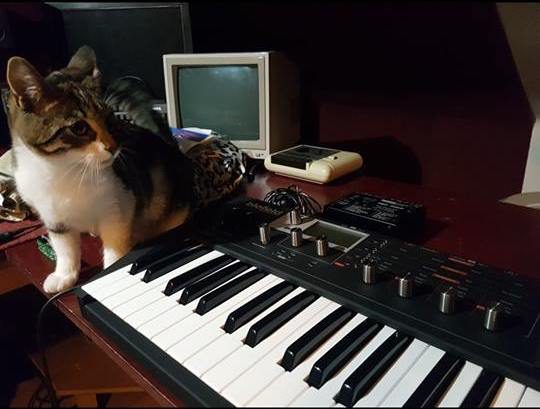
Boris checks out a Waldorf Blofeld synthesizer. Submitted by Edda Jayne Hill via our Facebook page.
A young and inquisitive Borris trying to work out the Blofeld.
I know he is more of an analogue cat tbh 😊
This past Thursday, the Center for New Music launched Compton’s Cafeteria Series, a set of occasional concerts featuring transgender performers. And I was there both the cover the show and be a part of it!
For those who are not familiar with the story, Gene Compton’s Cafeteria was a small restaurant chain and its Tenderloin location at the corner of Taylor and Turk Streets was one of the few places where transgender individuals, and especially transgender women, could safely congregate. There was, however, some tension between transgender patrons and the staff, who often called the police, with arrests and harassment ensuing. In 1966, this pattern led to the Compton’s Cafeteria Riots.
In the 1960s the Compton’s Cafeteria staff began to call the police to crack down on transgender individuals, who would frequent the restaurant.[8]Management felt that transgender customers were loitering and causing them to lose more desirable business. In response, they implemented a service fee directed at transgender individuals and blatantly harassed them in an attempt to get them to leave the restaurant.[8] In response to police arrests, the transgender community launched a picket of Compton’s Cafeteria.[9] Although the picket was unsuccessful, it was one of the first demonstrations against police violence directed towards transgender people in San Francisco.[9] On the first night of the riot, the management of Compton’s called the police when some transgender customers became raucous. Police officers were known to mistreat transgender people.[10]When one of these known officers attempted to arrest one of the trans women, she threw her coffee in his face.[2] According to the director of Screaming Queens, Susan Stryker, the cafeteria “erupted.”[5]
https://en.wikipedia.org/wiki/Compton%27s_Cafeteria_riot
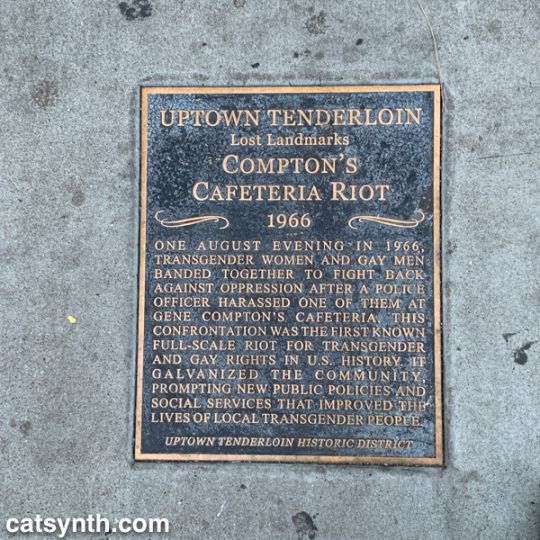
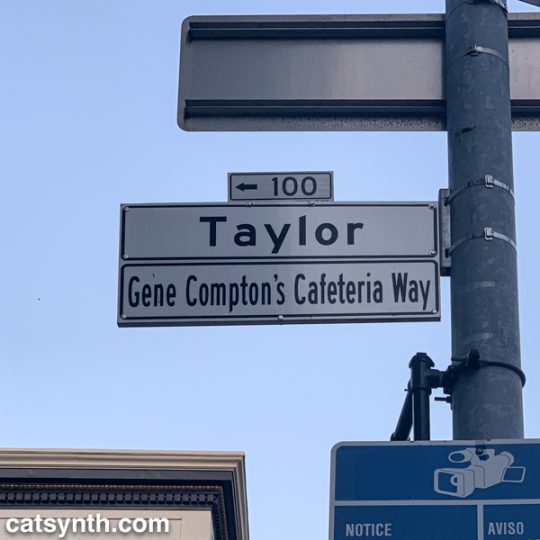
This was nearly three years before the Stonewall Inn Riots in New York but has not gotten nearly the visibility in the time since. There is a plaque on the sidewalk in front of the former site at 101 Turk Street, and there is now an honorary street renaming of the 100 block of Taylor Street as Gene Compton’s Cafeteria Way – we featured the sign in our most recent Wordless Wednesday post.
More importantly, the immediate vicinity has been recognized by the city as a “Transgender Cultural District.” As the Center for New Music is located in the heart of this new district, it seemed natural for them to host a series celebrating transgender visibility (and audibility), and I am grateful to the staff there and to my friend David Samas for proposing this and making it happen.
The show itself was a successful event featuring vary different performances, although they all made extensive use of hardware synthesizers. You can see some of the highlights in my latest video.
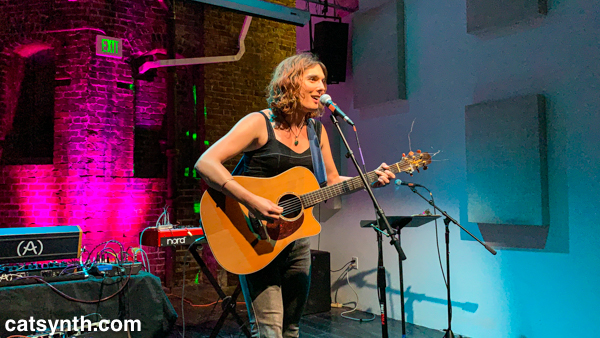
The evening started with a set by Rusty Sunsets (aka Cara Esten). Her performance was divided into two sections, the first featuring acoustic guitar and voice, and the second incorporating synthesizers and drum machines. Both parts were unified by Esten’s folk-song style, with a series of compositions about her upbringing in Oklahoma and loves lost and found. Perhaps the poignant was a love song inspired by the 1911 Triangle Factory fire in New York where 146 workers, the vast majority of whom were women, perished. My favorite was the final song which brought together a Moog Mother-32 and other synthesizers with plaintive but optimistic singing.
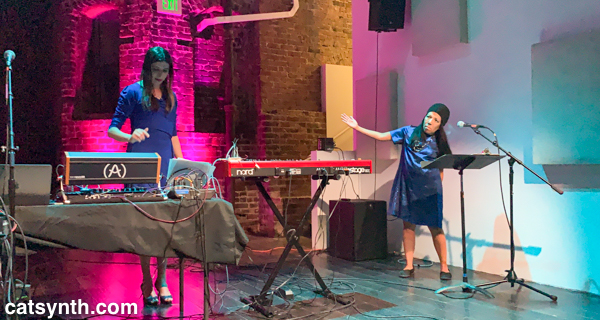
Next up was Pitta of the Mind (Amanda Chaudhary and Maw Shein Win). We performed a short set with a featured color of blue – set against the fuschia background lighting and my automated multicolor blinking lights. Musically, it had a very punctuated quality with abstract sounds from the modular and Arturia MicroFreak against some of Maw’s poems that featured open space and short lines. We mixed it up for the final piece, which had lusher and more emotive quality with longer lines and acoustic piano – these pieces are a strength for us and we always include at least one.
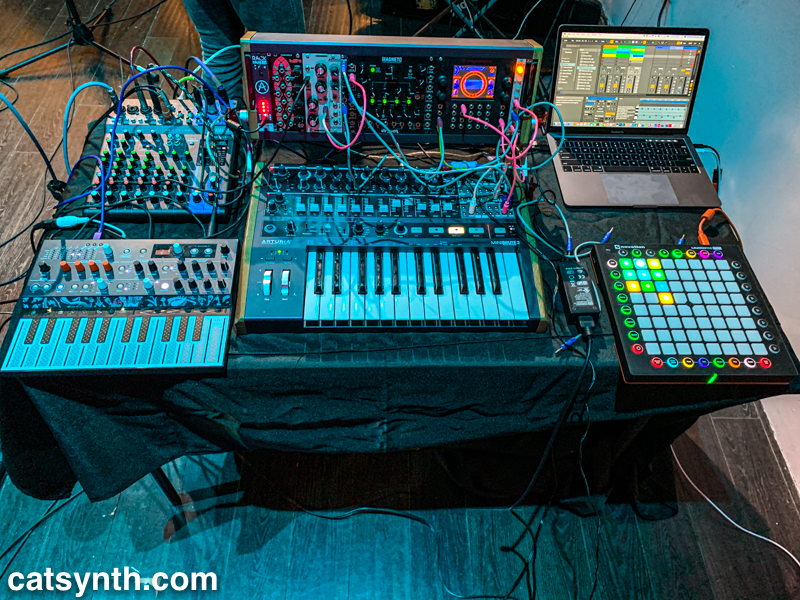
Then it was time for the final set, featuring my solo electronic performance. I started with the solo version of White Wine (and a cup of white wine). The Casio SK-1 was sampled and remixed in Ableton Live, with the statement of the melody and cords, followed by a cacophony leading into two distinct rhythmic sections: first a funk/disco sound featuring MicroFreak bass and a jazz piano improvisation; and then a Stereolab inspired electric-organ solo leading into a final section of tape-delayed metallic sounds (Strymon Magneto and Pocket Gamelan from Crank Sturgeon).
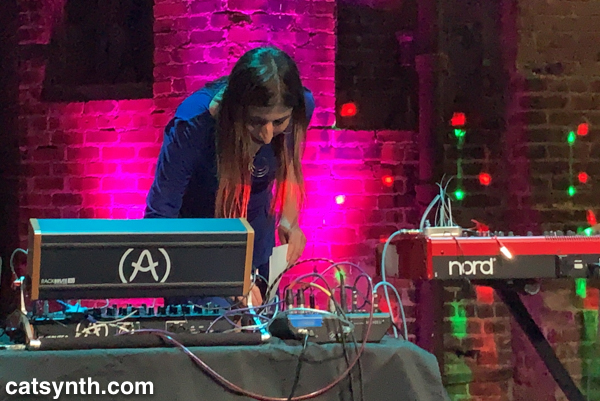
After that, it was on to the cat-infused and disco-and-French-House inspired Donershtik. The piece is just a lot of fun, a classic 70s analog melody (in this case on the Arturia MiniBrute) in Phrygian mode followed by playful modular improvisation (anchored by the MOK Wavewazor) going into the electric piano disco/house section.
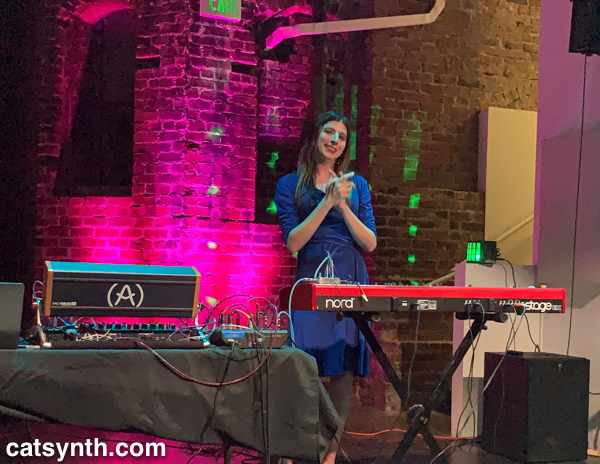
Overall, I think this was one of the best of my live solo sets, tightly choreographed with a relatively diverse and robust setup, and well-defined and well-rehearsed pieces. Once again, structure and hard work paid off.
But I also fed off the positive energy and enthusiasm of the crowd, which brought together regular friends and fans with members of the transgender community. It was a beautiful night overall, and I look forward to both being present and helping organize the next in this series.
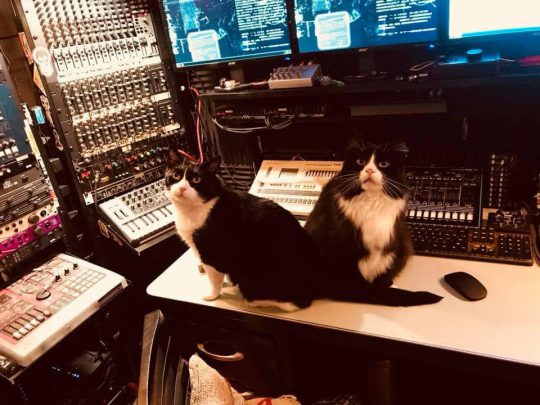
Blixa and Sasha hanging out in the studio. Submitted by Neil Parker via our Facebook page.
Identification of the synths and other gear in this picture left as an exercise to the reader.