Paul Stapleton improvisation sets, Luggage Store Gallery

Today we look back at a recent concert at the Luggage Store Gallery that featured composer, performer and musical inventor Paul Stapleton in three improvisation sets with a variety of collaborators from the Bay Area and beyond.

In all three sets, Stapleton performed on his “Bonsai Sound Sculpture” a contraption with various metallic and electronic elements, including bells, metal rods, a thumb piano and a turntable. While this provided a common grounding element for all three sets, it did not limit the variety of sounds or musical possibilities. It was apparent that Stapleton could explore quite a range of sound and musical structure within just a few minutes of the first set which also featured Ted Byrnes on percussion and Laura Steenberge on bass.

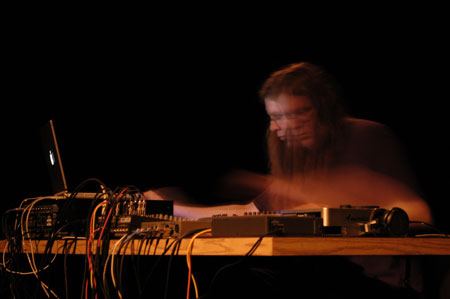
Paul Stapleton

The performance started off with frenetic motion before shifting into a software texture with gamelan-like sounds followed by percussive bowing of long tones. As the intensity ebbed and flowed, the most distinctive element was (for lack of a better term) the “turntable thingy” in Stapleton’s sound sculpture, though I did like the rhythmic work by Byrnes on the drums and how it played against the bells and other metallic sounds.

The next set featured Stapleton together with Edward Schocker on Asian wind instruments and Matt Ingalls on clarinet and violin. I have only heard Ingalls on violin a few times, but this was the instrument he used to open the set. He was then joined by Stapleton bowing a section of the sculpture and Schocker on a small reed instrument that I believe was a pir’i – the small instrument packed quite a punch with wobbly tones the weaved in and out harmonically between the long bowed tones. This gave way to a period of high scratchy timbres and then an interlude of rough metal thumb piano and Ingalls on clarinet. Schoker also switched to sho, a free-reed instrument, in a section with Stapleton that was more drone-like There was a varied texture over all, but some exceptionally loud sections.

The final set of the evening brought back Byrnes and Steenberge on percussion and bass, respectively, along with Matt Davignon on turntable and electronics and John Ingle on saxophone. Things got off to a staccato start, with lots of short notes, and turntable gestures. Indeed, one of the fun parts of this set was to hear how Davignon and Stapleton used their turntables differently, with Davignon using the instrument to manipulate recognizable recorded sounds with voices. The turntables also interplayed with cymbals and with vocalizations by Ingle. In addition to flurries of short notes, there were loud rough textures, a very “jazzy” moment, and static noise set against soft percussive tones.

The evening went by quite fast, with each set relatively short. But I thought it worked well this way, keeping up the energy and variety. Say what you need to say, and then stop. And on that note, we sign off.

John Cage at Tom’s Place

Today we look at last week’s performance at “Tom’s Place” in Berkeley featuring vocal and piano music of John Cage. Cage is of course one of my musical heroes, and his works for prepared piano are among my favorites.

The concert opened with two of his early pieces for prepared piano performed by Janis Mercer. Waiting (1952) consisted of a long period of silence followed by a short repeated phrase, followed by more silence. It could be seen as a stepping stone of sorts between Cage’s prepared-piano music and 4’33”, which was also written in 1952. Mercer also performed Bacchanale (1940), Cage’s first piece for prepared piano. It opened with dramatic repeated tones that evolved into shorter and then longer repeated phrases. The harmonies were anxious and fit with the timbre of the prepared strings. Prepared piano is sometimes called “piano gamelan”, and the name seemed appropriate for this movement, with its polyrhythms and complex minor harmonies. The following movement was much more percussive, with something that suggested bass and hi-hat.


[Janis Mercer. Photo by Michael Zelner.]

The concert continued with John Smalley performing Experiences No 2 for solo voice. This was the first of two pieces on the program that Cage wrote for Merce Cunningham dances. This one used a text by e.e. cummings. Musically, it had a static and yearning quality, with phrases having an “incomplete” feeling melodically.

This was followed by an untitled vocal interlude from Four Walls informally titled “Sweet Love”. It is a playful piece, both in terms of its music and text (which was written by Cunningham). The performance by Laurie Amat clearly brought out this quality.


[Laurie Amat. Photo by Michael Zelner.]

The concert resumed after a short intermission with In a Landscape featuring Mercer again on piano. Not only was the piano of the “unprepared” variety, the piece was actually quite tonal, with a dreamlike quality and something approaching a folk melody If I was presented the piece and asked to guess the composer, I would be more likely to say Debussy than Cage.


[John Smalley and Laurie Amat. Photo by Michael Zelner.]

The final piece of the evening was Litany for the Whale, song by John Smalley and Laurie Amat. The piece consists of slow vocalization of the letters of the word “whale” in call-and-response form over an extended period of time. The length of the piece (over twenty minutes) and slow motion make it quite challenging for both the performers and the audience. For the performers it was quite an endurance test and for those of us in the audience the challenge was to keep focused on it. What worked best was to go into a meditative state and focus on some details of sound while letting others simply pass.

The show was quite well attended with a full and appreciative house. Overall, I was glad I made the trip to Berkeley on a Wednesday evening to hear it.

2012 Outsound Music Summit Benefit Dinner, June 11

The 2012 Outsound Music Summit begins on July 15, less than two months away. And thus is it time for our annual Outsound Benefit Dinner. It looks to be a great evening of food and music, and this year it will be in the “CatSynth HQ neighborhood” of San Francisco, otherwise known as South of Market.

Once again, we will be treated to a culinary experience from chef Miles Ake.

The menu is still to-be-announced. And our music will be provided experimental electronic musician Thomas Dimuzio!

San Francisco-based Dimuzio is one of those unsung artistic figures whose influence and abilities have substantially outstripped his visibility. Composer, multi-instrumentalist, sound designer, experimental electronic musician, collaborator and mastering engineer – Dimuzio has been busy doing his thing(s) since the late 1980’s, but is still only known to a small circle of electronic music enthusiasts. A true sonic alchemist who can seemingly create music events out of almost anything, Dimuzio’s listed sound sources on his various releases include everything from “modified 10 speed bicycle” and “resonating water pipe” to short-wave radios, field recordings, loops, samplers and even normal instruments such as clarinet and trumpet. And while his wide range of musical interests make it impossible to pin a label on him, Dimuzio clearly has an insider’s knowledge of older experimental musical forms such as musique concrete and electroacoustic, as well as more current dark ambient, industrial, noise and post-techno styles.

We know that many who read this site love and support new music. Those in the Bay Area who would like to attend this benefit event can register here. If the benefit dinner is not an option, Outsound of course welcomes donations of any size to help make the Summit a success.

re:BOUND, visual and performance art at Live Worms Gallery

Two weeks ago I participated in a two-day opening with visual artist Yong Han and performance artist Jacqueline Loundsbury Live Worms Gallery in San Francisco. Together, we created an experience combining sculpture and two-dimensional artwork with music and performance art.

The overall show was anchored by Yong Han’s sculptures, paintings and drawings. The sculptures, which range widely in size, use a combination of metal, ceramic, beeswax and other materials. The two dimensional pieces were a combination of ink drawings and paint.


[Image courtesy of Yong Han.]

There are elements that are common in his work across media, including graceful geometric curves and lines with organic shapes and patterns seamlessly integrated. Indeed, some of the two-dimensional works appear to the shadows of his sculptures.

What particularly works for me in these pieces, whether two dimensional or three dimensional, is their simplicity. The lines and curves form repeating patterns and leave empty spaces; and the areas of color are simple and well-deliniated as well. Many of the pieces have a very delicate feel to them, but some of the more recent ones are very densely packed and suggest strength.

The basic structural theme of thin metal and curving lines carried over from the visual art to the performance aspects of the event, providing a level of continuity between the two. The first night featured Jacqueline Loundsbury in an improvised performance piece called re:BOUND where she wrapped her body in steel wire bindings. Large rolls of steel wire were placed around the performance space where she stood and visitors were encouraged to participate by taking pieces of wire and wrapping them around her bare body. Throughout this performance, she was quite exposed and accepted the risks of not knowing what participants might do – something taken to much more dangerous extreme by some of the early performance artists in the 1970s. Indeed, the resulting “wrapping” was less of a cocoon and more an overwhelming array of adornments, such as headgear and other decorative elements, some sexually charged. And the whole amalgamation of wire seemed quite heavy and uncomfortable. But she successfully completed the performance and the resulting embodied artwork fit well with the existing sculptural pieces. After extricating herself from the wire, some of the pieces themselves became independent elements (along with the unused wire) for the presentation on the next day.

The second evening featured my live improvised electronic music in the space with the artwork and a video projection of Loundsbury’s performance from the previous night. For the set, I used several iPad apps including Animoog, Bebot and iMS-20, along with the Dave Smith Evolver and a couple of newly acquired analog synthesizer modules, the Wiard Anti-Oscillator from Malekko Heavy Industry and the E350 Morphing Terrarium from Synthesis Technology. Overall, I intended the sounds to reflect the wire theme that was present in the sculptures, drawings and the performance, with sounds that were metallic, continuously curving, or otherwise reflecting of the other elements. You can see a short clip below of the video projection and the music-gear setup in action.

re: BOUND, with Yong Han, Jacqueline Loundsbury and Amar Chaudhary from CatSynth on Vimeo.

The improved music continued for the whole evening, about four hours in all, with breaks for selections from my CD Aquatic.

A decent number of people came through the show over the duration, a combination of people who knew advance from announcements as well as some who wandered in from the surrounding North Beach neighborhood and enjoyed the experience. I am glad I was able to participate, and look forward to working with both artists again in the future.

Other Cinema: Re-Tracked Animation, Artists’ Television Access

A couple of weeks ago I attended an evening of silent films and live music at Artists’ Television Access called “Re-Tracked Animation.” The program was part of the regular Other Cinema series that occurs at ATA most Saturdays.

As we arrived, there were old film clips (from the 1940s or earlier) playing with various soundtracks. The initial film featured a keyboard player wearing a turban (to look stereotypically “exotic”) set against something that sounded like the Chipmunks. The next short featured a more abstract grainy cartoon with figures made from simple geometry against a more electronic noise-based soundtrack – this one was quite interesting in itself. The final video, a very old Porky Pig cartoon, was played straight.

It was then time for the main features to begin. Jeremy Rourke presented several of his animated video pieces with live accompaniment on guitar, voice and percussion – specifically, singing bowls. His visuals combined found material, often with a “turn-of-the-20th-century” feel to it, with more contemporary video backgrounds and illustrations. You can see one of the videos, eyes hearing stars, in this clip below:

This one in particular featured some moments I referred to as “Monty Python meets Central Park” in that it reminded me a bit of Terry Gilliam’s animations, but the highly processed background of modern-day urban park video and abstract graphical elements give it a unique feel. Musically, the texture was sparse and worked in concert with the video rather than vying for attention away from the imagery, so the overall experience was quite captivating.

For his final piece, Rourke came on stage wearing all white and carrying an all-white guitar. It was clear that he and his instrument were going to be part of the screen for the next video, and that is indeed what happened.

The final video featured more live footage than his earlier animations, and the music was purely guitar-based.

After an intermission, the program resumed with a screening of the Brothers’ Quay In Absentia with music by Karlheinz Stockhausen. Regular readers know that Stockhausen is one of my musical heroes, so I was quite interested to see and hear this piece. The film, although done in 2000, feels like it is much older. The grainy images paint dark and dystopian visuals of ruined machinery against the main scenes of a woman in an asylum and her repetitive existence, writing notes on paper, placing them in envelopes and into a grandfather clock. The music, which is from Stockhausen’s piece “Zwei Paare”, predates the creation of the film, but they nonetheless work together well to create the overall haunting and eerie landscape.

The final set featured members of the ensemble Thomas Carnacki with Greg Scharpen, Jim Kaiser, Jesse Burson, and Gregory Hagan performing live audio tracks to two films. The first was Jan Svankmajer’s The Fall of the House of Usher, based on the Edgar Allan Poe story of the same name. The Poe story was read live by Dean Santomieri along with the music. The visuals featured an empty and abandoned looking manner home, perhaps how the House of Usher would look after the fall. It was forlorn and sad, but rich with texture. And Santomieri’s voice is always captivating in live readings.

The final piece of the evening featured the ensemble performing live to Ladislas Starewicz’ strange but delightful stop-animation film The Mascot. The film, which was created in 1933, features a cast of puppet dogs, cats, dolls, skeletons and any number of other creatures.

It is amazing to think what Starewicz was able to do in the 1920s and 1930s with his creations, without the aid of 3D computer animation or even more modern model-making done at special-effects houses. Below is a still from the original film:

The film is available on the Internet Archive (http://www.archive.org) in its entirety, so I will be tempted to try my own hand at an audio accompaniment for it one of these days…

Untitled Analog Modular Exploration

This morning we at CatSynth have a sound track for your enjoyment.

Last week I was finally able to start putting together my first analog modular system, inspired by my NAMM trip in January. So far I have installed two modules, a Wiard Anti-Oscillator by Malekko Heavy Industry and an E350 Morphing Terrarium by Synthesis Technlogy/MOTM. In this sample, they are modulating one another, with the “X-Y” output of the E350 as the main audio out.

I just let Pro Tools run as I was exploring. I expected to stop after a couple of minutes, but found myself quite enrapt. After ten minutes, I decided it was enough for this track and brought it to a close. I was quite happy with the result, and consider it to be a genuine work of improvised music.

I hope to start uploading more to Soundcloud and Bandcamp in the coming weeks.

ReCardiacs Fly, Surplus 1980, PG13 at Hemlock Tavern

Today we look back at ReCardiacs Fly’s show at the Hemlock Tavern in San Francisco last month. It was a great show of music in prog and post-punk styles together with experimental/avant-rock groups PG13 and Surplus 1980.

The evening opened with PG13, the “power trio” of Phillip Greenlief (saxophone), John Shiurba (guitar), and Thomas Scandura (drums). I had originally heard them a few years back at the Skronkathon. They did have the loud-rock-trio thing down at the time, but in the intervening time they have become more finessed and detailed without losing that original intensity.

[Photo by Michael Zelner.]

They opened with driving syncopated rhythm and power chords. The rhythmic textures brought all three instruments (saxophone, guitar and drums) together. This was undeniably rock – held together by Scandura’s drums – but later sections did have a more jazz-like quality, which I thought worked when done with sudden changes in volume and texture. I of course did like that one of their songs (composed by Greenlief) was The Totally Unbelieable but Absolutely True Adventures of George Cleaver the Cat. Loud music with complex rhythms about cats works for me any day.


[Photo by Michael Zelner.]

After PG13, it was time for us to take the stage. For those who have not read the previous ReCardiacs Fly articles, we are (possibly the only) tribute group for the UK avant-prog band Cardiacs. We model our line-up after the original band, and don suits and creepy theatrical makeup reminiscent of their appearance in the 1980s. This music is complex and intense, and challenging to play, but a lot of fun for us and for the audience when we pull it off. A few songs came out quite well at the Hemlock, in particular “Burn Your House Brown”, which you can see in this video:

“In a City Lining” also came out quite well. On a technical level, the sound was the best we have had for any ReCardiacs Fly show, with the mix between the amps, speakers and acoustic space balanced so that we could hear everyone even in the loud parts. And we were quite loud, appropriately so.

As always, the performance was full of energy, and we got a great response from the modestly sized but enthusiastic audience. The full lineup of the band features Polly Moller on lead vocals, Masc Laspina on guitar, Chris Broderick on saxophone, Tim Walters on bass, Amar Chaudhary on keyboard,
Moe! Staiano on drums, and Suki O’kane on percussion.

The final set features Surplus 1980, a post-punk project led by Moe! Staiano with a rotating cast of band members. This evening features Moe! together with Bill Wolter and Melne Murphy on guitars, with Thomas Scandura returning on drums and Jason Hoopes on bass.


[Photo by Michael Zelner.]

The band was incredibly tight rhythmically and harmonically, as if they had been playing these songs together for years. In particular, there is the challenge of getting all three guitars to be in sync, which they were able to do, will Bill Wolter front and center. And the group’s lyrics were often quite funny (this in the context of our just completed Cardiacs’ set). It’s difficult to recall any particular line at this point, but they definitely worked at the time. Most of the musical techniques were standard but with complex rhythms and phrases, but Wolter did have quite an array of effects pedals, and during one of the final songs Moe! pulled out a vinyl record which he proceeded to use on his guitar like a pick and destroyed in the process (the record, not the guitar).

Overall, it was fun night of loud rock music from friends and colleagues whom I usually here in more overtly experimental contexts. I hope our bands will get a chance to play together again sometime.

Rubber ()) Cement, bran(…)pos, Hora Flora at Luggage Store Gallery

Today we look back at a recent show featuring noise and theater at the Luggage Store Gallery, part of Outsound Presents’ regular Thursday-night experimental-music series.

The first set featured Hora Flora, a project of Raub Roy. Most often, we associate noise music with electronic affects, but this set focused on acoustic noise opportunities. It opened to the sound of electric toothbrushes on drums. It turns out this sound can be quite rich, and also quite loud at times. Over the course of the performance, he used other acoustic generators for excite the drums, most notably large colorful balloons.

The set continued in this way, with the balloons and toothbrushes on the drums creating ever changing acoustic noise drones, with other elements such as didgeridoo and portable cassette players layered on top. The cassette players were very deliberately placed at even intervals on the beam that spanned the length of the gallery in front of the audience. I was right near one of them, but the sounds were still quite subtle when combined with the overall drone texture.

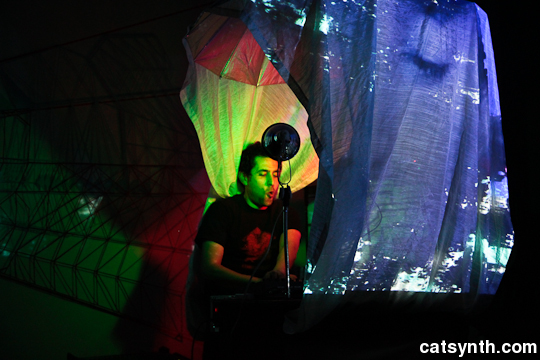
Horoflora was followed by bran(…)pos. I had last seen him perform at the 2011 Outsound Music Summit. Once again, he was performing from within a curtained space with video projections on the outside, but the setting was far more intimate setting. From my vantage point, I was able to see both his live performance “behind the curtain” as well as the enveloping video projection.

In his performance physical use of his face both generated and shaped the sound, which in turn controlled the video. The performance opened with expressive percussive sounds, which become more resonant through electronic processing and gradually formed a rhythmic pattern. It continued with a series of slurps, crunches and other forms of face percussion mixed with breath, voiced sounds and synthetic sounds. In addition to electronics for direct vocal processing, there were synthesizers as well, including an Access Virus:

Overall, the performance had the phrasings and overall structure of storytelling, but in a language whose words I cannot understand. It did come to a strong finish with growls and roars against a frantic thudding pulse.

The final performance featured Rubber (() Cement (pronounced “Rubber oh Cement”). The set was quite the spectacle, with a large costumed figure, a space creature of sorts, next to a towering old-school computer system made from cardboard. The visuals and sounds reminded me a bit of Caroliner Rainbow, but on a smaller scale, and on top of the audience instead of separated by a formal stage.


[Photo by Michael Zelner.]

Somewhere inside that lumbering lurching figure was a large custom string instrument. The plucking and striking of the strings formed the sonic base of the performance, which were both processed electronically and countered by other synthesizer sounds emanating from the “computer”. I suspected that the things would get quite loud, and indeed they did, with lots of loud shrieky pedal noises processing the strings and reprocessing themselves in complex ways. Of course the focal point remained the physical and visual aspects of the performance. In fact, that is a bit of an understatement, as part of the audience experience including being “attacked”. I got swiped at least once by one of the extending parts appendages, which are actually quite heavy – I was nearly knocked over. Things got a little crazier as the creature moved out into the audience. But it was all in good fun, and I don’t think anyone was hurt. Definitely an unusual experience for this series.

Overall, it was a great show attend, with different sites and sounds than usual. The audience was different as well, with the artists bringing their own followings. I hope to see more of them at other venues in the near future.

Flower Futures Futures: Our Reconnaissance Fly demo tracks

We have been hard at work on our first Reconnaissance Fly album Flower Futures this year. And things are coming together. We have put together this set of demo tracks Flower Futures Futures available as a free download. Enjoy!

A taste of our spong cycle and album-in-progress, Flower Futures. We set the fine spoetry found in our inboxes to music, reclaiming a sliver of botspace for humanity.
credits
released 29 March 2012
Chris Broderick: c-melody saxophone, clarinet, bass clarinet
Amar Chaudhary: electric piano, piano, organ, electronics
Polly Moller: voice, flute
Larry The O: drums, percussion
Tim Walters: bass, electronics

SIMM Series: Hay/Honda/Kuehne trio and Forward Energy

Today we look at a recent show in Outsound Presents’ SIMM Series that featured two different but energetic ensemble performances. Jim Ryan’s Forward Energy was back for a CD release performance. And they were preceded by a trio of Emily Hay on flute+vocals, Motoko Honda on piano, and New-York-based Valerie Keuhne on cello.


[Emily Hay and Valerie Kuenhe]

Before the show, I went up to the piano to take a closer look at the array of gear arranged on top, including a Korg Kaoss Pad and 4ms Noise Swash. These were used by Motoko Honda during the set, though she mostly used it to control audio from the other performers.

The set opened with cabaret-style piano (no electronic effects yet), joined by flute trills and melodies. Keuhne’s cello complemented Hay’s flute, but then grew more intense and frantic, eventually reaching high-energy “bow-wrecking” levels. Hay switched from flute to vocals that nonetheless retained a flute-like quality. The rhythm of the voice and piano were set strongly against the cello.

Keuhne started the second piece, again with fast bowing, harmonics and percussive effects. Her performance was forceful and featured rich tones. The piano and flute came in more subtly, with processing by the Kaoss Pad. It was easier to hear the electronics with the flutter technique on the flute and percussive vocal effects, with a variety delays, pitch bends and harmonizations. While controlling the effects, Honda continued her vigorous piano performance, using the inside of the instrument in addition to the keys.

Hay opened the next piece with flute mouthpiece and electronic effects. Here I think the 4ms pedal was being used, particularly on the buzzing effect of the low drone from the cello. The overall texture became quite noisy, but the vocals and scraping effects from the cello came through. The final section featured the full ensemble, and particularly forceful piano performance by Honda that included shaking the instrument. The ending was a little quieter from all, but nonetheless still vigorous.

After a short break between sets, Forward Energy took the stage in a performance celebrating the release of their new CD The Awakening. The group featured Jim Ryan on voice and saxophone, Rent Romus on saxophones, CJ Borosque on trumpet, Scott Looney on piano, Eric Marshall on bass, and Timothy Orr on drums.

The set started off immediately with a burst of energy. After this opening fanfare, the music relaxed into a fast jazz rhythm with repeating atonal patterns. The horns (Ryan, Borosque, Romus) took turns with solos separated by ensemble improvisation sections. There were passages where the three horns played together as a single instrument; and Rent Romus’ solo had a more soulful and deep quality compared to the overall frantic and anxious quality of the piece. Scott Looney’s piano solo switched back and forth between rhythmic chords and fast runs that I couldn’t possibly play myself. The bass solo by Marshall was accompanied by scraping metallic percussion and prepared piano, including drumsticks and metal percussion on the strings.

The rhythm section opened the next piece, with resonances in the piano and slow percussion tones. This eerie mixture was set against slow trumpet. Then all at once the ensemble started playing loud and fast. Then a sudden silence followed by prepared piano. It kept going back and forth this way, soft versus angry. I found myself particularly noticing the various gongs that Looney was using inside the piano to both visual and aural effect

The final piece was where the reeds pulled out their virtuosic techniques. Rent Romus played double saxophone (similar to a few nights earlier at the Music of Invention concert), and Jim Ryan launched into his poetry (one friend on Twitter referred to this as “Jim going bore poet”) with lines ranging from “Naked on the plane of full being” to “Did you ever see an elf die?” I can with all honesty that I have never actually seen an elf die. It was delightfully weird, and I think some of the lines took the other musicians by surprise. The prepared piano accompaniment was noisier and scratchier than in the previous piece, which gave the overall background a more staccato and pointed texture.

Overall, the performance did live up to the name of ensemble, and it was clear that everyone, especially Jim Ryan, had a great time with it.