CatSynth Pic: Loki and Waldorf Streichfett

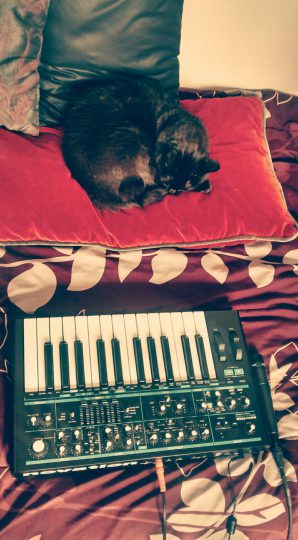
Loki poses with a Waldorf Streichfett synthesizer in a beautifully composed photo.  From Nicky Skolagava via the Facebook group Synthesizer Freaks.

The angle makes the Streichfett look large, but it’s a rather compact little box with an interesting story.  From the Waldorf website:

Streichfett combines the best of the previously extinct species of String Synthesizers of the 70s and early 80s. Its dual sound engine features a fully polyphonic strings section and an eight voice solo section, which is essential for recreating classic movie sounds from the 70s and 80s. The Ensemble Effect provides depth and movement to the String Section, while the Effects section adds adjustable Phaser and Reverb. Additionally, the Animate Effect can be used to modulate the strings registration, allowing spectacular sound morphs.

Programmed: Rules, Codes, and Choreographies in Art, Whitney Museum

We at CatSynth have long been interested in the intersection of art, technology and conceptual process.  Programmed: Rules, Codes, and Choreographies in Art, 1965–2018 surveys over 50 years of video, computational and conceptual art, cleverly weaving them together into a single narrative whole.  The three disciplines are united by the concept of a “program” or set of instructions through which the work of art unfolds, whether a computer program, instructions for a performance, or strict concept on a visual object.  Video and lights abound, but there is also painting, dance, and more.

Installation view.   Photograph by Ron Amstutz.

One of the artists who embodies the range of works is Nam June Paik.  Immediately on entry to the gallery, we are bombarded with his massive installation Fin de Siècle II.  Originally made in 1989, it has been beautifully restored for this exhibition.  It contains numerous clips from broadcast video and art video taken out of context and turned into a moving collage on a grand scale.

https://www.instagram.com/p/BqYA_d3BGHz/

At the opposite end of the video spectrum is his 1965 piece Magnet TV.  A black-and-white CRT television set is disrupted by a large magnet, creating a unique but sometimes unpredictable pattern that is in its way rather spare and graceful.

Nam June Paik. Magnet TV, 1965. Modified black-and-white television with magnet.

In the first piece, the process is in the composition, arrangement, and looping of the various video clips.  In the latter, it is the physics of the magnet and the CRT.

Motion and experiments with electronics are also at the heart of James L. Seawright’s contemporaneous piece, Searcher, which features gradual motion and changes in light.  The shadows it casts are also part of the experience of the piece.

There is an interesting juxtaposition of one Joseph Kosuth’s classic neon text pieces, Five Words in Green Neon, and W. Bradford Paley’s Code Profiles, a Java program that generates images.  They bring together the concepts of “text as art” and “code as art” – the message is the medium.

Joseph Kosuth.  Five Words in Green Neon, 1965.  Neon
W. Bradford Paley.  Code Profiles, 2002 and 2018.  Java applet.

Paley’s code may be one of the most literal examples of the exhibition’s theme, but code need not be computer code as we think of it today.  Many works from earlier periods were based on a series of instructions, where the instructions are the work and the performance or visual object are the expressions of said work.  One such example is Sol Le Witt’s sculpture Five Towers.  The three-dimension grids are assembled by a program with various combinations into a simple but beautiful result.  I particularly enjoyed looking through it.

Sol LeWitt.  Five Towers, 1968.  Basswood with alkyd enamel paint.

Josef Albers’ color-field rectangles can similarly be generated from a “program”.  Like Le Witt’s piece, one could conceive of doing something like this with a computer, but neither artist chose to do so, instead being themselves the interpreters for the code.

Josef Albers.  White Line Square VI, 1966. Screenprints on board

The performing arts have long been linked to programs, whether the traditional score or choreography, or more modern uses of algorithms or conceptual instructions.  Performance was most strongly represented in the exhibition by Lucinda Childs’ Dance, done in collaboration with Sol LeWitt and Philip Glass.  Childs, who is known for a precise and almost algorithmic approach to dance, choreographed a series of 5 pieces to a score by Glass.   She made drawings in different colors for the different movements and projected these onto the floor.  During the dance segments, the colors of her drawing were also used for the lighting.  Finally, LeWitt filmed the dancers, and the film was then projected behind live performers.  The documentation of this complex counterpoint was on display in the gallery, including the film, score, and drawings.

Philip Glass.  Score for Dance #1, 1979.  Photocopy with ballpoint pen.
https://www.instagram.com/p/BqX_IEFhkQC/

Program, object, video and performance also come together Lynn Hershman Leeson’s Lorna.  Lorna is an interactive video story on a laser disc (anyone else remember laser discs?).  Users can determine how the story unfolds through one of three endings via a remote control.  The screen and control are placed within a simulated apartment decked out entirely in leopard print, and the viewer is invited to sit in a comfy chair while the controlling the story.  This self-guided performance is at once programmed, but also immersive in that the viewer becomes part of the piece, both in space and in terms of control.

Lynn Hershman Leeson.  Lorna, 1979-84. Video, color, sound; with television, interactive laser disc shown as DVD, modified remote control, television cabinet, night table, end table, wood chair, upholstered chair, mirror, fishbowl with plastic goldfish, clothing, wallet, belt, shoes, watch, telephone, magazines, framed storyboards, and framed art

Video permeates the entire exhibition, popping up directly and indirectly in at least half of the pieces, or not more.  But video has many different aspects.  Is not a collection of discrete LEDs programmed to represent a moving image, as in Jim Campbell’s Ambiguous Icon #5 (Running, Falling), a video?  It is certainly a low resolution one, but this low resolution and discrete electronics allow us to see the individual elements that simulate movement in our perception.

Jim Campbell.  Ambiguous Icon #5 (Running, Falling), 2000.  LED lights and custom electronics.

We conclude this survey with a new site-specific commission by Tamiko Thiel.  She created an augmented-reality mobile app (in collaboration with developer /p) that overlays organic forms on the angular, geometric space of the museum’s outdoor terrace.  

Thiel’s organic growths are beautiful and playful, but also have a darker aspect.  Some resemble plastic refuse, and others coral formations.  Both are emblematic of the crises facing our seas due to pollution and climate change.  At the same time, the algorithmic process she uses, a formal grammar developed in 1968 by the Hungarian biologist and botanist Aristid Lindenmayer, is fascinating.

Tamiko Thiel  (with /p),  Unexpected Growth, 2018. Augmented reality installation, healthy phase. Commissioned by the Whitney Museum of American Art

There were many more works in this exhibition that we can discuss in a single article.  Each one had something compelling and different about it.  For anyone interested in or curious about these forms of art, I highly recommend checking out this exhibit! 

Programmed: Rules, Codes, and Choreographies in Art, 1965–2018 will be on display at the Whitney Museum of American Art through April 14, 2019.

CatSynth Pic: Modal Electronics Modulus 002 Unboxing

This cat is interrupting the unboxing of a new Modulus 002 synthesizer from Modal Electronics.  By Godric Wilkie via Facebook.

When the little thug isn’t swearing at Sascha, he’s sitting on my synths…

The “little thug” has stumbled upon an interesting instrument that we at CatSynth don’t know much about, but learning more here.  Now called a Modal 002, it’s a rather massive beast.

CatSynth Pic: Syd and Roland Juno 60

Syd struts down a Roland Juno 60 with maximum floof effect.  From Moustafa Ismail via the Facebook group Synthesizer Freaks.

A bit more on the Roland Juno 60, one of the classics:

Among the first in Roland’s amazing Juno family! Six analog voices of polyphony and patch memory storage!! The Juno-60 sounds great, however, like the Juno-6 it lacks MIDI control. The Juno-60 includes 56 patches of memory storage. The Juno-60 is still popular due in part to opinions that it sounds better (punchier) than the Juno-106. The Juno-6 and 60 are very rich sounding synthesizers and are great analog machines as long as you can withstand the absence of MIDI control. 

http://www.vintagesynth.com/roland/juno60.php

Toward a Concrete Utopia: Yugoslavian Brutalism at MoMA

We at CatSynth are admirers of brutalism, as anyone who follows us on Twitter can attest.  We love the geometric forms, how it screams “modern”, and how it makes such an intense break with tradition.  And I will admit, I also have a little fun using it to poke fun at the architectural conservatism prevalent in places like San Francisco.  But above all, it provides a singular beauty to built spaces.

Brutalism perhaps reached its zenith in the former Yugoslavia during the period between the end of World War II and 1980, a period that is highlighted in a current exhibition at the MoMA, Toward a Concrete Utopia: Architecture in Yugoslavia, 1948–1980.  It highlights the work of several Yugoslavian architects in the period and pieces ranging from prosaic apartments to public arenas to monuments.  The buildings themselves are, of course, not on display in the museum, but their stories are told through models, photographs, and examples of interior objects.


Installation view of Toward a Concrete Utopia: Architecture in Yugoslavia, 1948–1980, The Museum of Modern Art, New York, July 15, 2018–January 13, 2019. © 2018 The Museum of Modern Art. Photo: Martin Seck

A convergence of factors came together which allowed these modernist experiments to flourish.  Yugoslavia broke away from the Soviet bloc in 1948 and began to forge its own socialist path and identity.  It constituted itself as six republics in a federation in which traditional regional identities were subordinate to a new and modern whole.  At the same time, the country was devastated by World War II and needed massive rebuilding.  Finally, new ideas in architecture were emerging along with new materials, notably advances in concrete, steel, and glass allowed a new built environment to take shape.

The simple forms and surfaces were used for everyday buildings, such as apartment complexes, schools, and medical facilities.  But rather than just one-offs, they become part of a unified cityscape, a grand plan.  This was perhaps no more so than in Skopje, the capital of Macedonia, which was devasted by an earthquake in 1963 and largely rebuild using modernist design and principals.

Janko Konstantinov. Telecommunications Center. 1968–81. Skopje, Macedonia. View of the Southwestern Block façade. Photo: Valentin Jeck, commissioned by The Museum of Modern Art, 2016
MARKO MUŠIČ.  Photograph by VALENTIN JECK
Ss. Cyril and Methodius University Campus, Skopje, Macedonia 1967–1974.  (Gotta love an architect named “Music”)

There are, of course, numerous rectilinear designs, sometimes in steel and glass, and sometimes dominated by concrete.  But concrete also allowed for the exploration of curved structures and organic shapes.  We see this in many of the large civic arenas, but also in the brutalist monuments built in the post-war period.  This “cell-like” structure in Macedonia takes it to the extreme, looking at once like an organic organism and a spaceship.

Wandering through the exhibition, one cannot help but imagine being the real spaces.  For me, the modernist, severe style brings a sense of calm and welcome that more traditional styles don’t always provide.  Ornament can be beautiful, but it is rarely ever calming in the way that simple texture and geometry is.  The calming nature of simple forms can extend to the interior spaces as well as the exterior, and the exhibition includes examples of everyday objects and furnishings.

Installation view of Toward a Concrete Utopia: Architecture in Yugoslavia, 1948–1980, The Museum of Modern Art, New York, July 15, 2018–January 13, 2019. © 2018 The Museum of Modern Art. Photo: Martin Seck

Sadly, the Yugoslavian experiment ultimately failed, with country breaking apart and the entire region plunging into extreme nationalism and devastating wars in the 1990s.  This is a cautionary tale as we watch the plague of nationalism rising around the world, including in the United States.  Many of the architectural works in this exhibition did survive the wars.  But they do face continued challenges to their survival, including maintenance and a push to return to more “traditional” forms.  The “Skopje 2014” initiative, for example, is both farcical and tragic.  Despite these challenges, I hope the countries of the region will recognize and preserve the legacy of their modernist period for years to come.

This article only scratches the rough, hardened surface of the wealth in this exhibition.  It was truly a wonderful experience, even if so much was in my imagination through the artifacts.  Toward a Concrete Utopia: Architecture in Yugoslavia, 1948–1980 will be on display at the Museum of Modern Art in New York through January 13, 2019.

Happy 2nd Gotcha Day, Sam Sam!

It’s been exactly two years since Sam Sam made the long trip from southern California to come live with us at CatSynth HQ!  And not a day goes by that we are not grateful to have her in our lives.  I’m pretty sure she feels the same way.

Sam Sam checking out the next studio setup

Samantha, or “little Sam Sam”, had a complicated life.  She started out (as far as we know) in the suburbs south of San Francisco, and then moved with her human to the high desert north of Los Angeles – we like to joke that she lived “out in back of Palmdale where the turkey farmers run” in tribute to one of our musical heroes, Frank Zappa.

When her human passed away, she then went to live with his sister, also in southern California.  Unfortunately, the sister’s health was declining and another cat bullied Sam Sam, so this was not a happy chapter for her.  As her new human was preparing to go into assisted living, Sam Sam needed a new home.

In December of 2016, I was still deeply grieving after Luna’s death – and also reeling for the shock and horror of the election.  I hadn’t yet prepared to welcome another cat into my life, but when a friend and bandmate reached out to me that he needed to find a new home for a sweet cat whose human was headed to assisted living – and then shared her adorable photos, I said yes.  How could I not?

At first, Sam Sam was exceedingly shy and skittish, spending most of her time hiding under the bed, coming out only for food, water, and the litter box.  She was mostly silent but occasionally emitted these tiny squeaks.  As she adjusted to her new home, her personality blossomed.  She’s quite friendly, vocal, outgoing, and quite a ham.

Sam Sam scratch-n-roll

And she has no trouble demanding exactly what she wants from her humans.

“I want food nooooowww!”

We close with this episode of CatSynth TV featuring Sam Sam is all her adorableness.

Please join me in wishing Sam Sam a very happy Gotcha Day!

CatSynth Pic: Miko in the Studio

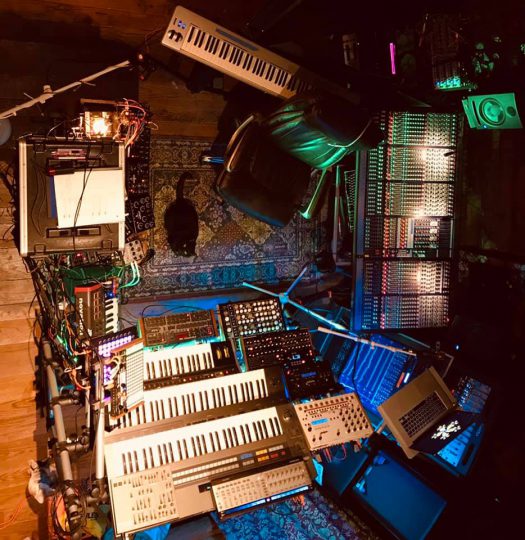
Meet Miko, another of the cats that lives with our friend Charles Whiley in Arkansas.  She assists him in the studio as he produces his wild synth jams; and she is absolutely adorable!

You can see Whiley’s previous contributes to CatSynth via this link.

Identification of the synths left as an exercise to the reader.