

Author: catsynth
CatSynth pic: Grainslide for Monome
From the B-Roll, via matrixsynth:

“…a friend and fellow monome user Jared just recently released his new monome app called Grainslide. I tested an early version of the app on Day 213 and he has since made adjustments and released it to the community. It’s a simple but effective concept. His layout design is unique to most other monome apps which I think is great. It’s not a quick sample cutting app although you could play it that way. It’s a layering tool really.”
I am curious to check out Grainslide. The mlr application that I often use with the monome would be the quintessential “sample cutting app” – it has worked well for me in live performance, but I really have only scratched the surface on what I can do with this controller.
Jonty Harrison at 2011 San Francisco Tape Music Fesitval
On Sunday night I attended the final performance of the San Francisco Tape Music Festival. This performance featured a retrospective of works by composer and “sound diffusion guru” Jonty Harrison. He was visting from Birmingham, England, and on site to present his pieces and personally mix and diffuse the sound in the hall.
“Tape music” of course need not be on audio tape – indeed, all the pieces in the performance were rendered from digital media on a laptop. Indeed, it would better be described as “sound diffusion performance”, in which pre-recorded media is mixed and rendered via a large speaker system into a concert hall. The immersion in the sound coming from the speakers and the fact that this experience is shared with other audience members, makes this a true performance rather than simply listening to a CD on a home stereo system. Additionally, the active shaping of the sound via live mixing and diffusion makes each performance unique – the speakers are the instrument. The environment at the theater at Fort Mason was relatively comfortable for listening, and the concert featured a state-of-the-art 18+ speaker sound system. I was fortunately able to get a seat towards the center of the hall in order to get the full experience. One of the other motivations for performances with pre-recorded media was that many electronic sounds could not be rendered in real time on available technology, although that limitation has diminished. It was probably the only way for Harrison to realize his 1982 piece Klang, but my sense is that portions of his 2004 piece Rock’n’Roll could have potentially been done in real time, albeit without the precision of pre-recorded media.
Klang opened the concert. It began with a sound that suggested a metal or ceramic kitchen dish – the program notes say that it was in fact a casserole. At first, the connection to the recordings was quite transparent, as if listening to an ensemble of invisible casserole performers. But over time it diverged from the original, with more time stretching, harmonization and other effects and layering into larger structures. This builds up to a climax of pitch-shifting sounds that seem more water-like than casserole-like before returning to the original sound alone for the conclusion of the piece, I liked the way Harrison built up the piece from a single simple sonic idea – a compositional technique that he employed for all the pieces presented this evening.
..et ainsi de suite… was described as a “French Suite rather in the manner of the musique concrete tradition.” It is based on a series of acoustic recordings of rough wine glasses that were transformed through a variety of signal processing techniques to form a series of movements. Like Klang, it featured an exposition and recapitulation of the original sounds, but I did not get an overall narrative of the other movements, which featured more signal processing. Instead, I found myself getting lost in the sounds, which is not necessarily a bad thing.
The next piece, Rock’n’Roll, was the most recent of the pieces in the concert, composed in 2004. It is based on the sounds of a “garden roller with a concrete wheel” and the ensuing sonic mischief when trying to roll it around the composer’s garden pathways. I had to do a Google image search after the performance to find concrete garden roller. It seems that these are more commonly found in the UK. Nonetheless, the sound of rolling concrete against stone does provide for a rich source of material as does the sound of falling and breaking rock. This piece kept close to original timbres, though Harrison did explore time and especially space with advanced mixing and diffusion into the 8-channel array. By mixing the sounds spatially, sublet timbral effects can be achieved, and the listener is not watching a garden roller but instead listening from within a pile of falling rocks.
It seemed that each of the pieces followed the pattern of exploring a particular physical material: ceramic, glass, concrete/stone. The next piece Stream was all about water. However, while it was initially quite recognizable as water, the sound quickly took an otherworldly quality – the listener was immersed in an environment that was unmistakably liquid, with bubbles and burgled and undulating waves, but unlike any natural aquatic environment on Earth. Once again, I got lost within the sonic environment and lost track of the details and progression of the piece – although it did quite loud at times.
The final piece Hot Air was a bit of a departure, and felt like it had a more dynamic sound pallets and musical structure. It was nominally based on another element, air, but the sonic source material seemed more varied than inth previous pieces. There were direct references to air, such as stretching balloons, whistling sounds, and things being hurled through the air. But the timbres also had a very machine-like and industrial quality at times, and these were things that I visualized while listening to the piece. Large industrial machinery, neon electrical signs, etc. But every so often a clear reference to air came through, and some of the moments with balloons or other objects were quite comical. I even heard some of my neighbors in the audience laugh.
During the intermission, I viewed several works of visual art by Aaron Finnis based the concept of tape. Basically, he used magnetic tape on paper to create minimalist textures of vertical stripes.
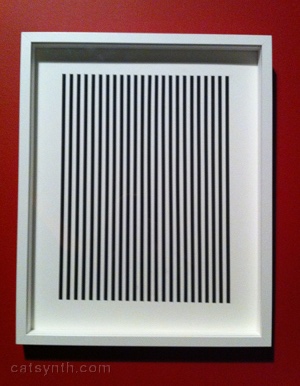
[Aaron Finnis, Modulation 2000 (2MB R-T-T-Y).]
The simple texture and geometry and connection to the festival theme was itself interesting, but there was an added dimension when one matched the titles to the works. The titles, included information about the tape used, such as capacity in megabytes for data tapes, or duration in minutes and seconds for audio tapes. For example, FIELD 9000 (9MB, ASCII Colors) described the data size and content of the media, although the media was now a visual art material and perceiving the content was not a possibility. Additionally, three of the cassette audio tapes seemed to be drawn from recordings of pure tones, with labels such as SPACE 440 (4.00 mins, A400).
Weekend Cat Blogging #292: at rest
For today’s Weekend Cat Blogging, we see Luna enjoying a nap:

It seems like she has been resting a lot lately. It’s been cold, it’s been dark, she is probably channeling some of my own fatigue, and of course she is a cat.
We were briefly jolted yesterday by a 4.1-magnitude earthquake in the Bay Area. It was relatively long, but still quite mild. Luna was on alert though, her ears pointing straight up and her eyes growing exceptionally wide. She did not run for cover, though.
Weekend Cat Blogging #292 is hosted by Kashim, Othello and Salome at PaulChens FoodBlog ?!. I quite like the monochrome graphic they created for today:

The Carnival of the Cats will be hosted by Billy SweetFeets.
The friday ark remains on hiatus.
CatSynth pic: Caliope with tone generators and effects

Wordless Wednesday: Doll and Metal Beams

Rent Romus and Emergency String (X)tet, Meridian Gallery
Last month, I attended the CD release of Emergency Rental at the Meridian Gallery. Emergency Rental is a collaboration between the Emergency String (X)tet and Rent Romus “exploring sound in and outside the elements of free improvisation between saxophone and strings.”
The personnel for the Emergency String (X)tet changes (hence the “x”), but does have a stable core of regulars. Founder Bob Marsh was joined by Doug Carroll on cello, with Adria Otte, Angela Hsu and Jonathan Segel on violins, Kanoko Nishi on bass koto, and Tony Dryer on contrabass.
Overall, the music moved back and forth seamlessly between free improvisation with extended techniques and passages that borrowed from more idiomatic jazz ideas. Early on, there was a bit of a shuffle beat and jazz-like saxophone lines set against more anxious tones from the strings, a mixture of both long tones and pizzicato. There were times when the saxophone and strings seemed to match one another in both tone and musical structure, such as a section that featured glissandi and scraping tones. The next section featured long bass notes and more scratching melodies set against a very lyrical saxophone line. This gave way to loud growling saxophone against a rich pad of strings.
One piece focused on extended techniques, including prepared strings with chopsticks and other items placed between the strings and bodies of the instruments – something I have often seen the Emergency String (X)tet do. Doug Carroll also reoriented his cello upside-down and sideways at various times. Romus played his saxophone without a mouthpiece, blowing directly into the body the way one might on a brass instrument. He also used a sound that I dubbed the “angry breath noises.”
The second half started off very percussive, and even though the ensemble was entirely acoustic, this section reminded me of the analog electronics in early electronic music like Stockhausen’s Kontakte. This segued into a more idiomatic duo of saxophone and walking bass was set against atonal glissandi from the other strings. There were other interesting sections, such as a syncopated rhythm that came together and broke apart, and a section of pure percussion by all the instruments that reminded me of tapping and bouncing balls.
Emergency Rental, which marks Romus’ 25th album release, is available from Edgetone Records.
CatSynth pic: Bella
Submitted by Alessandro Cilano:

here’s my cat Bella, sitting on the chair of power at my desk.
She’s grumpy as there are too many places to fill in my modular and she’s not allowed to play with the patch cables…
We have seen some pictures in the past of his cat Guiliano.
If You can’t find that perfect setting on Your Synthesizer, try using Your Cat.
Weekend Cat Blogging: New Year and Photohunt:Fuzzy
We at CatSynth attempt to wake up to the new year…slowly. Here is our first published photo of 2011:
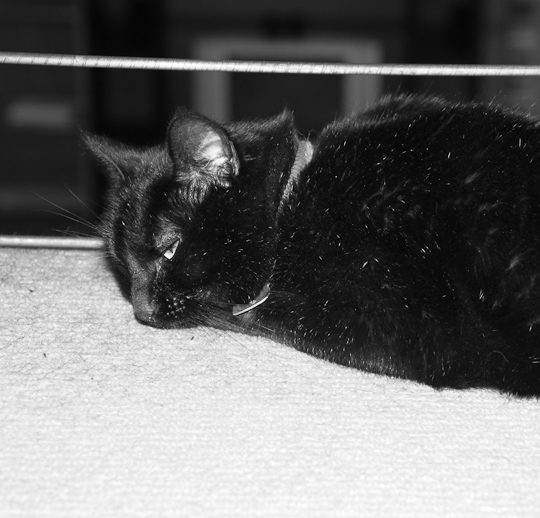
The theme of this weekend’s Photo Hunt is fuzzy, which is easy with Luna around. One can easily see the fuzziness of her thick winter fur. Cats do seem to get thicker fur in the winter…and contrary to stereotypes, we do have a winter season in California.
This may end up being about as much as we do today.
Weekend Cat Blogging #291 New Years Edition is hosted by Pam and the cats at Sidewalk Shoes.
The Photo Hunt is hosted by tnchick. This week’s theme is Fuzzy.
The Carnival of the Cats will be hosted by Nikita Cat.
And life goes on…