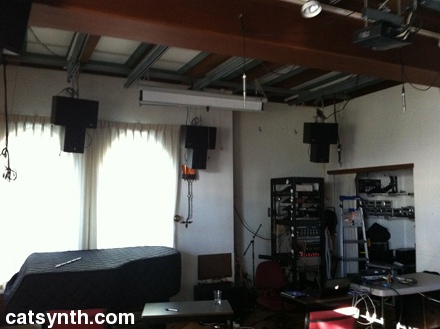
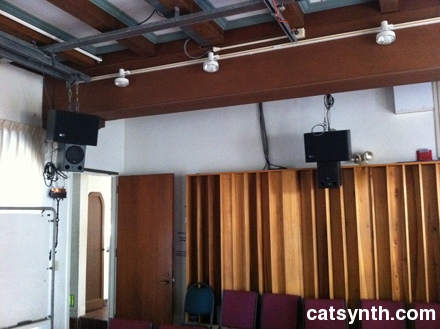
Preparing for tonight’s performance

I will be performing tonight in Oakland at Rooz Cafe (1918 Park Blvd, Oakland, CA) at 7PM tonight. Details below:

A rescheduling of a an old date, remade in Rooz-y glory:

-Zeina Nasr
Emphatic, ethereal vocalisms

-Amar Chaudhary
(www.amarchaudhary.com/)
Complex, articulate solo work with an electronic aesthetic

-Karl Evangelista/Shaun Lowecki/Sean Peterson Trio
(www.karlevangelista.com)
(www.shaunlowecki.com)
-Animated, explosive inside/outside music

I have been busily preparing today with a small setup, similar to one I had planned for January 17:

Once again, I will have the monome controlling the MacBook, primarily for live sampling and looping today. I will be using the dotara, an Indian folk string instrument, as one of the live sample sources. I will also bring a bell and the prayer bowl as live sources. The iPad will be running Curtis, which gets more an more advanced with each upgrade and is becoming a true musical instrument. I will also be using TouchOSC to control Open Sound World, including a brand new implementation of my piece Charmer:Firmament for iPad, replacing the retired Wacom graphics tablet. This is a dry run for the big concert next Friday (March 4), so we’ll see out it goes.

I had been hoping a new contact mic would arrive today – I am considering that for March 4 as well – but of course FedEx showed up just while I was out at an important art-related meeting, so I missed it and they are the one courier that won’t leave things. So I will be using an ordinary mic once again for the live sampling/looping – maybe it’s for the best.

Update: Just as I finished posting this article, a package arrived.  Not the contact microphone, but it was an exciting new toy, the Wicks Looper.

You see previous CatSynth pics and videos with this and related devices via this link (the cat in most of these is also named Luna). I have been considering getting one these for a while, and the current run of performances provided the impetus.  Although I have not yet played it, I am seriously tempted to try it out for tonight’s set.  After all, what’s the worst that could happen?

Zimoun and Jim Haynes at Swissnex

In mid-January, I had the opportunity to see a performance by Swiss artist and instrument-maker Zimoun and local artist Jim Haynes at Swissnex here in San Francisco.

Swissnex is tucked away on quiet block in a “neutral zone” between the FInancial District, Chinatown and North Beach (an area I enjoy passing through on some of my long walks). The space is very minimal and stark white, with bits of the structural architecture and industrial quality of the building present. Within this space, a large array of music-making machinery was set up. One one side was Zimoun’s very minimal instrumentation, and on the other the chaotic array of gear and elements that would make up Haynes’ performance.

Zimoun’s instrument was incredibly simple, a series of cardboard boxes on top of which were mounted ping-pong balls on motorized arms. The boxes served as resonant chambers for the excitation of the ping-ping balls.


[Click to enlarge.]

The performance unfolded as simply as the instrument itself. First, one of the five units began to vibrate, producing a low rumbling sound. Gradually the other ball+motor+box elements entered the mix, producing an odd harmony of machine noises. Out of this combination, I heard a higher-pitched metallic sound. I am not sure if this came directly from the machinery of the instrument, or was an acoustic artifact from the interaction of the different sounds. That is one of the interesting things about having such a minimal concept behind a piece, it allows one to focus on the output and explore minute details that would often be lost in a more complex performance. The piece continued as continuous sound, without much in the way of change or development, for about twenty minutes. The combination of the sound and visual environment allowed for a few minutes of peaceful detachment and I was able to experience it purely as signal and image processing without social context.

Jim Haynes’ performance was a sharp contrast to Zimoun, both aurally and visually. His table was covered with a diverse array of audio devices and lab equipment.

[Click to enlarge.]

At first, I took the metal column and rings to be a custom-made theremin of sorts before realizing that it was the rings and tower familiar from countless science classes.

After an initial burst of loud noise and feedback (which reassuringly let us all know that “yes, this thing is on”), the sound unfolded as an exploration of traditional elements, notably fire, air and earth. He opened with fire, specifically from the flame of a lit candle. He latter added sand, which poured from a bottle he placed on the metallic rings so that the sand could gradually fall out onto a contact microphone. While Zimoun’s performance invited detachment, Haynes’ required close attention. Many of the sounds that emerged seem closely related to the elemental sources: from the fire a series of crackling sounds and wind sounds from the excited air, and from the sand a sea of granular noises that could at times seem like liquid. But there were other sounds as well, the sound of ambient radio static, something akin to vinyl noise, a high-pitched shaking sound, and metallic rattling. Whether these were directly from the fire and sand or from the BOSS Dr. Sample and associated effects boxes is unclear.

This performance was in many ways a preview for Zimoun’s exhibition at the Gray Area Foundation for the Arts (GAFFTA) which opened a few days later. That exhibition is still ongoing and will close on on February 22nd. Follow the link for more details.

CatSynth pic: Diego and Befaco Slicer Prototype

From comun y corriente, via matrixsynth:

Googlish translation from matrixsynth:

The other Diego had domestic problems that will prevent you bring your Spanish guitar, so you will be forced to play with this wild animal.

And another picture from amstrad on flickr, featuring Kiska:

Finally, an update from c+c via the comments on matrixsynth:

ust a brief explanation of what was going on here… This was published a couple of days before our first Corrientazo, a concert featuring many musicians using compact synthesizers and DIY stuff. So we were announcing that Diego, from Befaco, was going to play with a prototype of their new Slicer / 8 step sequencer, to be released later this month (more info soon!).

Then I heard news from Amstrad that he was no longer going to play spanish guitar + MFB 522 in the concert, because the cat ate the guitar! So he brought his DIY modular, from the Befaco workshops, instead; and played it via MIDI from his iPhone!”

I would be curious to hear the iPhone + Befaco performance…

Ivy Room Hootelatkenanny, December 2010

Today we look back at the Ivy Room Hootelatkenanny, the December edition of the Ivy Room Hootenany improvised music series. The Ivy Room in Albany, CA, has in fact turned into a great venue for new music, with many performances even beyond this long-running series. The combination of music, mixed drinks and quirky decor seem to come together.

Despite the play on words in the title, there was nothing Hannukah-related about the performances that evening.

The first set featured a quartet I put together with Bill Wolter on guitar, Dave “Djembe” Coen on percussion and JP O’Keefe on drumset. Gear-wise, I kept things pretty minimal, with just the Dave Smith Evolver and the iPad running Curtis and the Korg iMS-20 apps.

I started out the set with my usual metallic patch on the Evolver, and quickly added granular sweeping with Curtis. Slowly the percussion came in, with soft rolls on the cymbals and djembe. As Bill Wolter with soft chromatic harmonies on guitar, I switched to a different Evolver patch and to the iMS-20 with some analog-like arpeggios. These set up a rhythmic foundation which the drums matched with a strong 16-note rhythm – the tempo and pulse were reminiscent of disco but texture and individual rhythmic phrases were more complex – something akin to 1970s fusion. The iMS-20 served as a de facto bass with heavily filtered patches set against the guitar improvisation – at various times I opted for a softer tone like an electric bass, others a highly synthetic sound like a “techno bass.” Harmonically and melodically, we danced around blurs, pentatonic, chromatic and tri-tone patterns against the ever changing but steady pulse rhythm of the two percussionists. At one point, Bill started playing the strings below the bridge and I used this sound effect opportunity to return to Curtis. We kept the pulse going for a bit, then cut out for a quiet moment. Then the rhythm gradually re-emerged, a bit more tribal and accented off beat, and with more inharmonic timbres on synth and guitar. Then we returned the jam feel with guitar, bass and drums, and continued in one of these patterns or another for the remainder of the set, at one point switching to a 6/8 rhythm with a more humorous sounding synth line. I have to admit, this was one of the most fun I have played in a while, both idiomatic and experimental at the same time, both completely free-form and rhythmically structured. I will have to get this quartet back together again sometime soon!

We were followed by the duo of Kenneth and Kattt Atchley. Their music also combined experimental electronic elements with a strong idiomatic style, in their case something reminiscent of late-night electronic music at dance clubs or lounges. They did several distinct pieces during their set. The had a slow steady rhythm with soft electric-piano chords set against analog or analog-like electronic sounds, relative high pitched with pitch LFO. The chords and rhythm continue in a very moody, almost R&B fashion while the high pitched electronic sounds ride above more rapidly. Then all at once it stops, replaced by a very distant-sounding synth pad, and the voices and poetry returned amidst the sparser texture. The music moved back and forth seemelessly between these two overall textures. Kenneth and later Kattt at various moments intone “I wouldn’t change a thing” and descriptive phrases about “East Bay nights” and “Pacific Fog cooling the air”. The texture eventually gave way to harsher electrical noises and pulsating sounds that still have a harmony of their own – and one can still hear minor chords in the background. When the chords and rhythm return to the forreground, there are a bit more fragmented than before.

The next piece was entitled Over Ice. It started with very liquidy and crystalline sounds, with words and melody in a descending minor scale. There was something vaguely religious or spiritual sounding about this pattern, almost like a chant. A sparse rhythm emerges, and the high crystalline sounds remain in the background. It eventually because very abstract, with electronic hits and noises sounding at first in a random pattern that gradually becomes more rhythmic. After a monologue section, the original melodic pattern returned, but with a more rhythmic foundation.

The final set featured Dean Santomieri with Michael Zelner on reeds, and Suki O’Kane “massaging the skins”, i.e. on percussion. It consisted of improvisation around a series of poems featuring “spine words” and “spine phrases” based on Jonathan Franzen’s best-seller Freedom. Things opened with resonating cymbols and Santomieri’s introductions, followed by the initial poem based on the spine word “Franzen.” The music consisted of short clarinet and percussion phrases filling in the spaces in between Santomieri’s words, with some more extended instrumental lines. The overall texture was very sparse with individual notes, but also some jazzy phrases and some extended wind techniques set against a diversity of percussive sounds. Among the spine phrases used were “left right rhetoric”, “Lolita” and perhaps the most memorable “Franzen, Franzen, Franzen”. Indeed, the author’s name was frequently used in many playful contexts, such as “Franzomancy reveals a function, the zen idolatry…”. Section with more complex and richly tonal words followed by noisier and squeakier instrumentals. During one of the poems, Zelner switched to extended-technique flute, which was set against small metallic and wooden percussion from O’Kane. He returned to clarinet this time employing multiphonics for the final poem, which again used the spine “Franzen, Franzen, Franzen”.

RIP Milton Babbit

Milton Babbit, a noted and influential composer, teacher and thinker, passed away this Saturday at the age of 94. He is someone who I had met personally and with whom I had a rather influential encounter.

He is known for his highly complex and highly rational music – music that could truly be called “experimental” in light of his vision of academic music programs as laboratories for. He was not only involved in the early expansion of serialism beyond pitch into rhythm and dynamics, but also involved in the early development of electronic music. He was one of the first directors of the “Columbia-Princeton Electronic Music Center” and involved with the development of the RCA Mark II synthesizer. Many of his compositions from the 1960s were either fully electronic, such as his 1961 aptly named Composition for Synthesizer and his piece Philomel which featured electronic sounds and the processed voice of Bethany Beardslee. Philomel was probably his most well-known work, and you can hear a clip in this video:

Many remembrances describe his music as difficult or unapproachable, indeed the New York Times obituary opens with a description of his music as “impenetrably abstruse”. But I actually find several of the pieces beautiful, I could see listening to them and enjoying them for particular moods rather than as objects of study. Although he is most closely associated with the integral serialism that informed his composition, I see in pieces like Philomel similarities to works by Karlheinz Stockhausn and Luciano Berio based on very different compositional ideas.

I had my own encounter with Babbit about 16 years ago, when I was applying for the graduate composition program at Julliard. I had gotten a callback for live interviews with professors, and I found myself in his office with him looking over my scores. He was very friendly and humorous, and had kind words for my music (far more so than any other reviewer that day). Most significantly, he advised me about the relatively conservative “star-struck” environment Julliard – which has its place for turning out the next generation of professional concert musicians who aspire to cross the street to Lincoln Center – but that I would probably be happier continuing my work at a university such as Yale where I was completing my undergraduate work or Princeton where he taught. There was nothing condescending or discouraging about his advice – it was more a sense of “you are one of us” and I remember it fondly to this day. It was also important in the process that eventually brought me to UC Berkeley and to my current life in California.

My positive personal experience with him was in contrast to the portrayal he received in some of my early classes, where his statements about music most notably his essay “The Composer As Specialist / Who Cares if You Listen?” (an editorial retitling that he never liked) were often put into a dichotomy with others – I recall a couple of smackdowns with Babbit’s essay on one side and a counter-essay by Susan McClary on the other. As someone who was struggling to figure out where I fit in the world of academic music, moving between very rational and very theatrical, I sometimes took the bait on one side or the other. In the end, the argument was a non-argument. In fact, one of the fun things I have learned about Milton Babbit from the obituary writings was his fondness and knowledge of popular and theater music (particularly pre-World War II) and his brief experience with Broadway musicals. Something to keep in mind as we continue to make new music.