From Andez Flamenco on flickr, via matrixsynth:
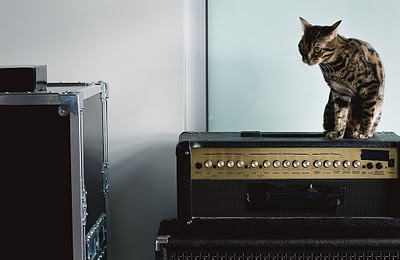
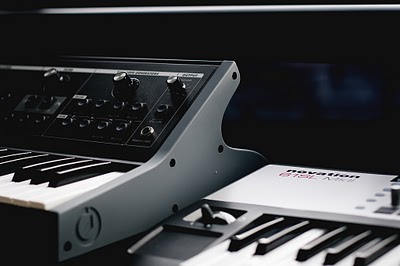

From Countess Gina on flickr, via matrixsynth:
Submitted by Nicolas Pauly via facebook:
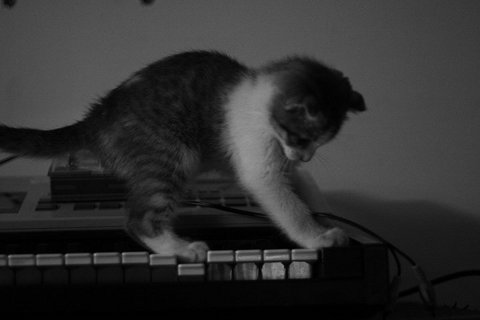
Here, the kitten is playing a Yamaha DX9, with a circuit-bent Roland TR-626. This is also a just a great photo.
Submitted by Leonardo Martins via facebook.
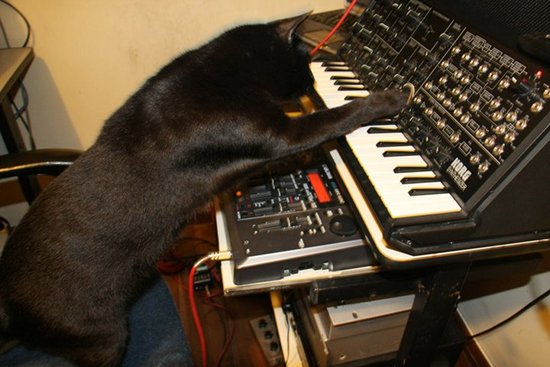
“My Pantero playing the Korg MS-20ic!!!”
The Korg MS-20ic is a controller for the “Korg Legacy Collection” software version of the MS-20.
Today we at CatSynth conclude our series from the recent Outsound Music Summit with my own report from the MultiVox program that featured Reconnaissance Fly, the Cornelius Cardew Choir, and Amy X Neuburg. We did feature a guest review by Joe McMahon last week, which covers the same show from an outside perspective. My own perspective is anything but outside, given that I was in two of the three groups performing at night.
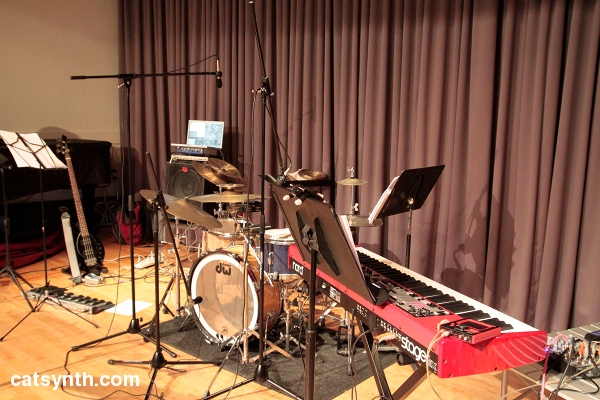
This was a professional show, with formal load-ins, sound checks, and staging. Reconnaissance Fly features a full rhythm section, so we had a lot of equipment to set up:
[click image to enlarge]
On the left is Tim Walters’ bass and Macbook running SuperCollider. In the middle is Moe! Staiano’s drum set, and on the right is my own keyboard+electronics setup featuring the Nord Stage, the trusty Korg Kaoss Pad, and the little stuffed cat for good luck. Here is another perspective with more detail:
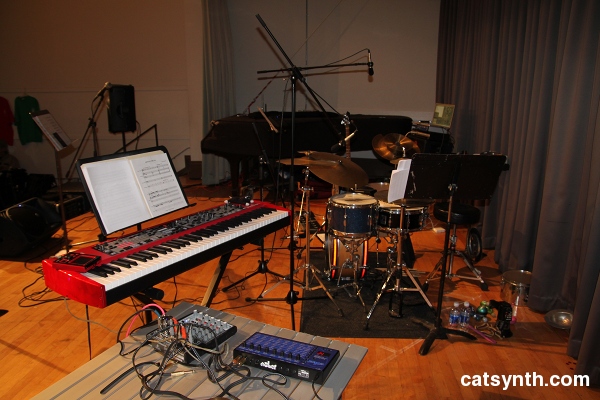
[click image to enlarge]
The Evolver was actually for the Cardew Choir, but I set up everything at once. One can also see Moe!’s toys and other support percussion instruments.
Onto the show itself. Here is the full band on stage, with myself, Polly Moller (flute/vocals), Tim Walters (bass), Moe! Staiano as our special guest “concussionist”.
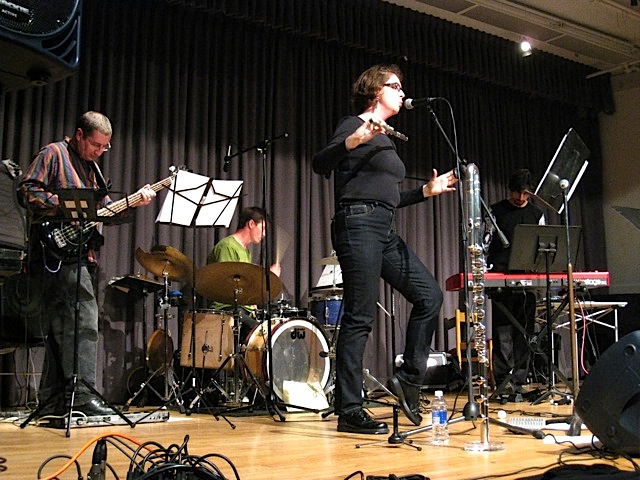
[Photo by Michael Zelner. Click image to enlarge.]
We performed a full nine-piece set from Flower Futures, our “spong cycle” featuring music set to spam poetry. The set now has an eclectic mix of styles, from experimental avant-garde to prog rock, along with latin and jazz influences. We as always with Small Chinese Gong and ended with An Empty Rectangle – we always like playing that last one, but it’s even better with Moe!’s drums! I particularly enjoyed playing the medley of Electric Rock Like a Cat and Sanse is Credenza – the end of the first piece, with free-improvisation on flute set against B-diminished chords, elides into an early 1970s jazz fusion jam on the same chord (think “Chameleon” from Herbie Hancock’s Head Hunters album). This is a relatively high-energy and somewhat challenging piece, and while it was fun to play, it also felt good to then return to the relative calmness of Oh Goldfinch Cage, which featured samples of “human calls” for training birds to speak, with phrases like “Hello, how are you?” and “pretty bird”, processed with ring modulation and turntable effects.
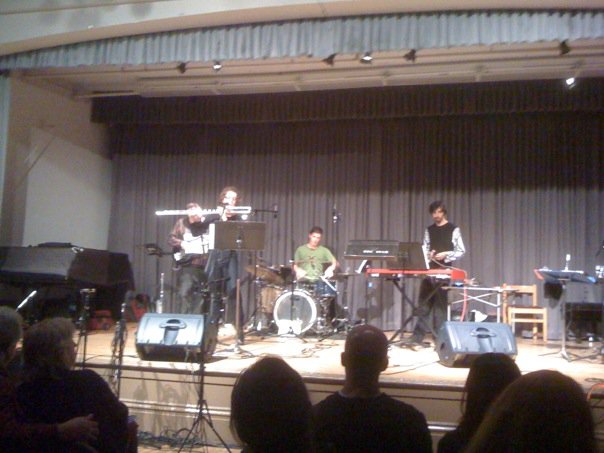
[Photo by Bill Wolter. Click image to enlarge.]
Overall, it was a great performance with a lot of energy. It’s easy to lose sight of that in the midst of playing, where one focuses on mistakes and challenges – personally, I forgot to check that patches for the Nord were all queued up at the start of the performance, and the heat from the lighting and large crowd added unexpected challenges. But it was received well by the audience (a full house), and it seemed like they were asking us for an encore!
The Cornelius Cardew Choir was a stark contrast to Reconnaissance Fly in terms of form and energy. Our first piece, Joe Zitt’s “That Alphabet Thing” was a cappella with a freeform structure. Basically, it unfolds by each singer intoning the sounds of the letters of the alphabet, starting with A and gradually working his or her way to Z. Everyone moves at a separate pace but mindful of others not to get too far ahead or behind, and there were a lot of fun moments of interplay among different choir members, such as back-and-forth with “Hi!” for H-I or “why?” for Y.
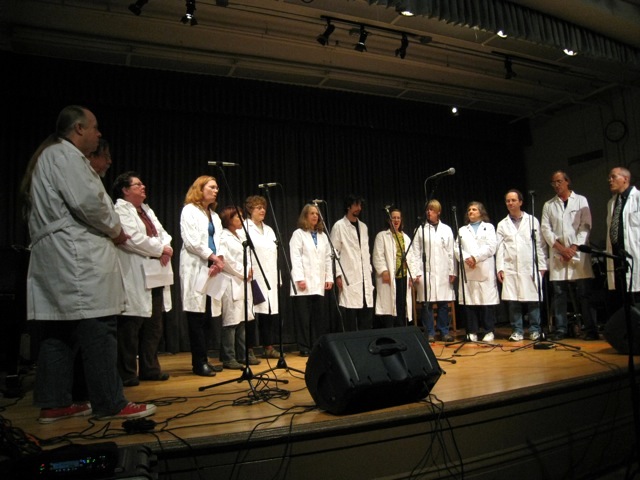
[Photo by Michael Zelner. Click image to enlarge.]
We wear white lab coats.
This was followed by “El Morro” by choir director and co-founder Tom Bickley. The piece was inspired by a trip to the El Morro monument in New Mexico and featured the text from inscriptions on a rock spanning carved messages from two centuries of Spanish, Mexican and American passers by, soldiers as well as other travelers. Each of us had a set of inscriptions to recite on a single pitch per inscription, set against an electronic background of rocks, birds of prey and highly processed vocal incantations. This was a rather complex piece conceptually, though not difficult to perform. Because we were so involved in the performance and the conceptual nature, it is hard to know how it was received in the audience.
The set concluded with a performance of Polly Moller’s Genesis. We had seen a previous performance of Genesis at the Quickening Moon Concert. The previous performance was entirely instrumental. This time, the parts of the spatial and higher dimensions were voice. I performed part of “universal time”, using the sequencer on the Evolver as the time-keeper and performed various modulations of the tempo and timbre. Polly played the role of the “new universe” with a flute solo featuring multiphonics and other techniques. Tom Bickley conducted the piece by walking around the stage and carrying chimes.
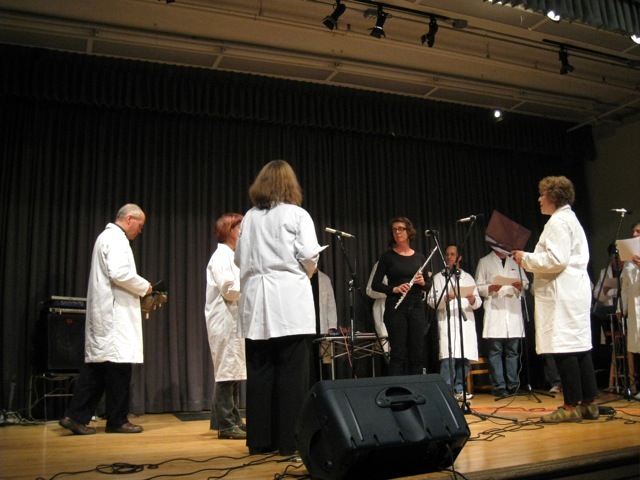
[Photo by Michael Zelner. Click image to enlarge.]
This was a very meditative performance, with the chimes, the flute multiphonics, the ever changing electronic rhythm and timbre, and the vocalists singing their respective dimension numbers in different languages.
The final set of the evening featured Amy X Neuburg. As always, her “avant cabaret” set was very polished and spoke well to both her technical expertise with her instruments and her versatility as a performer. She employs several styles of singing, often in a single piece, moving from classical to cabaret/jazz to experimental vocalizations. Her synchronization with looping electronics is very tight, seemlessly adding and subtracting samples and recordings within the rhythms and phrasings of the song.
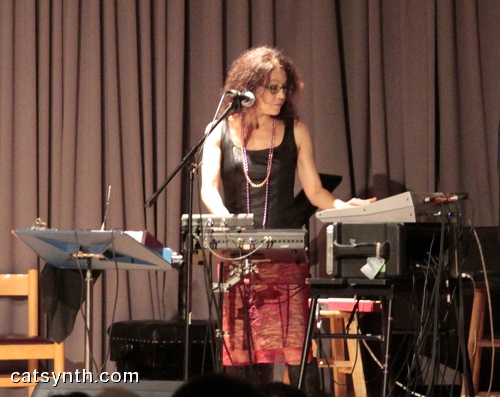
[click image to enlarge]
There were pieces familiar from past performances, such as “Life Stepped In” where she deftly mixes looping technology and theatrical vocals. She also did a few improvisational pieces, the first of which featured the Blippo Box. This is an instrument with chaotic oscillators that never quite sounds the same twice, but she always manages to control it quite well – in this performance she made it sound like a voice, to which she responded with her own voice. She also performed an improvisation with a Skatch Box which she made at the “build your own Skatch Box” presentation earlier in the week (and which I unfortunately missed). It’s hard to make a skatch box sound like a voice, but she could make her voice sound like the growls and scrapes that it produced.
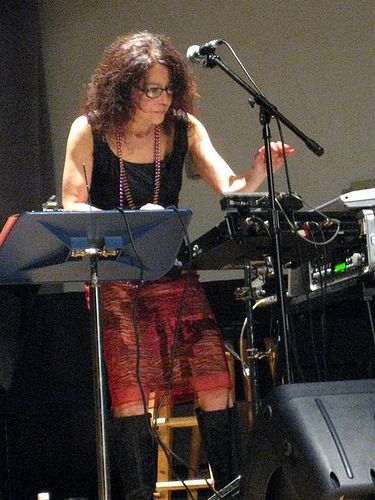
[Photo by Michael Zelner. Click image to enlarge.]
She ended her set with a tribute to Kim Flint, who was very active in the looping and electronic-music communities, and the founder of Loopers Delight, and who passed away after a tragic accident in Berkeley in June. He was someone I knew as well from both music and social events. Amy’s tribute was a performance of the first piece she ever created using the Echoplex, which he co-invented.
Another weekend has arrived, and with it Weekend Cat Blogging.
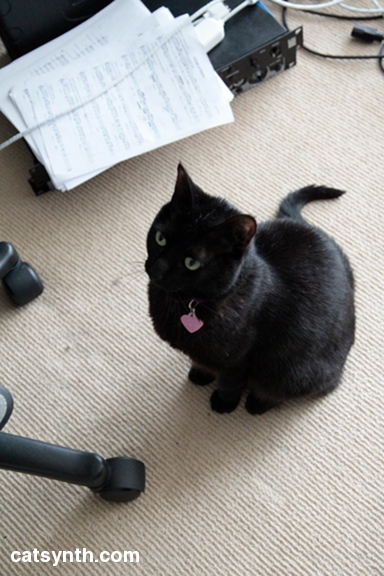
Here we see Luna in the studio in an embarrassing state of disarray. July was a rather busy month – actually most of them are, but this one was a bit different. Between the Outsound Music Summit and all of the associated rehearsals, the various photo shoots and my new job that started last week, there hasn’t been a lot of time for much else. In particular, the studio has a victim of entropy with a lot of equipment being moved out of place for use in shows (like the keyboard and cables) or to make way for new items (the E-MU modules in the back of the picture are being moved because the space is being taken up by the new Pro Tools HD system, but I need them still to be easily accessible). And then there is the never ending torrent of paper. Some of it useful, like the scores from Reconnaissance Fly, the Cardew Choir and Conduct Your Own Orchestra night that can be seen behind Luna. Others, like just about any piece of paper sent by any financial institution, are mostly useless. But they accumulate as one sorts them out.
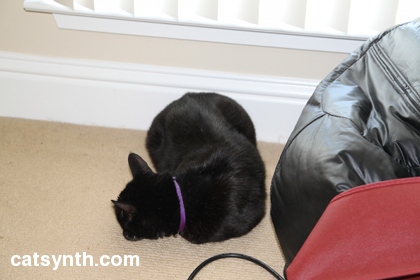
The new job has also meant less time at home, and less time with Luna. I suspect she spends a fair amount of our time apart napping. It is a moment to reflect on the month that has past, and how it was a chance to focus on things that were of particular importance – my cat, music, art, city life, friends. Hopefully, after the initial change and chaos, things will be begin to come back into balance.
We have also been tardy is visiting our fellow WCB participants over the past couple weeks, and will do our best to make up for that this month.
As for today, we have to start cleaning up a bit.
Weekend Cat Blogging #269 is hosted by Pam at Sidewalk Shoes, with a nice photo of Smudge in the yard.
Carnival of the Cats #333 will be up this Sunday at One Cats Nip.
The monthly Bad Kitty Cats Festival of Chaos will be at Mind of Mog.
And the Friday Ark is at the modulator.
We resume our reports from the 2010 Outsound Music Summit after a brief break. In this article I review the last night of the festival, titled “SoundScapes” and featured musicians whose music focuses on noise and sound textures. While this is often from electronic sound sources such as effects pedals or DIY synthesizers, many were from acoustic sources such as metal objects or conventional instruments like piano.
The evening was framed by the theatrical announcements of the artists by guest emcee Cy Thoth, a regular DJ on KFJC 89.7 FM.

[click image to enlarge]
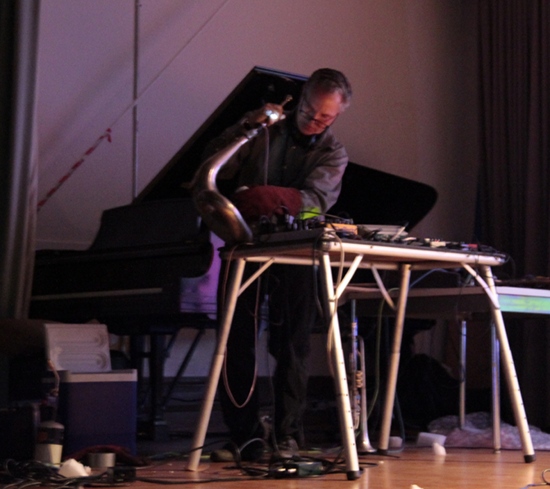
The concert began with Phog Masheeen, a trio featuring Mark Soden, Jr, Dr. Francene Laplan and William Almas. They presented a single large-scale work for electronic and acoustic sound plus video called “Anthroscopic Tourism.” I was not quite sure how the medical term “anthroscopic” related to the sounds and images in the piece, which focused on the interplay of Kaplan’s pots and pans set against electronic sounds and loops and Soden’s electronically enhanced performance on trumpet and a large pipe from a Yamaha motorcycle. Soden had demonstrated some of the techniques he was using with the trumpet during the Touch the Gear event. But he added to the the performance techniques Soden used with his instruments rubbing dry ice against them. As most readers know, dry ice is extremely cold (and difficult to handle); and this it can have a strong effect on the shape and behavior of metal tubes. At one point, he smashed a block of dry ice before picking up pieces to use. He also had a blowtorch. The music often involved loops (sample based or otherwise) against which Kaplan played rhythms and timbres on the pots and pans – this was offset by the more freeform sections with Soden’s trumpet and pipe. Almas’ visuals included a variety of urban and industrial scenes, text, and footage of old musicians, which were mixed with live video of Soden’s performance.
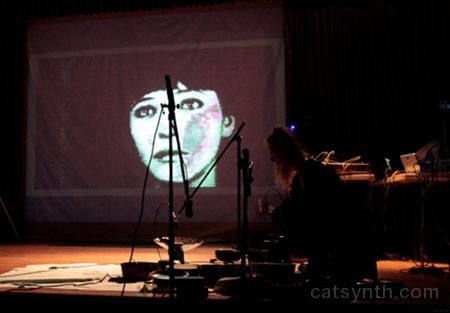
[click images to enlarge]
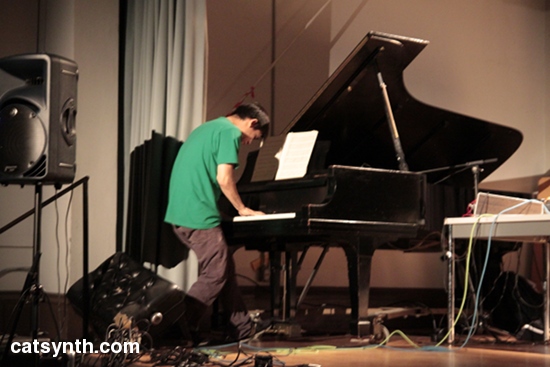
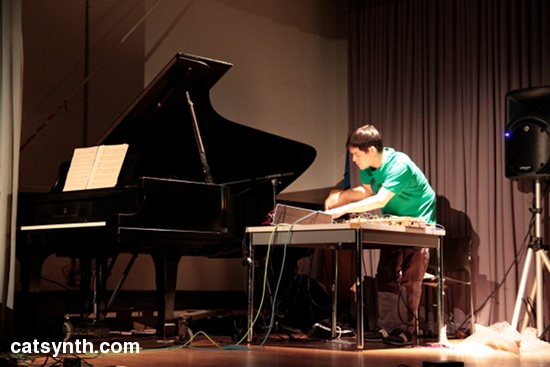
Next up was Headboggle (aka Derek Gedalecia). The tone was set from the beginning both in terms of sound and slapstick comedy by his stepping on bubble wrap that happened to be placed behind the table with his electronics, and then slipping on the way to the grand piano. Actually, the comedic timing of his various slips, slides, tripping over his own feet and double-takes was expertly done, as in an old silent film or Vaudeville act. There was a bit of a scare for several of us in the audience when it appeared he had broken the bench of the piano, but I was assured this was all part of the act, this particular bench was found broken, and that no pianos were actually harmed in the making of this performance. Musically, he combined chaotic oscillators from Ciat Lombarde synthesizer – a reminder to finally put together my Ciat Lombarde kit – with classical and ragtime piano phrases, loops and deep bass sounds from a Micromoog. The piano and electronics are of course quite contrasting, but every so often the sounds and phrases (and physical humor) converged quite well.
[click images to enlarge]
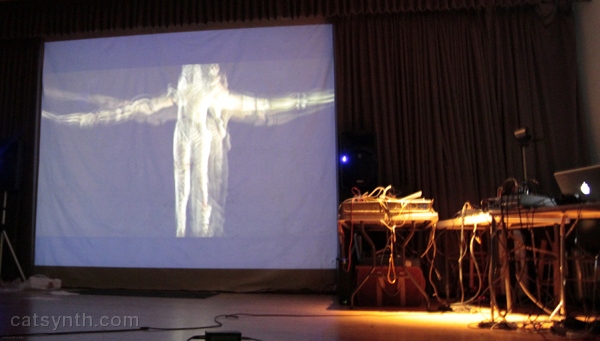
Headboggle was followed by Kadet Kuhne, who presented video and live-music piece Fight or Flight, described by our emcee Cy Thoth as “space madness.” In fact, it was a very polished live electronic performance, very dark and ambient (although interestingly Kadet Kuhne talked in the pre-concert Q&A session about her desire to perform “lighter” ambient music). It began with low frequency sounds and a rumbling buzz, and included doors opening and closing and various sounds of machinery, with electric hums, blips and glitches. It was quite captivating and easy to get lost in. At one point, arpeggios and then beats emerged from the combination of noise percussion and more harmonic sounds, which got progressively louder as the piece built up to a climax and then faded to nothingness. The music was set against a video that focused entirely on a cloth-encased figure suspended in mid-air. It wasn’t clear at first whether this was a cloth figure or an actual person, though as the video progressed it became clear that it was the latter. The frequent shot and angle changes gave the video a glitchy quality which matched many of the electronic sounds in the music.
[click image to enlarge]
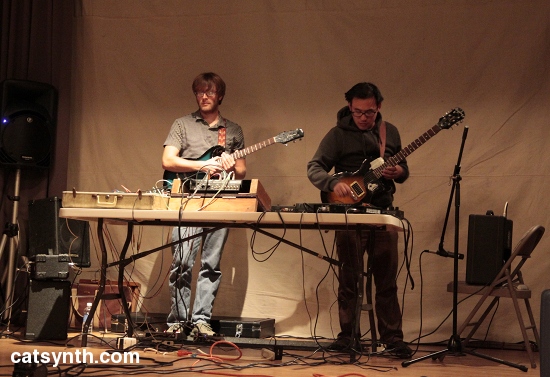
The final set featured Chen Santa Maria, the duo of Steve Santa Maria and George Chen. Both members of the group played electric guitar and a variety of electronic effects. The set began with a guitar drone set against high squeaking humming sounds. These sounds were soon joined by full guitar chords with heavy distortion and undulating raspy sounds from synthesizers or effects units. There were bursts of noise distortion and high shrieking. This was definitely a loud set. But there were still details to listen to (with appropriate ear protection). The harmonic patterns of the distorted guitars created rhythms, which was set against a more formal triplet rhythm from the electronic sound sources. This rhythmic pattern essentially continued for the remainder of the set, with periods of driving guitar, bursts of noise and more high shrieking tones which then decayed into a low rumbling noise. As the set drew to a close, the sounds became more “digital” with lots of blips and choppy sounds, but then this was replaced by a loud square wave. The square wave started out at a moderate pitch, but got lower and lower until it became a series of audibly distinct pulses, and then came to an abrupt stop.
Although this was the last performance of the festival, I will be presenting one more article, where I return to the MultiVox night which included my own performance with Reconnaissance Fly and the Cornelius Cardew Choir…
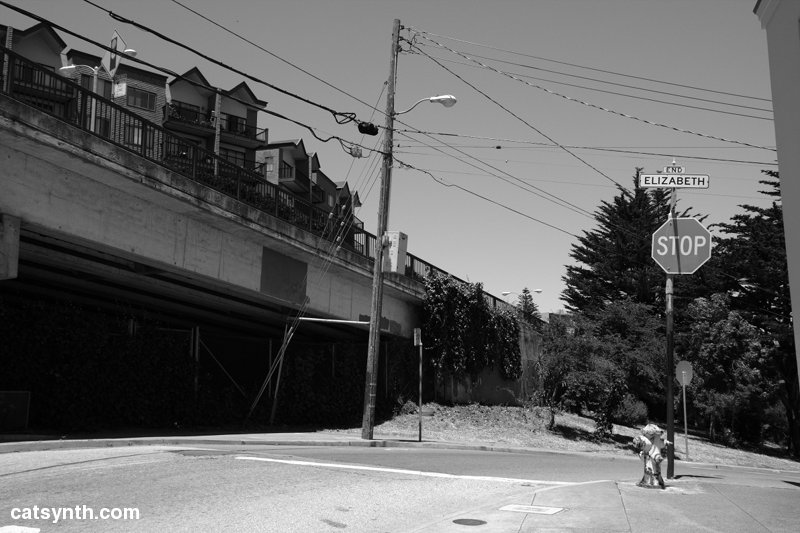
[Please click to enlarge photo. The details are an important element of this one.]
Note: you can always see more photos, including past Wordless Wednesday images, at my flickr site.