Truong Tran: the lost & found

Another review of art from the month that has past. In mid-February, I attended an artist talk with Truong Tran, part of a month-long exhibition of his work at Mina Dresden Gallery. The exhibition was presented by our friends at Kearny Street Workshop.

The gallery itself is a narrow and starkly white space. Upon entry, one is drawn first to the illuminated shapes and color fields that dot the walls. Moving closer to a particular artwork, one begins to see the meticulous detail and the variety of elements from which it is composed.
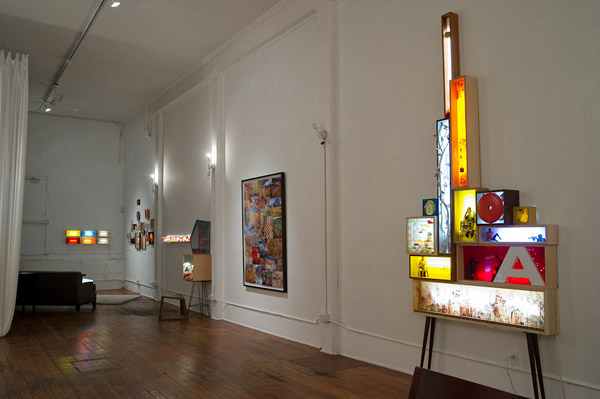
[Truong Tran.  Installation view.  Photo courtesy of the artist. (Click to enlarge.)]

As suggested by the title of exhibition the lost & found, the pieces are created primarily from found objects and materials. Tran is a self-described collector, indeed he admit, “I was a collector long before I was an artist.” This brought to mind the artist in residence program at the SF dump that I reviewed back in January. Far from a simple presentation of found objects, he constructs large-scale works from these constituent parts, placing them into boxes and the combining these boxes into larger structures. This process of found objects, containment and construction is perhaps most apparent in tower, the largest piece in the show:
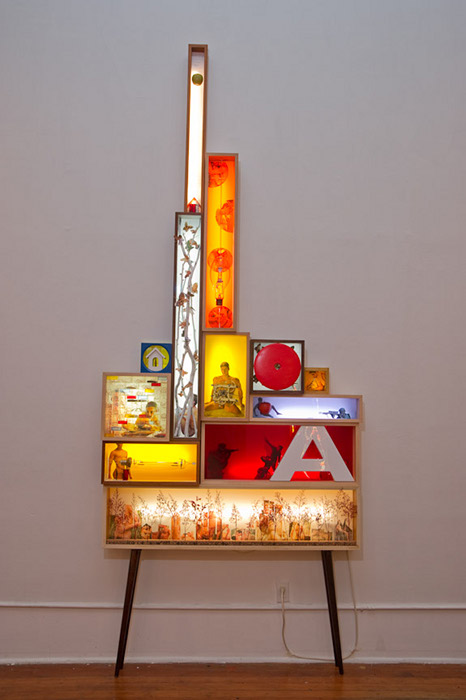
[Truong Tran, tower.  Photo courtesy of the artist.  (Click to enlarge.)]

Tran cites Joseph Cornell and Donald Judd as influences, and one can see the combination of “things contained in boxes” and large minimal geometric elements reappearing in many of the works. There is also a certain polished quality to many of pieces, particularly the illuminated works that most caught my attention. For example, the piece broken and whole, shown below looks to be a very minimalist installation with lights, rectangles and solid colors. On closer inspection, one can see that each box contains bones, presumably part of a “collection.”
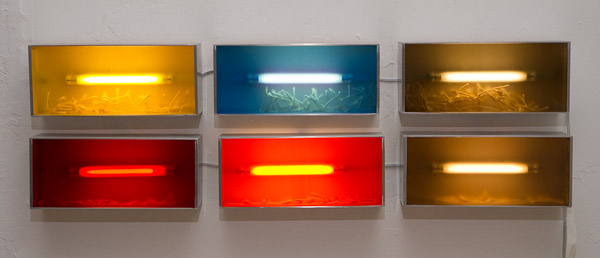
[Truong Tran, broken and whole. Photo courtesy of the artist. (click to enlarge)]
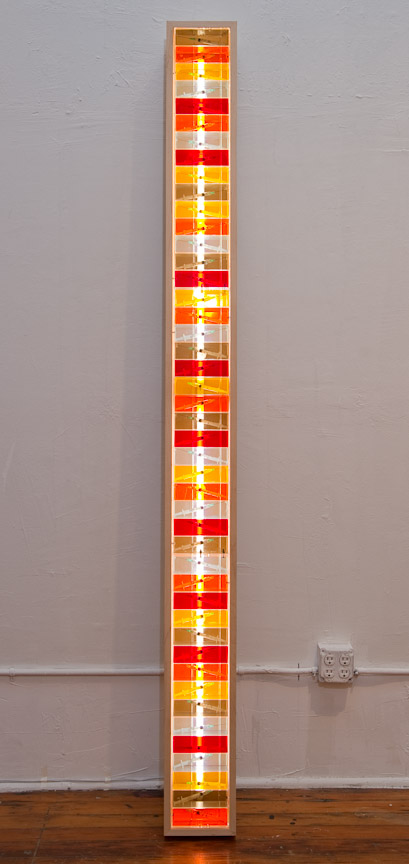
Truong Tran, a ladder to. Photo courtesy of the artist. (click to enlarge)

The use of found materials within a larger minimal pattern of boxes and solid colors appears in many of the works. The contained materials at times are provocative, such as the syringes that are placed in each box of a ladder to.

Tran is as established writer and author of several collections of poetry and a children’s book. With this exhibition, he is moving into a new medium of visual art and sculpture. However, his poetry is also very visual, as in his book within the margin where a single line of lower-case text is presented on each page. His other books published at Apogee Press have a similar visual quality to them. You can see some excerpts from a couple of the books here. Similarly, text enters into many of the visual pieces in the exhibition, such as the large letter “A” in tower. In both his written and visual works, there is a strong sense of things being “constructed”, and indeed he emphasized the concept of construction during his talk at the gallery.

One work that did not get mentioned during the talk but which drew my attention the invisible city. Once again, found materials (in this case, multicolored golf tees and thread) were arranged into a repeated rectangular pattern, but this time set against an image of a city skyline. While many of the pieces have an architectural quality to them (i.e., as “constructions”), this was only one where the image contained within was itself architectural.
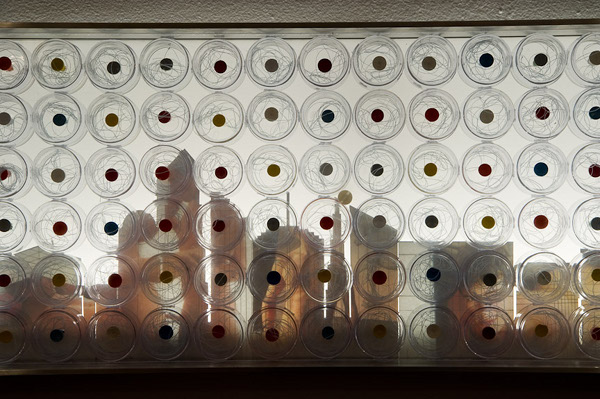
[Truong Tran, invisible city. Photo courtesy of the artist. (click to enlarge)]

However, there is another level of containment, as each of the buildings contains a pornographic image – I believe they are all images of men. This is another recurring theme in many of the pieces, perhaps best exemplified via boy with butterflies which at a distance appears to be a flock of hundreds of colored butterflies frozen in mid motion. Upon closer inspection, one sees that the butterflies are cut from pornographic magazines, and it is the sections of the male bodies in these images that give the butterflies their colors and patterns.

You can see some more photos of other works from the exhibition at The Lost and Found, a visual blog created by Tran. You can also see photos from the well-attended opening at KSW’s blog.

William Leavitt, Boyce/Greenlief duo and Karl Evangelista trio

I continue to work through the backlog of art and music reviews by presenting some of the openings and performances I saw on the particularly busy and fun evening of February 19 here in San Francisco. Although the evening included both musical performances and exhibitions of visual art, music was present as a central theme throughout.

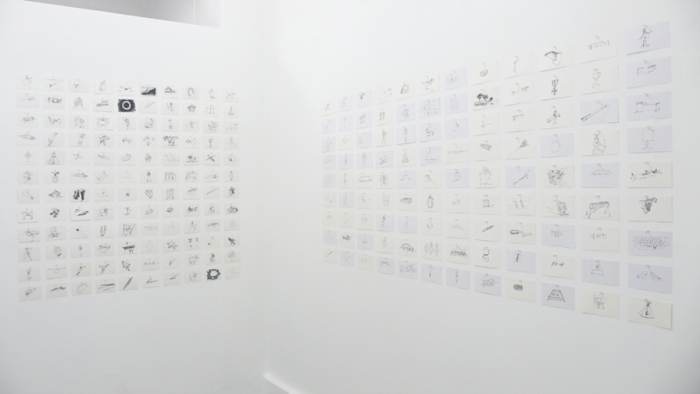
First up, we visited Jancar Jones Gallery for the opening of William Leavitt: A Show of Cards. The exhibition featured “over 300 ink drawings on index cards” (though I only counted 248) arranged in three groups on the walls of the gallery.


[William Leavitt, A Show of Cards: Installation View. Photo courtesy of Jancar Jones Gallery. (Click to enlarge.)]

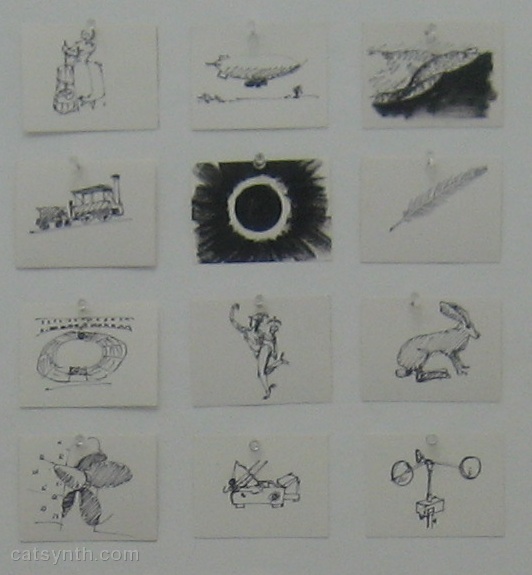
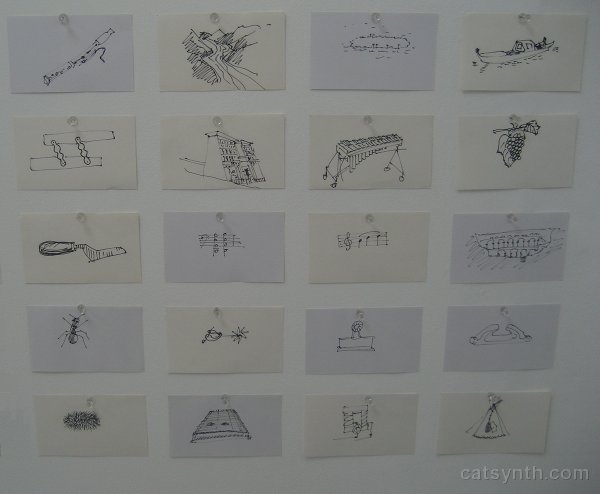
The gallery’s stark white walls presented a great surface for drawings, which were sometimes very sparse and sometimes quite detailed. Many featured musical elements, such as instruments or notes on a staff. There were also mathematical pieces (such as an x-y plot of a sine function), electronic circuit diagrams, architectural drawings, animals and abstract textures.


[Click photos to enlarge.]

It was fun to scan the rows of cards, picking out individual ones for closer inspection and comparison, particular the abstracts and the references to some of my own areas of expertise (e.g., music and electronics). It turns out Leavitt has a long-standing interest in electronic music, and was featured in this article at GetLoFi alongside circuit-bending godfather Reed Ghazala.

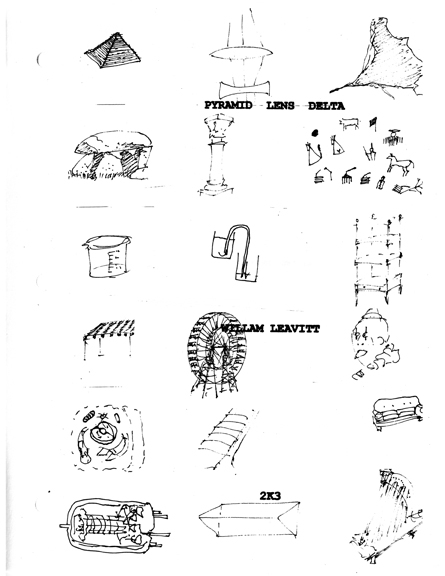
William Leavitt, Pyramid Lens Delta. Image courtesy of Jancar Jones Gallery. (Click to enlarge.)

In addition to being works of art in their own right, the cards serve as a source material for chance procedures that Leavitt uses in other works. In particular, a random subset of cards were used to generate a narrative that was incorporated into the text for his play “Pyramid Lens Delta” (the title came from the first three cards in the set). The script for the play was part of the exhibition. The back of the script contained the card set, and glancing through the text one could see where portions of the dialogue seemed to be drawn from the cards, particularly dialogue associated with Ivan, one of the characters in the play.

Leavitt has used chance processes for past works, including a theater piece The Radio which premiered in 2002. This piece includes not only dialogue but also an original score that included musique concrete. I would have liked to have seen this.


After Jancar Jones, we made a brief detour into that ambiguously defined area at the base of Potrero Hill to Project One for The Art of Noise, a visual exhibition coincident with the Noise Pop Festival. It featured large artistically altered portraits of well known musicians, as well as some installations, such Ted Riederer’s piece featuring drums covered in rose petals.


We finally ended up in the Mission District, and after a brief stop for tacos arrived at Bluesix for a pair of musical performances.

The saxophone duo of David Boyce and Phillip Greenlief. As noted in previous reviews, Greenlief’s virtuosic saxophone performances cover a wide variety of instrumental techniques. The duo weaved effortlessly between idiomatic jazz riffs and more free-form sections featuring multiphonics, noise production and vocals. The change between sections was both sudden and subtle; I was immersed in a jazz riff with long up-and-down lines or rhythmic patterns and only later would realize that we had moved to a more non-tonal (i.e., “noisy”) and arhythmic section. They demonstrate that these modes of music making need not be at odds (as they are sometimes portrayed on musician discussion lists) and can be part of a single piece of music. The performance did, however, inspire a short discussion with a friend about what is “experimental music” and why the performances this evening did or did not qualify as “experimental”.

Boyce and Greenlief were followed by the Karl Evangelista Spaceman Explorer Trio, featuring Karl Evangelista on guitar, Cory Wright on baritone sax, and Jordan Glenn on drums. Evangelista in his various groups blends jazz traditions with elements of late-20th-century experimental music. This of course led back to the question of whether or not this performance was “experimental”, particularly given strong jazz foundations on the pieces that we heard. The trio opened with loud driving rhythms and Evangelista and Wright trading long fast melodic runs. The piece “Hurdles” on Evangelista’s MySpace is quite representative. Another piece a somewhat slower groove with strong quarter notes (one might say a little bit “funkier”, more 1970s). Within this context, the melodies, riffs and one-off notes were often atonal, which helps to keep things moving forward. Overall, it was a fast-paced and virtuosic performance.

Weekend Cat Blogging and Photo Hunt: Foreign

This week’s Photo Hunt theme is foreign. Cats often intersect with my foreign travels, and with the objects that I bring home. Consider the Suzhou painting silk cat and Maneki Neko from Japan in the photo below:

We have seen these items before, in discussions of cats of China and the cats of Tokyo, respectively.

Here, we see Luna near some of our art pieces:

Most of these, including the large watercolor on the left and small metal sculpture, are local. However, the mostly yellow geometric print is foreign. It is by a Cuban artist. I visited Cuba twice in 2001 and purchased this print in the town of Matanzas. The topic of visiting Cuba as an American (and the entire U.S. policy towards Cuba) could fill up an entire article.

Sometimes one may assume something is foreign when it is in fact not. Consider this photo of Luna from December:

The title may be in French and evoke a bygone era in Paris, but it is actually the work of an American artist, Ken Bailey.

We close with some more maneki neko figures:

All of the cat figurines in this photo are from Japan. There is one more cat, however, on the matchbox. This is not foreign, and created by a local artist.


A sad note this weekend. Gattina and family, who regularly host “Cats on Tuesday”, said farewell to their cat Lisa this week. Lisa was a little over eighteen years old, which is a good long life for a cat.  We send them our thoughts.


Weekend Cat Blogging #248 is hosted by Meowza at his blog iMeowza.

Photo Hunt 203: Foreign is hosted by tnchick.

The Carnival of the Cats will be hosted this Sunday by Nikita Cat at meowings of an opinionated pussycat. We also wish Nikita a happy birthday this weekend!

And of course the Friday Ark is at the modulator.

CatSynth pic: Luna checks the mini jam

From rarebeasts on flickr:

“Luna checks out the Wicks Looper and DinoAxe.”

We at CatSynth are always delighted to meet another musical cat named Luna!

You can see the actual mini jam with the Wicks Looper and DinoAxe in this video:

We recently presented this Wicks Looper in this post. I am quite fascinated by this little instruments (and not just because of the black cat logo).

Anthony Discenza: Everything Will Probably Turn Out OK

With the month-long string of performances mostly behind me, I am trying to work my way through my backlog of reviews. Today we at CatSynth present a recent exhibition by artist Anthony Discenza at Catherine Clark Gallery entitled Everything Will probably Work Out OK. That phrase has become a bit of a mantra since the exhibit, and I keep the original card on my desk, reminding myself as I work on my music or other projects that “everything will probably work out ok.” It might not, but it probably will.  Additionally, the card, with simple black lettering on a white background, appeals to my interest in text-based art – indeed, the relationship between text and image was a central theme of the exhibition.

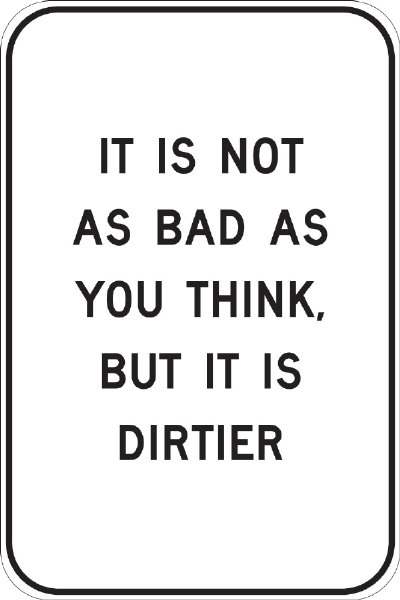
I particularly liked his series of “street signs”, which featured cryptic and humorous messages in the familiar rectangular shape and sans-serif type of signs used in American cities.

[Anthony Discenza, KITTENS and DIRTIER, 2009.  Photographs courtesy of Catherine Clark Gallery.  Click to enlarge.]

In addition to the gallery presentation, several of the signs were posted on streets (prior to the exhibition). In the example presented here, A LAPSE INTO THE ROMANTIC, one can see how the signs really fit the part in terms of scale, design, layout and type.

[Anthony Discenza, Lapse into the Romantic, 2007.  Photo courtesy of Catherine Clark Gallery.  Click to enlarge.]

With just a peripheral glance one could easily assume this is just another sign explaining some parking or traffic rule. A selection of the street signs were also featured in the exhibition catalogue.

Another prominent series featured plays on the “Hollywood elevator pitch”, where someone attempts to summarize their idea as “A meets B”. In Sometimes a Great Notion (Part 1). Discenza presents a wall of absurd pairings drawing from pop culture, literature, history and other sources.  Examples include “It’s M.C. Escher meets Z. Z. Top”, “It’s Le Corbusier meets Chuck Norris”, “It’s Star Trek: The Next Generation meets The Indigo Girls”, and “It’s Twitter meets SARS”. You can see a full version of the text from the piece here. He also has some extended chains as light boxes:

[Anthony Discenza, Teaser #1, 2009. Photo courtesy of Catherine Clark Gallery. Click to enlarge.]

In addition to the visual pieces, there was also an audio installation Untitled (The Effect). In a dark room with low lighting, a disembodied female voice narrates a text describing visuals or instructions that seem disjoint but also seem to flow naturally. The text is based on fragments gathered by searching for a specific phrase on Google.

Although this quote from the press release seems to most describe the audio work, it could easily apply to the visual text-based pieces as well:

I’m very interested in text—in part because I’ve always drawn so much inspiration from literature—and specifically for the way that text can act as a kind of score, enticing the mind to construct things that don’t exist anywhere else. I’m curious about that peculiar fluidity of something experienced primarily in the imagination, and I’m fascinated by the way a small fragment of something—maybe only a few sentences, or even just a phrase—can, under the right conditions, conjure an entire narrative.

Discenza is also known for his past work which features meticulously edited and constructed video work. The exhibition does include one piece Charlton Heston: The Future Has Already Been Written in which he intersperses several Charlton Heston films on a frame-by-frame basis. It takes a moment to get used to seeing the rapidly changing images, but once one’s eyes and brain adjust, scenes and transitions become clearer (and I quickly recognized Planet of the Apes).

CatSynth video: Analogue synths and sleeping animals in my bed

From Synthiefrau on YouTube, via matrixsynth:

“Hello lovely synthfolks, my cat Cleo and my dog Susi have a funny life. They always sleeps the hole day and listening to my music;-). The sequenz comes from my Dot.com 911 Sequenzer, I play the Minimoog, Synton Syrinx, Moog Prodigy, The effects comes from the Roland Juno 60 and from Doepfer Dark Energie”

I quite like the leopard-print Minimoog and modular case.