From Sawa Masaki on flickr, we have another photo featuring Taro:

Taro is like me, and partial to flats rather than sharps. I am pretty sure the synth is a DSI Mopho. Please comment if you think otherwise.
Also appears on matrixsynth.

From Sawa Masaki on flickr, we have another photo featuring Taro:
Taro is like me, and partial to flats rather than sharps. I am pretty sure the synth is a DSI Mopho. Please comment if you think otherwise.
Also appears on matrixsynth.
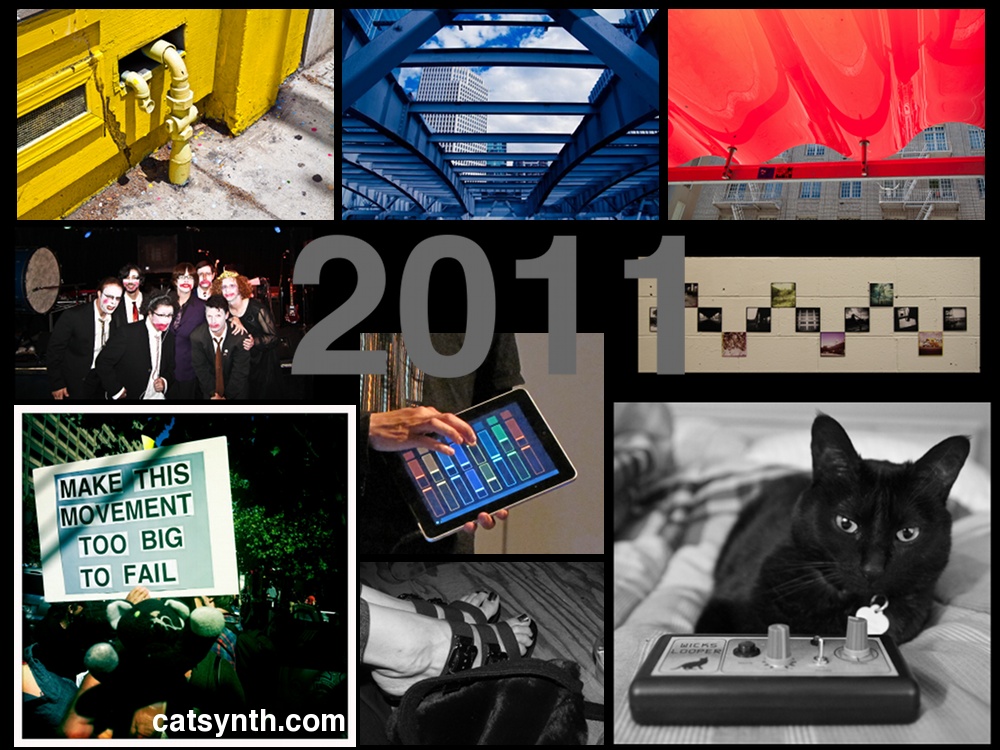
As has become a tradition here at CatSynth, we present our end-of-year image.
[Click to enlarge.]
It was a bit of a challenge to decide what to put in, as there were so many this time. But I think these are particularly representative. And it’s also significant that it is more colorful than previous end-of-year images.
The first few days of this year were quiet and a bit dark. That changed quickly, with tumultuous events around the world, and new experiences close to home. It’s the year I finally had a photography show, and by the end of the year I had several. There were new surprising types of performances and the costumes to go with them. I deepened my connections back in New York with friends, music, art and the landscape. And I no idea what I would have the chance to participate in something like the Occupy movement . There were many sad moments as well, with the loss of friends.
In all, 2011 has been particularly rich and productive, if sometimes a bit chaotic. If one had told me at the end of 2007 or 2008 (or 2001 for that matter) that this is what life would be like now, I would have been pleasantly surprised. There is a sense, however, that the patterns of this past year are not sustainable. This will have to be part of the plan for 2012, in particular getting organized, staying healthy and trying to make good choices. We will see how that unfolds as the new year progresses…
Happy New Year and thank you for all the support and warmth from those who read these pages!
Earlier this month, I participated in a show at the Luggage Store Gallery in San Francisco called Space Music Night that turned out to be quite memorable. So what exactly is “space music”? It is not straightforward to come up with a definitive answer, except that it should reflect some sense of “outer space” as one might imagine it. Or, perhaps more accurately, as people might have imagined it in the 1960s and 1970s. The music that we performed that evoke “space rock” that one might associate with early Pink Floyd or Gong, but also more freeform ambient soundscapes. The latter comes closer to ambient music one might hear on NPR’s “Hearts of Space” program but without crossing over that dangerous line into New Age. The music was certainly contemplative at times, but retained an edge to it and often veered back to rock and jam idioms, and moved back and forth between defined harmonies and more abstract timbres. The “space” effect was also heightened by having a dark room with abstract video projections by Tim Thompson.

The show was divided into two sets with four musicians each. Although many of us were familiar to one another, this was the first each each set of four played together as a group. The first set featured Matt Davignon on drum machines and effects, Kristen Miltner on electronics, Karl Evangelista on guitar, and Andrew Joron on theremin. Musically, this set had a very thick electronic texture with a soft beat from the drum machines that came in and out of presence. The electronics and heavily processed guitar provided anxious harmonies, and the theremin seemed to be narrating a space story with warbles and slides that approached the rhythm of human speech. At moments, the rhythm dropped out altogether, while at others it came closer to an extended jam. You can hear a bit of the set in the following video:
In the second set, I performed with iPad and the Dave Smith Evolver, along with David Leikam, Sheila Bosco on drums, and Steve Abbate on guitar. Perhaps it was the instrumentation of the set, or the musical leanings of the performers (including myself) towards strong rhythm, but we very quickly gelled into a steady rock jam rhythm that extended for most of the length of the set except for avery deliberate breaks. I mostly used Sunrizer on the iPad to provide ethereal harmonies to set again Leikam’s Moog Rogue and his “electric bass cello” and provide structure for melodic improvisation. This was definitely approaching the “space rock” idiom that inspired the evening.
I was quite happy with how well we able to play together despite having not played together before, and indeed a few people afterwards expressed some surprise that we hadn’t. But perhaps we will get a chance to play again.
Today we look back at the second of my November performances in New York. This one took place at Theater Lab in Manhattan in one of the venue’s stark white studios that served as both performance venue and blank canvas. There were several now-familar faces from east coast shows, as well as new artists that I heard for the first time.
The show opened with an acoustic performance by PAS, featuring Robert L. Pepper, Amber Brien, Michael Durek and John “Vomit” Worthley with guest Carlo Altomare (one of the founders of TheaterLab) on piano. The acoustic instruments included a wide variety of percussion, strings and winds, as well as DIY combinations of objects (buckets, balloons, etc.) to produce other sounds. In this way, they played acoustic instruments as if they were synthesizers.
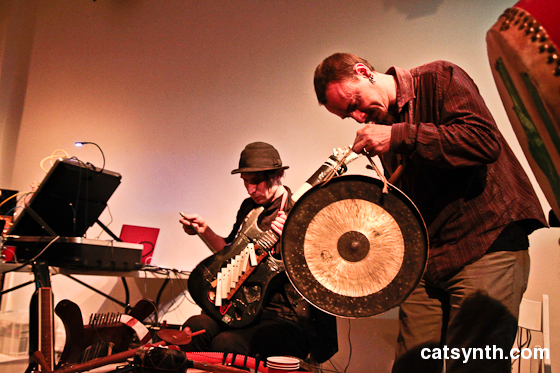
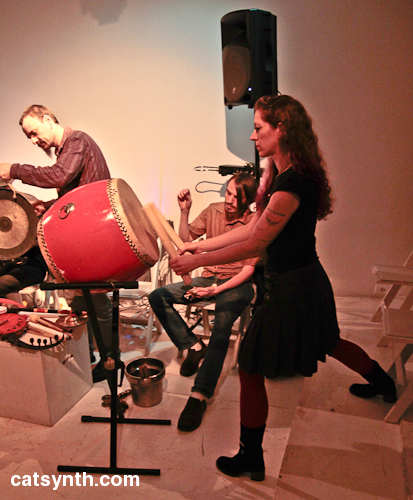
[PAS. (Click images to enlarge.)]
The performance moved between gradually evolving by strongly rhythmic material and more freeform noise textures, all expressive and performed with a wide dynamic range. At various times, the performers moved around the space, among the audience and up into the loft, which added a theatrical element as well as spatialization. You can see and hear for yourself in this video:
PAS live with Carlo Altomare at Experi-MENTAL Night at Theaterlab. November 26th, 2011 from PAS Music on Vimeo.
The particular combination of instruments and idiomatic playing gave portions of the performance an Asian feel (particularly at the beginning of the video), but even there the piano provides an avant-gard counterpoint and the overall texture moves to something more reminiscent of Henry Cowell before moving into a more experimental dramatic mode featuring Altomare soloing on piano and Pepper repeatedly chanting “Piano Man!” I like how they were able to move so easily between the different timbres and textures and rhythms without stopping, except of course for the silences that occurred in response to the instruction “Silence!” In all, a great set that set a confident tone for the entire evening.
Next was a duo featuring Richard Lainhart on a Buchla synthesizer and Lucio Menegon on strings and effects. They performed a live improvised set to a film by Scratch Film junkies.
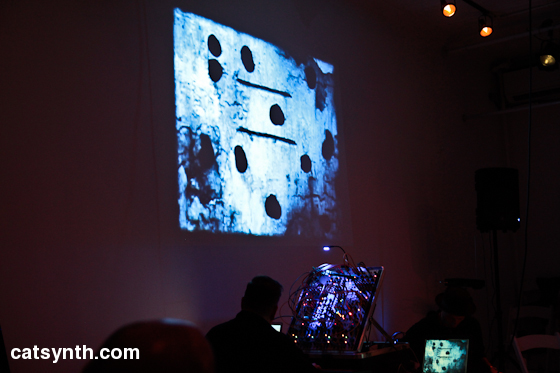
The film was beautiful and mesmerizing, though I did find myself also watching the Buchla to see and hear what was happening. In general, the synth performance was subtle and blended well with the string sounds to produce an overall ambient texture, with occasional metallic and inharmonic swells. The eerie and slowly moving sound fit the abstract video, with frequently changing clips overlaid with digital effects that simulated paint and chemical treatment. At times, the harmonies and timbres seemed to approach an acoustic orchestra and choir, as one might hear in a science fiction film, while others seemed to channel the sounds of bowed metal and glass.
PAS presents Experi-MENTAL Night with a duo by Richard Lainhart and Lucio Menegon at Theaterlab from PAS Music on Vimeo.
This was followed by a trio featuring Jay Pluck on piano, Julia Violet on vocals, and Michael Durek returning, this time on theremin.
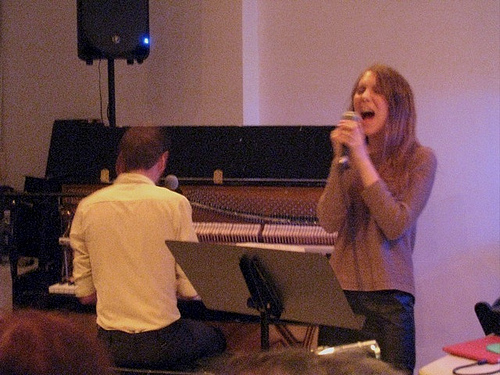
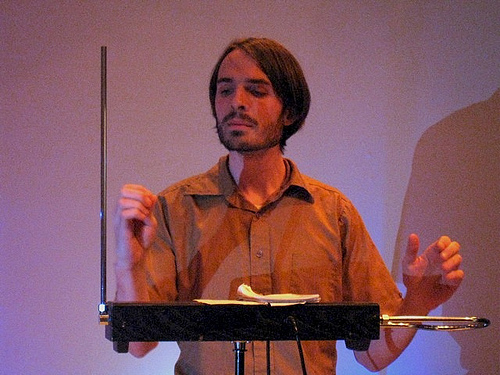
[Jay Pluck, Julia Violet, and Michael Durek. Photos by Michael Zelner. (Click to enlarge.)]
This was the most traditional and idiomatic of any set during the show. The songs were songs, quite lyrical and featuring traditional harmonies and melodic lines for voice and theremin. The introduction featured a theremin solo – Durek is quite good at getting standard pitching and phrasings from the instrument – set against gently rolling arpeggios of romantic chords on the piano. As Violet’s vocals enter, the music takes on a light cabaret feel, but the theremin backed with Mini-Kaoss Pad effects, continues to give it a somewhat otherworldly quality. The second song, which featured more major harmonies, had a bit of a 1960s rock quality to it, as if it was it was a song from a popular album rescored for piano and voice. Here the theremin had a bit of a darker tone.
After that it was time to take the stage. It was basically the same setup as a few nights earlier at the AvantElectroExpectroExtravaganza in Brooklyn, but with a few musical differences. I opened with a newly programmed piece that featured timbres based on the Bohlen 833 scale in which I could call up individual pitches and harmonics via the monome and iPad working together. The end result was a somewhat an ambient piece that was relaxed but with anxious undertones.
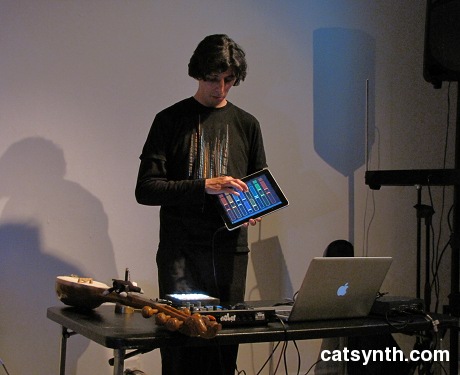
[Click to enlarge, if you must.]
I did reprise my Wicks Looper and Korg Monotron improvisation that had worked well at the previous performance, as well as another another piece featuring additive synthesis in which iPad-controlled tone clouds are set against short percussive tones. At the end of the set, I was joined by Robert L. Pepper from PAS for a duo improvisation featuring acoustic instruments and electronics. We started with a steady pattern on the dotara and large drum, gradually bringing in some electronic sounds controlled by the monome and other acoustic instruments and effects. Overall, we meshed very well musically despite this being our first time ever playing together! I particularly liked the moment where we were both playing string instruments, as it felt particular aligned and expressive. This gave way to a finale with dotara and drums that approached traditional folk music and a well-defined final note. You can hear the full solo and duo in this video:
Amar at TheaterLab, New York. from CatSynth on Vimeo.
The final set featured Richard Lainhart’s film The History of the Future with a live soundtrack performed by the “Orchestra of the Future”, an ad hoc ensemble featuring many of us who had performed in the previous four sets. The film featured clips and images from old educational and demonstration films featuring depictions of possible feature technologies. It’s a snapshot of “what the future used to be” in previous eras.
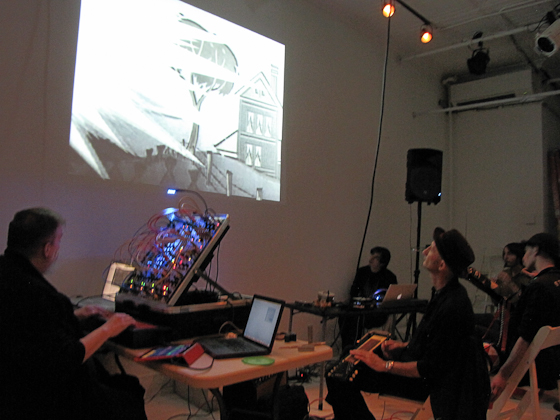
[Orchestra of the Future.]
The improvised soundtrack, which featured a variety of acoustic and electronic instruments, was rich in texture and dynamism and dramatic moments. Everyone did a good job of watching what was happening on the screen and listening to each other. There were moments where it seemed like the relative volumes of instruments were off, but that was a minor issue. It was a great way to end the evening (and a bit of a relief to be in the large ensemble after performing solo).
We had a decently sized audience for the show and a very positive response both during the event itself and in talking to people at the small reception afterwards. It was interesting that although this event was in New York, there were Bay Area connections both among the performers and the audience. This year has been a good one for bi-coastal collaboration and I look forward to more of it next year.
[Additional photos available at Michael Zelner’s flickr set. Additional videos available on vimeo by PAS Music and CatSynth.]
After our first ReCardiacs Fly performance this past spring, we were hoping for an opportunity to perform again. That opportunity came (and went) at the beginning of December as part of an energetic night of music at the Starry Plough in Berkeley that also featured Wiener Kids and Dominique Leone.
ReCardiacs Fly is the coming together of several members of Reconnaissance Fly (Polly Moller, Amar Chaudhary, Tim Walters, Chris Broderick) with Moe! Staiano, Marc Laspina and Suki O’kane as a tribute to the UK band Cardiacs. We performed a full set of Cardiacs songs – the four from the previous show as well as several new ones – with as much authenticity and energy as we could. Much of the work in learning these songs involves mastering the complex meter and rhythm changes that can often be quite unpredictable, and we spent a lot of time practicing in preparation for the show. And the work paid off. I thought R.E.S. in particular came out well, but you can hear for yourself in this video:
[Videography by Marjorie Sturm.]
I am still not sure what R.E.S. stands for.
I also thought Wooden Fish on Wheels came out well – it’s not as hard musically as R.E.S. and some of the others, as it stays in a relatively steady 4/4 ska-like rhythm. I would like take another shot at getting Burn Your House Brown and In A City Lining (both of which I quite like) up to the same level. Overall, however, it was a great performance, and we had a very enthusiastic response from the large crowd at the Starry Plough.

[Photo by Tom Djll.]
As one can see from the above photo, Polly was definitely getting into the character of lead singer Tim Smith. Most of our digital cameras cannot keep up.
The evening opened with Wiener Kids (Jordan Glenn, Aram Shelton and Cory Wright). They are one of the more unusual trios, with Glenn on drums and Shelton and Wright on reeds. As a result, their music has a very sparse texture, which they use to great effect for complex rhythms and lines. I found myself caught up in the patterns with lots of syncopations and unisons and empty space. Every so often they would come together into one jazz-like idiom or another before spreading out again with their unique texture.
Wiener Kids were followed by Dominique Leone together with Ava Mendoza, Aaron Novik and Jordan Glenn pulling double-duty by appearing in two out of three bands. And they were quite a contrast, with thick textures and rich harmony and a more song-like quality, but equally tight in terms of rhythm and phrasing. I found myself particularly interested in Aaron Novik’s use of bass clarinet as the equivalent of a bass guitar, complete with electronic effects.
This won’t be the last ReCardiacs Fly show, as we already have one planned for March in San Francisco. But until then, it’s back to some of the other musical projects. We conclude with an image of some flowers that fulfilled their deranged-rock destiny that evening.

[Photo by Michael Zelner.]
Today we feature Truffle and Brulee of Sweet Purrfections, who happened to be posing last week with a digital piano. I am pretty sure the piano is a Yamaha YPP 200. First, we have Truffle:

And now Brulee:

In their own words:
We love the keyboard in Mom Paula’s office. The keys are softer than the piano keys in the living room and the bench is cushioned (not like the wooden one at the piano). Brulee is trying to show Mom Paula a few things about playing the piano.


Today we look at two current exhibitions at the San Francisco Museum of Modern Art (SFMOMA) that opened in October and continue through mid-January: Richard Serra Drawing and Sharon Lockhart’s Lunch Break. I had the opportunity to attend the museum’s press preview for both of these exhibitions and posted live updates via my Twitter feed @catsynth (the hashtag was #serrapreview).
The main event of the day was the opening of Richard Serra Drawing. I have long been fond of Serra’s large-scall metal sculptures. The minimalist yet strong constructions of flat steel planes or gently curving metal are instantly recognizable as his. This exhibition was my first experience with his drawings and sketches. Many of the pieces had the same characteristics as his sculptures, the reliance on strong geometric forms in a minimal presentation, such as his 1973 piece Untitled. One could see this piece as the shadow of one of his sculptures.

[Richard Serra, Untitled, 1973; paintstick and charcoal on paper; 50 x 38 inches; collection of Mary and Harold Zlot; © 2011 Richard Serra / Artist Rights Society (ARS), New York; photo: Ben Blackwell]
Several of the pieces rivaled his sculptures in scale.

[Richard Serra, Blank, 1978; paintstick on Belgian linen; 2 parts, each 120 ¼ x 120 ¼ inches; Stedelijk Museum, Amsterdam; © 2011 Richard Serra / Artist Rights Society (ARS), New York; photo: Gianfranco Gorgoni]
However, to simply describe the work in this exhibition as Serra’s sculptures flattened to two dimensions would miss most of what makes it unique and surprising. Many of the large black pieces are done with painstick, and the large geometric shapes which smooth from a distance have a very rich and rough texture. However, to simply describe the work in this exhibition as Serra’s sculptures flattened to two dimensions would miss most of what makes it unique and surprising. Many of the large black pieces are done with painstick, and the large geometric shapes which smooth from a distance have a very rich and rough texture. It was something I referred to while visiting as “liquidy roughness.” The texture and medium also allowed Serra to move beyond basic geometry into forms that cannot easily be realized as sculpture. In out-of-round X, an exaggerated texture is present in the main circular shapes, and continues to diffuse out past its edges. It is not a simple graduation where the texture becomes more diffuse from the center, there is still some semblance of a geometric shape in the image. But it is nonetheless unlike any of his sculptures, and I would not have automatically marked this as Serra’s if I saw it from a distance outside of the exhibition.

[Richard Serra, out-of-round X, 1999; paintstick on handmade Hiromi paper; 79 ½ x 79 inches; collection of the artist; © 2011 Richard Serra / Artist Rights Society (ARS), New York; photo: Rob McKeever]
Indeed, more organic circular shapes and ambiguous edges abound in Serra’s drawings. He also escapes from the solid or semisolid forms with line drawings that add more empty space. In these drawings, he reduces the drawings to one-dimensional forms in a way similar to his use of planes in three-dimensional space.

The gallery presentation provided a chance to see the diversity of the works side-by-side, but also left a large amount of empty space that abstract pieces truly need to be appreciated. I liked this location which featured Diamond (1974/2011) in the foreground and the circular Institutionalized Abstract Art (1976/2011) around the corner. Both were redrawn on the walls for this exhibition. They are perhaps the most minimal of all the pieces, and as such benefited the most from the context of gallery and the association with the other works. They provided a contrast to more roughly drawn or textured pieces. The spacious presentation also allowed room to explore the shapes in a personal manner. One wall of pieces entitled Drawings after circuit featured simple lines against aging paper, and seemed ripe for interpretation as a Hipstamatic photo.
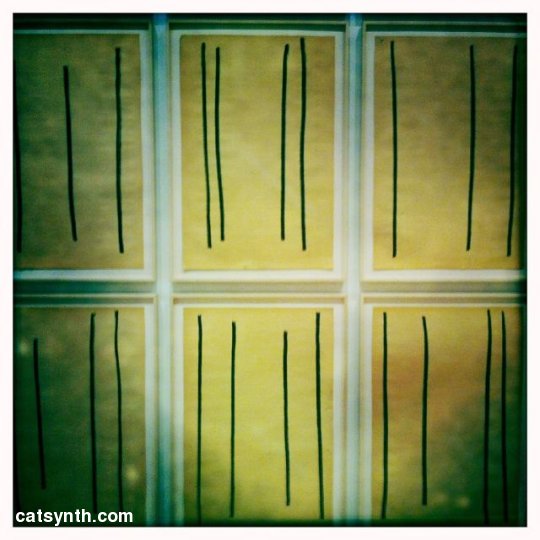
[Click image to enlarge.]
The notebooks, while not as monumental, presented another dimension of Serra distinct from both his large drawings and his sculpture. We see the freedom to explore shapes and ideas that don’t yet need to stand up in large scale.

[Richard Serra, notebook: Double Torqued Ellipses; Guggenheim Bilbao, Spain, 2005; paintstick on paper; sheet: 12 ¼ x 14 ½ inches; collection of the artist; © 2011 Richard Serra / Artist Rights Society (ARS), New York; photo: Rob McKeever]
There are not only small sketches of ideas that could be used in larger works, but energetic and curving sribbles and even playful human shapes. The notebooks serve more as inspiration for visitors (particular visitors who are themselves artists) than as works unto themselves.
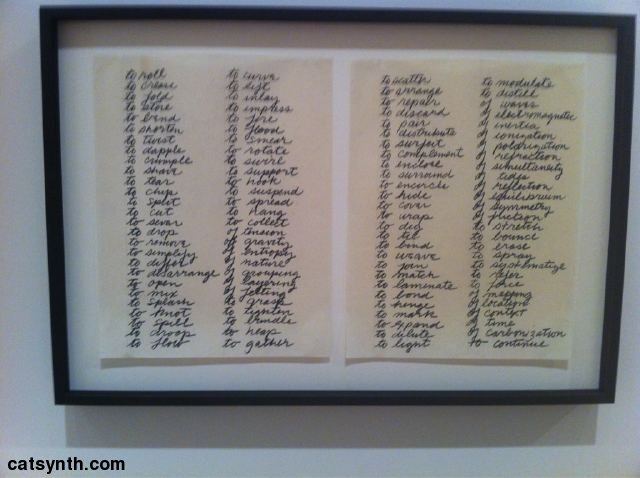
Perhaps the most unusual piece was the list of verbs that appeared at the beginning of the exhibition.
[Click image to enlarge.]
It could serve as both an artist statement as well as an art piece.
At the end of the tour, Richard Serra was present to discuss the exhibition and take questions from the press. He had a very clear and accessible way of describing his work and process, as much engineer as artist.

It was interesting to hear him describe traditional architecture he saw in Spain and Turkey as sources of inspiration for his work. I associate stylized form and intricate detail with such architecture, and what attracts me to Serra’s work is its break with these traditions for a more simple focus on large-scale textures and geometries, and the exploration of asymmetry. I did not get a chance to ask any questions myself, squished among members of the established art press, but it still good to just be present and listen.
Sharon Lockhart’s Lunch Break is quite a contrast to the Serra drawings in media, style and subject matter. Through photographs and film, Lockhart presents a personal-scale view of industrial labor at the Bath Iron Works, a large naval shipyard in Maine. The artist spent a year in the town and at the shipyard, “interacting with workers and gaining their trust and collaboration.” The result is a portrait that is both intimate and detached. In the photographs we see everyday objects and elements of the “shadow” economy among the workers, such has makeshift cafes and lunch stands. The film meanwhile turns a short period of the workers on lunch break into a monumental portrait of industrial life.
The film is based on ten minutes of footage tracking along the a 1,200 foot hallway, without any panning, zooming or any other motion of the camera besides the steady forward progression. Along the hallway, workers go about the normal routines during lunch break, sitting, standing, eating, reading, talking However, what we ultimately see is anything but routine. The film is slowed down to 80 minutes (one eighth the speed of the original). The result is a stretched out abstract industrial exploration, which emphasizes the expanse and straight lines of the hallway as we pass by the workers.

[Sharon Lockhart, Lunch Break (Assembly Hall, Bath Iron Works, November 5, 2007, Bath, Maine) (still), 2008; 35mm film transferred to HD, 80 min.; courtesy the artist and Blum & Poe, Los Angeles; © Sharon Lockhart]
The music, a similarly slowed down mixture of sounds collected from the factory space by filmmaker James Benning and composer Becky Allen, gives a heightened sense of a fictionalized industrial landscape. Of course, I immediately started deconstructing the sound, which appeared to be a combination of pitch and time shifting and granular synthesis, but this did not detract from the overall presentation of the film, which was projected on the wall of a dark elongated room with surround sound for an immersive experience and other worldly experience. Although the film itself was interesting to watch, it was the music that kept my attention for an extended period of time. I tended less to see the details of workers in the visual and focused more on the big picture of the hallway, while in the music I kept looking for details, little bits of metallic or machinery sounds, or the occasional hint of human activity, amidst the overall drone of low-frequency noise. It is hard to give a sense of the piece, with just an image. It should be experienced in person with the full sound.
The photographs that accompanied the film were not altered and presented images of the lives of the workers at the shipyard that would normally be hidden to outsiders. Several of the workers have set up small shops that sell coffee and food and operate as a shadow economy, where people leave money in boxes on an honor system.

[Sharon Lockhart, Dirty Don’s Delicious Dogs, 2008; chromogenic print; 41 1/16 x 51 1/16 in.; courtesy the artist and Blum & Poe, Los Angeles, Gladstone Gallery, New York, and neugerriemschneider, Berlin; © Sharon Lockhart]
The images are impersonal in the sense that they do not include any people, but the personalities of the workers who created the objects and spaces are indirectly present. In contrast to the film, with the industrial sounds of the music and scale of hallway dominate the viewer’s attention, the images and silence leave the viewer free to imagine the people who wrote the signs on the shops or attached the stickers to the lunch boxes. In particular, that was my impression from the sign “Please don’t forget to put money in the bank” with its accompanying smiley face. This sign forms the cover for exhibition catalog as well.

[Sharon Lockhart, Handley’s Snack Shop, 2008; chromogenic print; 41 1/16 x 51 1/16 in.; courtesy the artist and Blum & Poe, Los Angeles, Gladstone Gallery, New York, and neugerriemschneider, Berlin; © Sharon Lockhart]
Although Lunch Break presents it subject with a certain detachment and abstraction, it is hard to separate it completely from the economic and political reality of contemporary life in the U.S. As stated in the official release, “The project’s attention to the local and to the rarely portrayed experience of the working class take on a particular social and political relevance in the context of global capitalism, war, and economic recession.” The opening was occurring at the same time that the Bay Area incarnations of the Occupy movement were just picking up momentum (my first visit to OccupySF was just a few days earlier.) The combination leads to interesting questions about how protest, art, and the daily routines of working people intersect (and how they often don’t).
It was interesting to have seen both of these exhibitions together, and then reflect on them side-by-side several weeks later. My experience of Serra’s drawings is defined by shape and texture, and leads to more internal contemplation and fewer words that reflect the scale and space of the exhibition. By contrast, Lockhart’s Lunch Break speaks to me on a technical level with music, film and photography, and is on a personal scale. As such, it leads to more words and thoughts upon reflection. Both are valuable experiences and ways of seeing art.
Both exhibitions will be on view at SFMOMA through January 16, 2012. I strongly recommend checking them out if you are in the Bay Area.
[All captioned images are provided courtesy of the San Francisco Museum of Modern Art. Images marked “catsynth.com” were taken by the author during the press preview.]
A music video this morning, via matrixsynth:
“‘Shy and Strange’ by Uku Maze, 11. december 2011
Lyrics, melody, vocal, arranger & production: Tine Louise Kortermand
Bass & arranger: Boe Katharina Demsy Przemyslak
Beats, synth, arranger & production: Kristoffer OvesenOther participants: The dog Zeus, the rabbit Stampe and the cat Gilbert.
Video concept and finalcut edit: Tine Louise Kortermand
Camera: Tine Kortermand, Camilla Kortermand, Xenia Haurand & Rico Feldfoss. Colourgrading: Rico Feldfoss
Thanks to drawings and assistance: Xenia Haurand & Karen MØ”
Look for the white cat Gilbert about 2 minutes into the video. Also look for the bowed electric bass. There are also some interesting moments with line drawings and costuming (particularly the pink and white outfit), as well as a few gear shots with Jomox, Korg, etc.
With so many eyes turning northward at this time of year, we thought we take a look at the northernmost highway in the United States, Alaska’s Dalton Highway.

The Dalton Highway (Alaska highway 11) begins north of Fairbanks and extends northward towards Prudhoe Bay along the Arctic Ocean. It actually ends a few miles short of the ocean in the town of Deadhorse (what a great name!) with private roads covering the remaining distance. The southern section of the highway passes through the state’s forested interior, and on the E.L. Patton Yukon River Bridge. This is apparently the only bridge crossing the Yukon River in Alaska.

[Photo by Stan Stebs via Wikimedia Commons.]
As one gets further north, the trees disappear and highway winds its way through the sparse and undulating terrain as a narrow gravel road parallel to the pipeline. It is this landscape that perhaps most uniquely defines this road.

The stark landscape of clean rolling hills and muted greens looks quite interesting and inviting. But it is easy to forget that it does get very cold and covered in snow and ice for quite a bit of the year, and can be quite treacherous.
The landscape flattens out and becomes more barren as the highway approaches its northern terminus near the Arctic Ocean. It ends at a very unassuming intersection at the edge of a lake in Deadhorse, as seen is this image from Google Street View:


It looks like the left turn leads into the town itself, which includes the sign shown to the left and where one can book tours to the coast. The right turn appears to lead towards the oil installations, with street view stopping at a gate. Interestingly, the entire length of the highway can been seen on Google Street View. I can only imagine the scene of one of the Google cars traveling alone along the road.
Alaska is one of six states in the U.S. I have not yet visited. If I do make it there, I would like to see this highway. But probably not during the winter.

