Today we look back at the second of my November performances in New York. This one took place at Theater Lab in Manhattan in one of the venue’s stark white studios that served as both performance venue and blank canvas. There were several now-familar faces from east coast shows, as well as new artists that I heard for the first time.
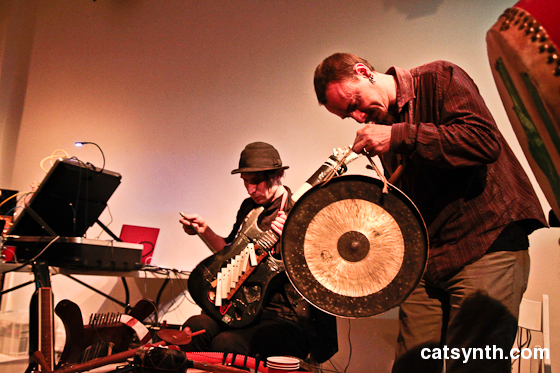
The show opened with an acoustic performance by PAS, featuring Robert L. Pepper, Amber Brien, Michael Durek and John “Vomit” Worthley with guest Carlo Altomare (one of the founders of TheaterLab) on piano. The acoustic instruments included a wide variety of percussion, strings and winds, as well as DIY combinations of objects (buckets, balloons, etc.) to produce other sounds. In this way, they played acoustic instruments as if they were synthesizers.


[PAS. (Click images to enlarge.)]
The performance moved between gradually evolving by strongly rhythmic material and more freeform noise textures, all expressive and performed with a wide dynamic range. At various times, the performers moved around the space, among the audience and up into the loft, which added a theatrical element as well as spatialization. You can see and hear for yourself in this video:
PAS live with Carlo Altomare at Experi-MENTAL Night at Theaterlab. November 26th, 2011 from PAS Music on Vimeo.
The particular combination of instruments and idiomatic playing gave portions of the performance an Asian feel (particularly at the beginning of the video), but even there the piano provides an avant-gard counterpoint and the overall texture moves to something more reminiscent of Henry Cowell before moving into a more experimental dramatic mode featuring Altomare soloing on piano and Pepper repeatedly chanting “Piano Man!” I like how they were able to move so easily between the different timbres and textures and rhythms without stopping, except of course for the silences that occurred in response to the instruction “Silence!” In all, a great set that set a confident tone for the entire evening.
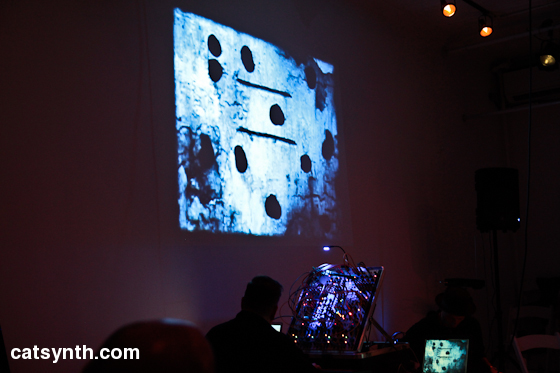
Next was a duo featuring Richard Lainhart on a Buchla synthesizer and Lucio Menegon on strings and effects. They performed a live improvised set to a film by Scratch Film junkies.

The film was beautiful and mesmerizing, though I did find myself also watching the Buchla to see and hear what was happening. In general, the synth performance was subtle and blended well with the string sounds to produce an overall ambient texture, with occasional metallic and inharmonic swells. The eerie and slowly moving sound fit the abstract video, with frequently changing clips overlaid with digital effects that simulated paint and chemical treatment. At times, the harmonies and timbres seemed to approach an acoustic orchestra and choir, as one might hear in a science fiction film, while others seemed to channel the sounds of bowed metal and glass.
PAS presents Experi-MENTAL Night with a duo by Richard Lainhart and Lucio Menegon at Theaterlab from PAS Music on Vimeo.
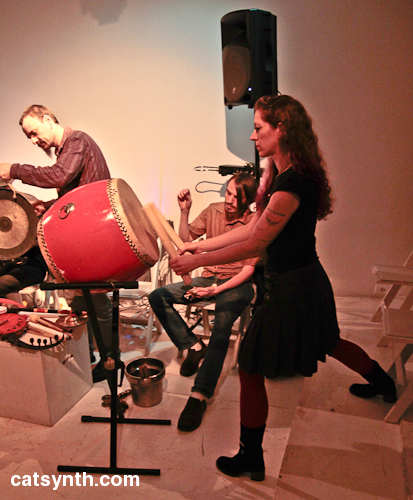
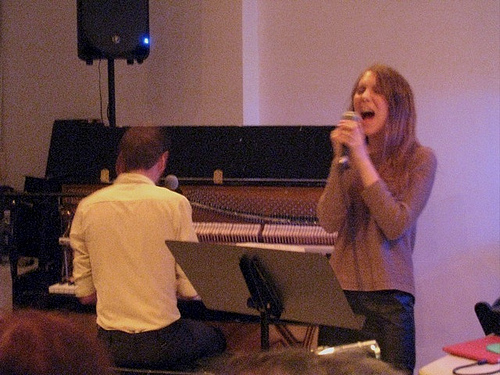
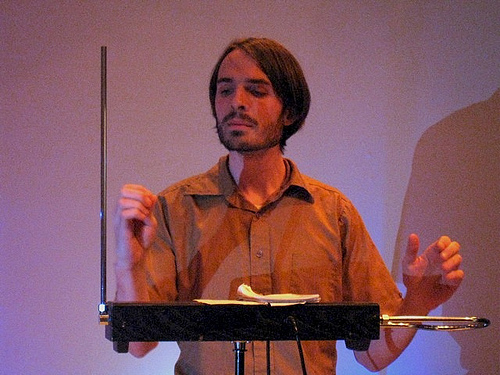
This was followed by a trio featuring Jay Pluck on piano, Julia Violet on vocals, and Michael Durek returning, this time on theremin.


[Jay Pluck, Julia Violet, and Michael Durek. Photos by Michael Zelner. (Click to enlarge.)]
This was the most traditional and idiomatic of any set during the show. The songs were songs, quite lyrical and featuring traditional harmonies and melodic lines for voice and theremin. The introduction featured a theremin solo – Durek is quite good at getting standard pitching and phrasings from the instrument – set against gently rolling arpeggios of romantic chords on the piano. As Violet’s vocals enter, the music takes on a light cabaret feel, but the theremin backed with Mini-Kaoss Pad effects, continues to give it a somewhat otherworldly quality. The second song, which featured more major harmonies, had a bit of a 1960s rock quality to it, as if it was it was a song from a popular album rescored for piano and voice. Here the theremin had a bit of a darker tone.
After that it was time to take the stage. It was basically the same setup as a few nights earlier at the AvantElectroExpectroExtravaganza in Brooklyn, but with a few musical differences. I opened with a newly programmed piece that featured timbres based on the Bohlen 833 scale in which I could call up individual pitches and harmonics via the monome and iPad working together. The end result was a somewhat an ambient piece that was relaxed but with anxious undertones.
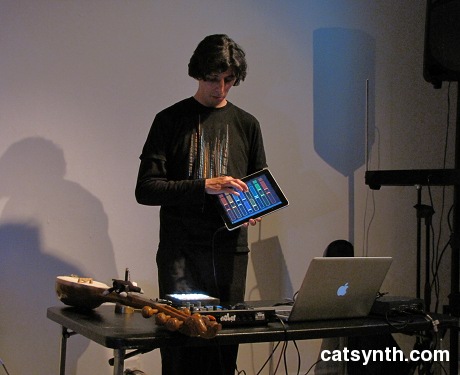
[Click to enlarge, if you must.]
I did reprise my Wicks Looper and Korg Monotron improvisation that had worked well at the previous performance, as well as another another piece featuring additive synthesis in which iPad-controlled tone clouds are set against short percussive tones. At the end of the set, I was joined by Robert L. Pepper from PAS for a duo improvisation featuring acoustic instruments and electronics. We started with a steady pattern on the dotara and large drum, gradually bringing in some electronic sounds controlled by the monome and other acoustic instruments and effects. Overall, we meshed very well musically despite this being our first time ever playing together! I particularly liked the moment where we were both playing string instruments, as it felt particular aligned and expressive. This gave way to a finale with dotara and drums that approached traditional folk music and a well-defined final note. You can hear the full solo and duo in this video:
Amar at TheaterLab, New York. from CatSynth on Vimeo.
The final set featured Richard Lainhart’s film The History of the Future with a live soundtrack performed by the “Orchestra of the Future”, an ad hoc ensemble featuring many of us who had performed in the previous four sets. The film featured clips and images from old educational and demonstration films featuring depictions of possible feature technologies. It’s a snapshot of “what the future used to be” in previous eras.
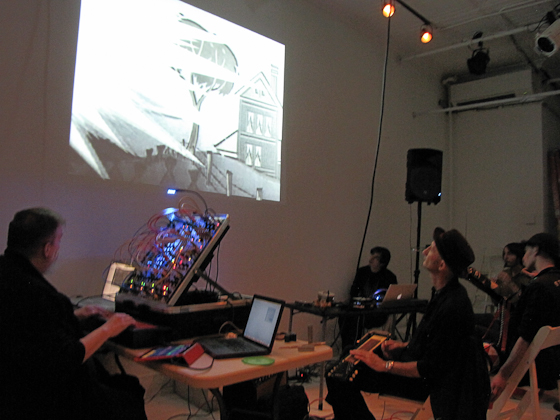
[Orchestra of the Future.]
The improvised soundtrack, which featured a variety of acoustic and electronic instruments, was rich in texture and dynamism and dramatic moments. Everyone did a good job of watching what was happening on the screen and listening to each other. There were moments where it seemed like the relative volumes of instruments were off, but that was a minor issue. It was a great way to end the evening (and a bit of a relief to be in the large ensemble after performing solo).
We had a decently sized audience for the show and a very positive response both during the event itself and in talking to people at the small reception afterwards. It was interesting that although this event was in New York, there were Bay Area connections both among the performers and the audience. This year has been a good one for bi-coastal collaboration and I look forward to more of it next year.
[Additional photos available at Michael Zelner’s flickr set. Additional videos available on vimeo by PAS Music and CatSynth.]



 Just north of both the art center and the downtown core is I-235, the main highway running through the city. We will head east to where I-235 ends at a junction with I-80 and I-35, and then continue east on I-80. I have personally seen the expanses of farmland along this nearly straight stretch of highway, with the occasional road passing overhead on via artificial mounds and the connected with a diamond interchange. We cross US 6, which once stretched across the entire country but now ends in the eastern Sierra in California. We pass by Iowa City and give a shout-out to the infamous Iowa Writer’s Workshop. The program has turned out numerous winners of the Pulitzer Prize and National Book Award, among other honors. My own experience with the world of writing is a bit limited, but it seems very different than the world of music.


 Although it seems natural to explore the state along and east-west axis, one can also travel south to north. Indeed, Iowa has what could be dubbed a “concept highway” running north-south called the Avenue of the Saints because it connects St Louis, Missouri, to St Paul, Minneapolis. It was only designated as a single route, Iowa State Highway 27, in 2001, and mostly overlaps with other longer established routes. In particular, it overlaps with I-380 from near Iowa City northward, passing through Cedar Rapids, the second largest city in the state.
 received some sad and sudden news this past Saturday that