ReCardiacs Fly, Wiener Kids, and Dominque Leone at the Starry Plough

After our first ReCardiacs Fly performance this past spring, we were hoping for an opportunity to perform again. That opportunity came (and went) at the beginning of December as part of an energetic night of music at the Starry Plough in Berkeley that also featured Wiener Kids and Dominique Leone.

ReCardiacs Fly is the coming together of several members of Reconnaissance Fly (Polly Moller, Amar Chaudhary, Tim Walters, Chris Broderick) with Moe! Staiano, Marc Laspina and Suki O’kane as a tribute to the UK band Cardiacs. We performed a full set of Cardiacs songs – the four from the previous show as well as several new ones – with as much authenticity and energy as we could. Much of the work in learning these songs involves mastering the complex meter and rhythm changes that can often be quite unpredictable, and we spent a lot of time practicing in preparation for the show. And the work paid off. I thought R.E.S. in particular came out well, but you can hear for yourself in this video:


[Videography by Marjorie Sturm.]

I am still not sure what R.E.S. stands for.

I also thought Wooden Fish on Wheels came out well – it’s not as hard musically as R.E.S. and some of the others, as it stays in a relatively steady 4/4 ska-like rhythm. I would like take another shot at getting Burn Your House Brown and In A City Lining (both of which I quite like) up to the same level. Overall, however, it was a great performance, and we had a very enthusiastic response from the large crowd at the Starry Plough.


[Photo by Tom Djll.]

As one can see from the above photo, Polly was definitely getting into the character of lead singer Tim Smith. Most of our digital cameras cannot keep up.

The evening opened with Wiener Kids (Jordan Glenn, Aram Shelton and Cory Wright). They are one of the more unusual trios, with Glenn on drums and Shelton and Wright on reeds. As a result, their music has a very sparse texture, which they use to great effect for complex rhythms and lines. I found myself caught up in the patterns with lots of syncopations and unisons and empty space. Every so often they would come together into one jazz-like idiom or another before spreading out again with their unique texture.

Wiener Kids were followed by Dominique Leone together with Ava Mendoza, Aaron Novik and Jordan Glenn pulling double-duty by appearing in two out of three bands. And they were quite a contrast, with thick textures and rich harmony and a more song-like quality, but equally tight in terms of rhythm and phrasing. I found myself particularly interested in Aaron Novik’s use of bass clarinet as the equivalent of a bass guitar, complete with electronic effects.

This won’t be the last ReCardiacs Fly show, as we already have one planned for March in San Francisco. But until then, it’s back to some of the other musical projects. We conclude with an image of some flowers that fulfilled their deranged-rock destiny that evening.


[Photo by Michael Zelner.]

CatSynth pic: Truffle and Brulee with Digital Piano

Today we feature Truffle and Brulee of Sweet Purrfections, who happened to be posing last week with a digital piano.  I am pretty sure the piano is a Yamaha YPP 200. First, we have Truffle:

And now Brulee:

In their own words:

We love the keyboard in Mom Paula’s office.  The keys are softer than the piano keys in the living room and the bench is cushioned (not like the wooden one at the piano).  Brulee is trying to show Mom Paula a few things about playing the piano.

cats on tuesday

Richard Serra Drawing and Sharon Lockhart Lunch Break, SFMOMA

Today we look at two current exhibitions at the San Francisco Museum of Modern Art (SFMOMA) that opened in October and continue through mid-January: Richard Serra Drawing and Sharon Lockhart’s Lunch Break. I had the opportunity to attend the museum’s press preview for both of these exhibitions and posted live updates via my Twitter feed @catsynth (the hashtag was #serrapreview).

The main event of the day was the opening of Richard Serra Drawing. I have long been fond of Serra’s large-scall metal sculptures. The minimalist yet strong constructions of flat steel planes or gently curving metal are instantly recognizable as his. This exhibition was my first experience with his drawings and sketches. Many of the pieces had the same characteristics as his sculptures, the reliance on strong geometric forms in a minimal presentation, such as his 1973 piece Untitled. One could see this piece as the shadow of one of his sculptures.

[Richard Serra, Untitled, 1973; paintstick and charcoal on paper; 50 x 38 inches; collection of Mary and Harold Zlot; © 2011 Richard Serra / Artist Rights Society (ARS), New York; photo: Ben Blackwell]

Several of the pieces rivaled his sculptures in scale.

[Richard Serra, Blank, 1978; paintstick on Belgian linen; 2 parts, each 120 ¼ x 120 ¼ inches; Stedelijk Museum, Amsterdam; © 2011 Richard Serra / Artist Rights Society (ARS), New York; photo: Gianfranco Gorgoni]

However, to simply describe the work in this exhibition as Serra’s sculptures flattened to two dimensions would miss most of what makes it unique and surprising. Many of the large black pieces are done with painstick, and the large geometric shapes which smooth from a distance have a very rich and rough texture. However, to simply describe the work in this exhibition as Serra’s sculptures flattened to two dimensions would miss most of what makes it unique and surprising.  Many of the large black pieces are done with painstick, and the large geometric shapes which smooth from a distance have a very rich and rough texture.  It was something I referred to while visiting as “liquidy roughness.” The texture and medium also allowed Serra to move beyond basic geometry into forms that cannot easily be realized as sculpture. In out-of-round X, an exaggerated texture is present in the main circular shapes, and continues to diffuse out past its edges. It is not a simple graduation where the texture becomes more diffuse from the center, there is still some semblance of a geometric shape in the image. But it is nonetheless unlike any of his sculptures, and I would not have automatically marked this as Serra’s if I saw it from a distance outside of the exhibition.

[Richard Serra, out-of-round X, 1999; paintstick on handmade Hiromi paper; 79 ½ x 79 inches; collection of the artist; © 2011 Richard Serra / Artist Rights Society (ARS), New York; photo: Rob McKeever]

Indeed, more organic circular shapes and ambiguous edges abound in Serra’s drawings. He also escapes from the solid or semisolid forms with line drawings that add more empty space. In these drawings, he reduces the drawings to one-dimensional forms in a way similar to his use of planes in three-dimensional space.

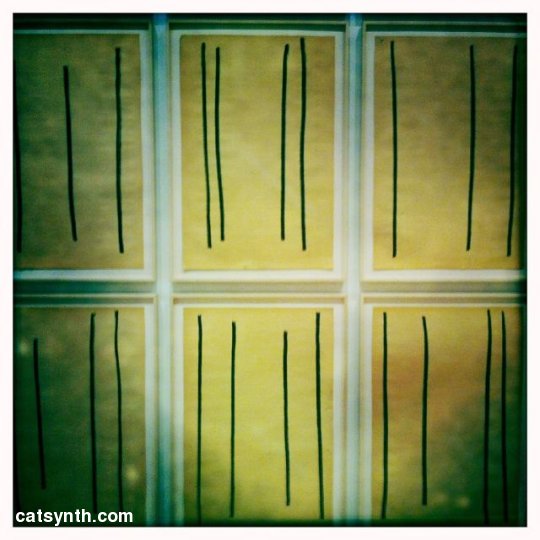
The gallery presentation provided a chance to see the diversity of the works side-by-side, but also left a large amount of empty space that abstract pieces truly need to be appreciated. I liked this location which featured Diamond (1974/2011) in the foreground and the circular Institutionalized Abstract Art (1976/2011) around the corner. Both were redrawn on the walls for this exhibition. They are perhaps the most minimal of all the pieces, and as such benefited the most from the context of gallery and the association with the other works. They provided a contrast to more roughly drawn or textured pieces. The spacious presentation also allowed room to explore the shapes in a personal manner. One wall of pieces entitled Drawings after circuit featured simple lines against aging paper, and seemed ripe for interpretation as a Hipstamatic photo.

[Click image to enlarge.]

The notebooks, while not as monumental, presented another dimension of Serra distinct from both his large drawings and his sculpture. We see the freedom to explore shapes and ideas that don’t yet need to stand up in large scale.

[Richard Serra, notebook: Double Torqued Ellipses; Guggenheim Bilbao, Spain, 2005; paintstick on paper; sheet: 12 ¼ x 14 ½ inches; collection of the artist; © 2011 Richard Serra / Artist Rights Society (ARS), New York; photo: Rob McKeever]

There are not only small sketches of ideas that could be used in larger works, but energetic and curving sribbles and even playful human shapes.  The notebooks serve more as inspiration for visitors (particular visitors who are themselves artists) than as works unto themselves.

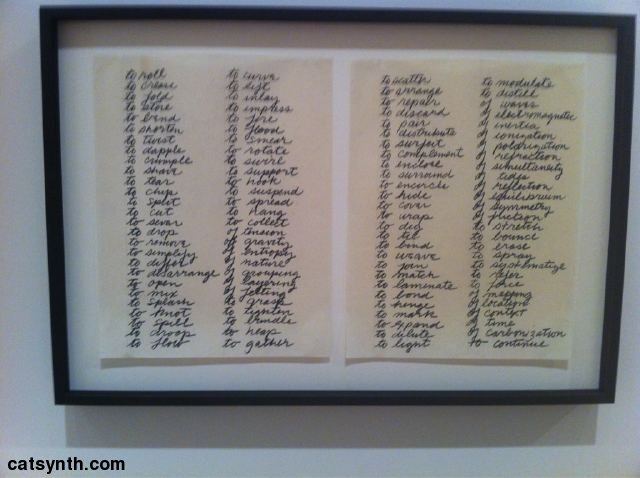
Perhaps the most unusual piece was the list of verbs that appeared at the beginning of the exhibition.

[Click image to enlarge.]

It could serve as both an artist statement as well as an art piece.

At the end of the tour, Richard Serra was present to discuss the exhibition and take questions from the press. He had a very clear and accessible way of describing his work and process, as much engineer as artist.

It was interesting to hear him describe traditional architecture he saw in Spain and Turkey as sources of inspiration for his work. I associate stylized form and intricate detail with such architecture, and what attracts me to Serra’s work is its break with these traditions for a more simple focus on large-scale textures and geometries, and the exploration of asymmetry. I did not get a chance to ask any questions myself, squished among members of the established art press, but it still good to just be present and listen.


Sharon Lockhart’s Lunch Break is quite a contrast to the Serra drawings in media, style and subject matter. Through photographs and film, Lockhart presents a personal-scale view of industrial labor at the Bath Iron Works, a large naval shipyard in Maine. The artist spent a year in the town and at the shipyard, “interacting with workers and gaining their trust and collaboration.” The result is a portrait that is both intimate and detached. In the photographs we see everyday objects and elements of the “shadow” economy among the workers, such has makeshift cafes and lunch stands. The film meanwhile turns a short period of the workers on lunch break into a monumental portrait of industrial life.

The film is based on ten minutes of footage tracking along the a 1,200 foot hallway, without any panning, zooming or any other motion of the camera besides the steady forward progression. Along the hallway, workers go about the normal routines during lunch break, sitting, standing, eating, reading, talking However, what we ultimately see is anything but routine. The film is slowed down to 80 minutes (one eighth the speed of the original). The result is a stretched out abstract industrial exploration, which emphasizes the expanse and straight lines of the hallway as we pass by the workers.

[Sharon Lockhart, Lunch Break (Assembly Hall, Bath Iron Works, November 5, 2007, Bath, Maine) (still), 2008; 35mm film transferred to HD, 80 min.; courtesy the artist and Blum & Poe, Los Angeles; © Sharon Lockhart]

The music, a similarly slowed down mixture of sounds collected from the factory space by filmmaker James Benning and composer Becky Allen, gives a heightened sense of a fictionalized industrial landscape. Of course, I immediately started deconstructing the sound, which appeared to be a combination of pitch and time shifting and granular synthesis, but this did not detract from the overall presentation of the film, which was projected on the wall of a dark elongated room with surround sound for an immersive experience and other worldly experience. Although the film itself was interesting to watch, it was the music that kept my attention for an extended period of time. I tended less to see the details of workers in the visual and focused more on the big picture of the hallway, while in the music I kept looking for details, little bits of metallic or machinery sounds, or the occasional hint of human activity, amidst the overall drone of low-frequency noise.  It is hard to give a sense of the piece, with just an image. It should be experienced in person with the full sound.

The photographs that accompanied the film were not altered and presented images of the lives of the workers at the shipyard that would normally be hidden to outsiders. Several of the workers have set up small shops that sell coffee and food and operate as a shadow economy, where people leave money in boxes on an honor system.

[Sharon Lockhart, Dirty Don’s Delicious Dogs, 2008; chromogenic print; 41 1/16 x 51 1/16 in.; courtesy the artist and Blum & Poe, Los Angeles, Gladstone Gallery, New York, and neugerriemschneider, Berlin; © Sharon Lockhart]

The images are impersonal in the sense that they do not include any people, but the personalities of the workers who created the objects and spaces are indirectly present. In contrast to the film, with the industrial sounds of the music and scale of hallway dominate the viewer’s attention, the images and silence leave the viewer free to imagine the people who wrote the signs on the shops or attached the stickers to the lunch boxes. In particular, that was my impression from the sign “Please don’t forget to put money in the bank” with its accompanying smiley face. This sign forms the cover for exhibition catalog as well.

[Sharon Lockhart, Handley’s Snack Shop, 2008; chromogenic print; 41 1/16 x 51 1/16 in.; courtesy the artist and Blum & Poe, Los Angeles, Gladstone Gallery, New York, and neugerriemschneider, Berlin; © Sharon Lockhart]

Although Lunch Break presents it subject with a certain detachment and abstraction, it is hard to separate it completely from the economic and political reality of contemporary life in the U.S. As stated in the official release, “The project’s attention to the local and to the rarely portrayed experience of the working class take on a particular social and political relevance in the context of global capitalism, war, and economic recession.” The opening was occurring at the same time that the Bay Area incarnations of the Occupy movement were just picking up momentum (my first visit to OccupySF was just a few days earlier.) The combination leads to interesting questions about how protest, art, and the daily routines of working people intersect (and how they often don’t).


It was interesting to have seen both of these exhibitions together, and then reflect on them side-by-side several weeks later. My experience of Serra’s drawings is defined by shape and texture, and leads to more internal contemplation and fewer words that reflect the scale and space of the exhibition. By contrast, Lockhart’s Lunch Break speaks to me on a technical level with music, film and photography, and is on a personal scale. As such, it leads to more words and thoughts upon reflection. Both are valuable experiences and ways of seeing art.

Both exhibitions will be on view at SFMOMA through January 16, 2012. I strongly recommend checking them out if you are in the Bay Area.

[All captioned images are provided courtesy of the San Francisco Museum of Modern Art.  Images marked “catsynth.com” were taken by the author during the press preview.]

CatSynth video: UKU MAZE shy and strange

A music video this morning, via matrixsynth:

“‘Shy and Strange’ by Uku Maze, 11. december 2011

Lyrics, melody, vocal, arranger & production: Tine Louise Kortermand
Bass & arranger: Boe Katharina Demsy Przemyslak
Beats, synth, arranger & production: Kristoffer Ovesen

Other participants: The dog Zeus, the rabbit Stampe and the cat Gilbert.

Video concept and finalcut edit: Tine Louise Kortermand
Camera: Tine Kortermand, Camilla Kortermand, Xenia Haurand & Rico Feldfoss. Colourgrading: Rico Feldfoss
Thanks to drawings and assistance: Xenia Haurand & Karen MØ”

Look for the white cat Gilbert about 2 minutes into the video. Also look for the bowed electric bass. There are also some interesting moments with line drawings and costuming (particularly the pink and white outfit), as well as a few gear shots with Jomox, Korg, etc.

Dalton Highway, Alaska

With so many eyes turning northward at this time of year, we thought we take a look at the northernmost highway in the United States, Alaska’s Dalton Highway.

The Dalton Highway (Alaska highway 11) begins north of Fairbanks and extends northward towards Prudhoe Bay along the Arctic Ocean. It actually ends a few miles short of the ocean in the town of Deadhorse (what a great name!) with private roads covering the remaining distance. The southern section of the highway passes through the state’s forested interior, and on the E.L. Patton Yukon River Bridge. This is apparently the only bridge crossing the Yukon River in Alaska.

[Photo by Stan Stebs via Wikimedia Commons.]

As one gets further north, the trees disappear and highway winds its way through the sparse and undulating terrain as a narrow gravel road parallel to the pipeline. It is this landscape that perhaps most uniquely defines this road.

The stark landscape of clean rolling hills and muted greens looks quite interesting and inviting.  But it is easy to forget that it does get very cold and covered in snow and ice for quite a bit of the year, and can be quite treacherous.

The landscape flattens out and becomes more barren as the highway approaches its northern terminus near the Arctic Ocean. It ends at a very unassuming intersection at the edge of a lake in Deadhorse, as seen is this image from Google Street View:

It looks like the left turn leads into the town itself, which includes the sign shown to the left and where one can book tours to the coast.  The right turn appears to lead towards the oil installations, with street view stopping at a gate.  Interestingly, the entire length of the highway can been seen on Google Street View. I can only imagine the scene of one of the Google cars traveling alone along the road.

Alaska is one of six states in the U.S. I have not yet visited. If I do make it there, I would like to see this highway. But probably not during the winter.

Weekend Cat Blogging: Hanukkah Cat

For this year’s holiday edition of Weekend Cat Blogging, we have scenes from our rather casual observance of Hanukkah.

Luna inspects the iPad-based menorah after the fourth night (which happened on Friday). The iPad app is from an Israeli studio, and has simulated oil flames rather than candle flames. It has the traditional prayer in Hebrew, which I cannot read particularly well – growing up, we either said it in English or from transliteration.

We do have a real menorah as well, but Luna is not allowed near it. You can see it in this post from the past.

Luna did get some new toys to play with. She is quite fond of the catnip-filled variety.


Weekend Cat Blogging #342 is hosted by Jules and Vincent, at Judi’s Mind Over Matter. Check out their great black-and-white photos.

Carnival of the Cats will be hosted tomorrow by Billy SweetFeets.

The Friday Ark is off this week for the holidays.

December 1 Electronic Music at the Luggage Store Gallery, San Francisco

The December 1 show at the Luggage Store Gallery in San Francisco marked my official curatorial debut for the long-running Outsound Presents’ series. The show featured three solo performances with electronics, all very different in terms of musical style and technologies. But while all featured and celebrated different facets of electronic-music technology, there were strong connections to the acoustic and natural environment.

The evening opened with a set by Headboggle (aka Derek Gedalecia) with an array of analog electronics, including a Blippo Box. The sounds and possibilities of analog electronics were paired sounds of nature as recorded in the Yosemite Valley. The music began with a rhythmic pattern of high-pitched sounds against longer machine noises and clear presentation of the nature recordings. Gradually, the two sonic strains collided and mixed together.

As with previous Headboggle performances (such as the set at the 2010 Outsound Music Summit), this one was full of energy and stage theater, with head banging, dropping of the stage furniture, and even a moment where he tossed shakers down the Luggage Store Gallery’s stairwell. The music also became more dramatic and percussive, with more glitches, percussive hits and bursts of noise, but all set against the continuing presence of the nature sounds. The harsher electronic sounds gave way to a more rarefied tone over time, with longer periods of harmonic oscillator sounds fading into a quieter single tone. After another percussive period that included lifting and dropping the table holding the care, the environmental sounds took center stage. Between the stereo speakers and the acoustics of the gallery, the leaves and other sounds were strongly spatialized and felt present.

Thea Farhadian followed with a set for violin and computer running Max/MSP. In some sections of her performance, the violin was more of a traditional chamber-music instrument, with its familiar timbres augmented by electronic samples and processing. In others, it was more of a controller, with pizzicato notes triggering long runs of notes from the computer or other purely electronic events. The set started out with solo violin, with the electronics emerging slowly like the orchestra in a concerto. The music continued to unfold as interplay between the violin and electronics. As the texture changed to more pizzicato notes with electronic responses of backward tones, the music grew more anxious, channeling the anxious moments of countless films. I also was reminded of works by Penderecki and Xenakis. A large barrage of electronic pizzicato sounds started to take on a drone-like quality with its density. In both the melodic and percussive sections, the music was harmonically a very strong, a brought in electronic orchestration that suggestion the presence of a cello or bass off stage. Other effects included fast glissandi and electronic pitch changes such as one might achieve by changing the speed of a tape.

Farhadian’s performance was divided into a series of short movements, and some had very different character. In one, short pizzicato notes on the violin acted as triggered for long runs of electronic notes and processing, with various speed, pitch and timbral changes applied. In another, a very lyrical string melody was set against fluttering sounds and dramatic low tones. In yet another, she used “prepared violin”, with bits of foil and other items placed against the strings for percussive effects. The electronic accompaniment was equally scratchy and inharmonic. And in one of the final sections, repeated rhythmic phrases and echoes perfectly aligned.

The final set featured Later Days (aka Wayne Jackson) with a variety of circuit-bent instruments, acoustic and electronic noisemakers, and a laptop running his custom Cambrian Suite audio softsynth with both hand-designed and algorithmically evolved patches. If Farhadian’s performance was all about software-based manipulation and Headboggle was focused on analog hardware, Later Days combined both.

The space was quickly filled with an ocean of electronic sounds, glitches, bleeps, rumbles, short loops and echoes. At one point, everything became extremely quiet, with a few lo-fi distortion sounds and high squeaky analog sounds. The new sampling and looping capabilities of the software were showcased with repeated loops of circuit-bent sounds, a solo on a photo-sensitive oscillator, a car horn and recordings from a microphone dangled out the window onto busy Market Street. The loops built up to a frenzy and the slowed down to almost nothing. The sounds picked up again in pitch and energy, with feedback loops providing an edgy and unpredictable quality. A metallic rhythm emerged, and the faded a single feedback loop. A flurry of “little loud bits” formed an odd harmony of their own. After a series of machine-like noises and a more elemental wind-like sound, the music slowed down once again and came to a watery end.

Over all it was a great concert with a rich variety of music. Indeed, the three artists fit together sequentially even better than I had anticipated. And fortunately, the logistics and technical requirements (e.g., soundchecking) were not that challenging, so I was able to enjoy the show along with the audience.

Fluxus in New York (MoMA and NYU, November 2011)

There have been numerous events this year marking the 50th anniversary of the Fluxus, including two exhibitions that I visited while I was in New York last month.

Fluxus was first named by George Maciunas in 1961, and involved a small network of artists in the United States, Europe and Japan who were already exploring some of the new movement’s ideas. Fluxus art generally involved event scores, or series of text or visual instructions that could be used by other artists to perform the works in the manner of a musical score, and the combination of instructional pieces into “Fluxkits” or “Fluxboxes”, collections of printed cards, games and ideas packed into boxes. Although much of this art was meant to be performed live at Fluxus events that ranged from formal concerts to spontaneous street performances and happenings – Fluxus events “could be performed by anyone, anywhere, at any time” – it also created durable works in the form of films, musical instruments, sculptures, and the Fluxkits themselves.

These ideas are not unique to the formal Fluxus moment of the 1960s and 1970s. Certainly, many of the ideas were present in Dada several decades earlier, as well as John Cage’s experiments with nondeterminacy in the 1950s. And the elements of Fluxus and its precedents are deeply embedded in contemporary art – the DIY sensibilities are present in many of the exhibitions I attend around San Francisco, for example. As such, the exhibitions are at least as much a historical snapshot of a particular time as they are examples of a particular artistic style and practice.


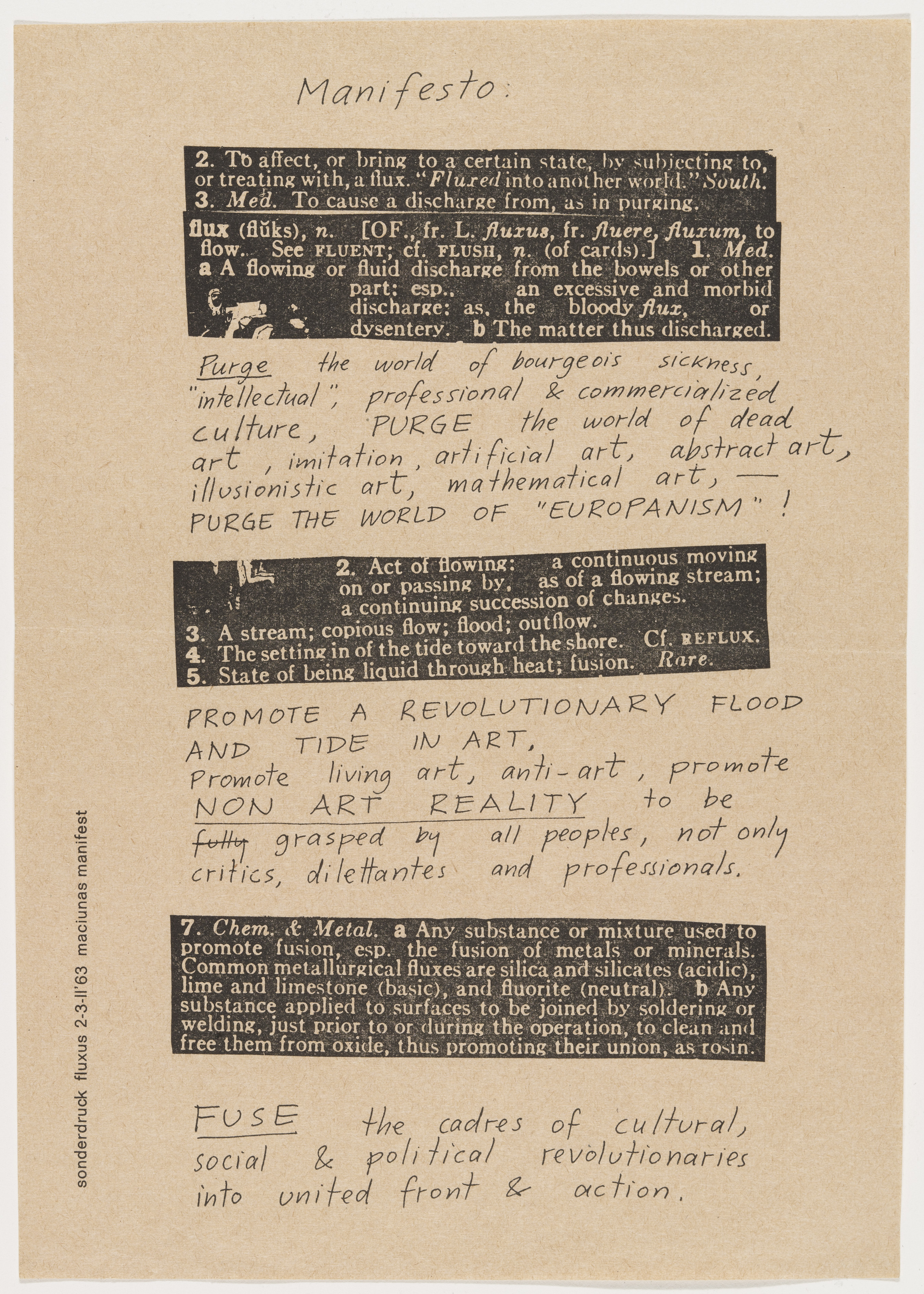
Thing/Thought: Fluxus Editions, 1962–1978 at the Museum of Modern Art (MoMA), presents works from the Gilbert and Lila Silverman Fluxus Collection, which was acquired by the museum in 2008. It was one of the largest collections of its kind and contains over 8,000 artworks and artifacts, including Maciunas’ 1963 Fluxus Manifesto.

[Fluxus Manifesto. 1963. Offset. Edited, designed, and produced by George Maciunas. 8 3/16 x 5 11/16″ (20.8 x 14.5 cm). The Gilbert and Lila Silverman Fluxus Collection Gift, 2008.  Image courtesy of the Museum of Modern Art. (Click image to enlarge.)]

The manifesto itself contains many of the elements associated with Fluxus, the “do-it-yourself” appearance with combinations of found material, personal notes (typed or handwritten), and declarations of spontaneous activity and a break with the traditional media and practices of art.

The duality of an object being at once instructions for a spontaneous artistic expression and itself a work of art appeared throughout the exhibition. This can be seen in the event scores as well as the flux kits.

[Fluxkit. 1965-66, Fluxus Edition announced 1964. Vinyl-covered attaché case containing objects in various mediums. Assembled by George Maciunas. 11 x 44 x 28″ (27.9 x 111.8 x 71.1 cm). The Gilbert and Lila Silverman Fluxus Collection Gift, 2008.  Image courtesy of the Museum of Modern Art.]

FluxKit 1965-6 is at once a practical and portable collection of objects for generating performances. But the individual pieces, such as the cards with their lettering and geometric shapes, and even the arrangement of the elements into the kit box itself, are quite elegant pieces of design. In particular, the cards seem to embody both the do-it-yourself aesthetic and the prevalent tenets of industrial modernist design in the 1960s.

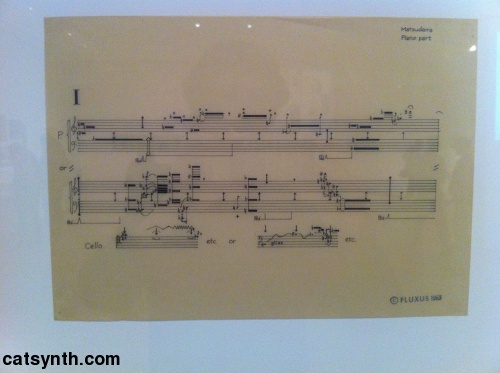
The score for Yoriaki Matsudaira’s Co-Action for Cello and Piano is at once a recognizable extension of traditional music notation and a visual piece with great deal of symmetry and geometry. I have not had a chance yet to try out the piano part myself, but will do so at some point.

[Yoriaki Matsudaira. Co-Action for Cello and Piano I. 1963, Fluxus Edition announced 1963. (Click image to enlarge.)]

The scores of John Cage fit naturally into this context as well, and were included in some of the displays in the exhibition (indeed, it seems like I always encounter at least one Cage piece during every MoMA visit). How closely Cage was involved in any of the Fluxus productions is unclear. He was however a major inspiration for the movement, and several of the prominent artists including George Brecht and Dick Higgins attended his classes

Perhaps the most intriguing of all the pieces were the instruments in Joe Jones’ Mechanical Flux Orchestra.

[Joe Jones. Mechanical Flux Orchestra. c. 1966, Fluxus Edition announced 1966.]

Each of these instruments, such as the Mechanical Violin and Mechanical Bells incorporate electrical motors and strikers that allow them to be self playing. Although these instruments were created in 1966, they still look contemporary with many of the electromechanical musical installations created today, although the electronic elements have improved. Similarly, Metal Zitar #4 has a striking minimalist appearance that could be part of a contemporary installation.

The contributions of Nam Jun Paik to the exhibition also explored the musicality of Fluxus, including it in his “essay” The Monthly Review of the University for Avant-Garde Hinduism! (Postmusic). In this piece, typewritten bits of the text are scattered at odd angles with the same DIY aesthetic as Maciunas’ manifesto and begins with the words “I am tired of renewing the form of music. – serial or aleatoric, graphic or five lines, instrumental or bellcanto, screaming or action, tape or live …”. Yet the art for which he is most known, his beautiful analog video compositions, are quite musical, and indeed he was quite directly influenced by Cage and Stockhausen to produce this body of work.

I primarily know Paik and his video art external to any experience with Fluxus. The same can be said for Yoko Ono, who was not formally a member of the group around Maciunas but was a friend and he admired and promoted her work. Her piece Eyeblink (Fluxfilm no. 9) was part of the Silverman collection and included in the exhibition.

It’s hard not to notice the way the term “Fluxus” and the prefix “Flux-” permeate so much of the work and any attempt to discuss it. Fluxus spawned, Fluxscores, Fluxkits, Fluxboxes, Fluxfilms (as in the previous piece by Yoko Ono), and even Fluxshops.

[Willem de Ridder. European Mail-order Warehouse/Fluxshop. Winter 1964-65. Photo: Wim van der Linden/MAI. The Museum of Modern Art. The Gilbert and Lila Silverman Fluxus Collection Gift. Image courtesy of the Museum of Modern Art.]

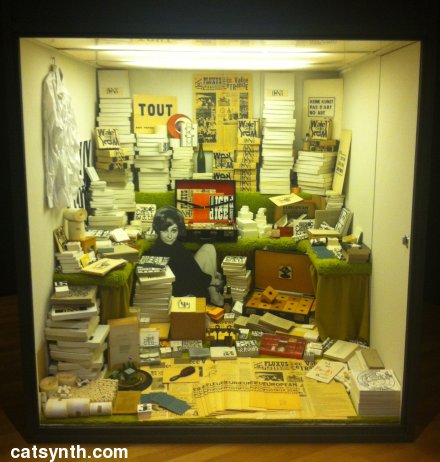
Willem de Ridder’s European Mail-order Warehouse/Fluxshop from the winter of 1964-1965 contains a jumbled array of Fluxus editions and kits. A reproduction of the Fluxshop by Jon Hendricks and Larry Miller was featured in the exhibition.

[Jon Hendricks and Larry Miller.  Construction of European Mail-Order Warehouse/Fluxshop, 1984.  (Click image to enlarge.)]

As much as any piece of the exhibition, it is a snapshot back into the time that this art was originally made.

The exhibition will remain on display through January 16, 2012.


A concurrent exhibition Fluxus and the Essential Questions of Life at the NYU Grey Art Gallery presented still more original works and artifacts, this time arranged as a series of “essential themes of human existence”, including “Happiness”, “Health”, “Who am I?” and “Freedom”.

The arrangement around the themes rather than chronology, medium or artist, gave the presentation a rich multi-media feel. For example, below we see a variety of works for “Happiness”, including a film by Yoko Ono, her conceptual object piece A Box of Smile in the cabinet, as well as others including Nye Ffarrabas’ rather prescient Rx: Stress Formula, a pill bottle with capsules with photocopied bits of paper.

[Yoko Ono, A Box of Smile, 1971/1984 ReFlux Edition,plastic box inscribed in gold: “a box of smile y.o. ’71.”Hood Museum of Art, Dartmouth College: AcquisitionsFund; GM.989.12.5.]

The wry sense of humor permeates much of the work in the exhibition, such as Ben Vautier’s glass bottle with a handwritten label “God” affixed to its side as answer to the question “God?” The arrangement by themes and the particular selections of pieces bring out this quality more than in the presentation at the MoMA, even though many of the same artists and types of work were featured.

Artists central to Fluxus, including Maciunas and Brecht, were well represented here. In contrast to the musical scores, some of Brecht’s event scores were quite minimalist, with the most extreme example being Exit which consists only of the single-word instruction “exit” and was featured (again with a bit of dry humor) under the theme of “Death?”

I did also get to see one of Nam Jun Paik’s pieces for modified television set, Zen for TV, which consists of a simple linear pattern crossing the middle of the screen with little or no change.

Paik’s process of modifying television sets to produce new analog video art is a direct forerunner of the circuit bending that many of us in the electronic-music community do today.

In addition to this exhibition, the gallery featured both historic and more contemporary works created at NYU and the Downtown art scene in the show Fluxus at NYU: Before and Beyond. On display were more scores from John Cage as well as a rather large score by Earl Browne. Numerous posters, books and photographs rounded out this presentation of work that, like the original Fluxus group, pushed the boundaries of their media. I regret that I wasn’t around a couple of weeks early when Larry Miller presented a special gallery tour in conjunction with Performa 11, but I am glad I got to see both exhibitions at the Grey Art Gallery before they closed on December 3.


Both exhibitions described above were quite inspiring, and it is interesting to note how much both the concepts of Fluxus and some of the artifacts intersect with my own music and performance work several decades later. I expect to have at least as strong an influence on the new work I am planning for next year. It also opens up an idea of whether or not this website can serve as a source for a piece inspired by Fluxus? Any and all ideas are welcome.