

Author: catsynth
CatSynth pic: Not Quite Quad Slope
From Appliancide (via matrixsynth).

More info via this link.
“Like most modular synthesizer users and builders, I suffer from Serge envy. Thankfully for all of us, Ken Stone licensed some of Serge’s designs to sell as CGS PCBs.
Here is my first module using these Serge designs”

The cat in the first photo is the “project supervisor.”
As another feline reference, “CGS” is “Cat Girl Synth”.

CatSynth pic: Mono cat
From softestthing on flickr:

Perhaps a little bit of a stretch – a Fender Rhodes technically isn’t a synth nor is the drawing technically a cat – but I quite like this image. (And I am a big Rhodes fan.)
Myrmyr and Tiny Owl, Luggage Store Gallery
June began with a particularly strong electroacoustic and noise performance at the Luggage Store Gallery in San Francisco with Myrmyr and Tiny Owl.
Myrmyr is the electroacoustic duo of Agnes Szelag and Marielle Jakobsons, and their performance was in anticipation of the release of their new album Fire Star. Their work incorporates strings (in this case, electric violin and cello along with other instruments) and advanced electronics. I have heard and reviewed Myrmyr before, but this set was perhaps the most beautiful I have heard from them. Set amongst a dizzying array of electronics and wires, it opened with a series of struck string sounds that invoked the sounds of strings in South Asian or East Asian music. Szelag’s voice emerged over a series of rich arpeggios and became part of the texture via live looping. The complex harmony resolved to a long major-seventh chord, after which the strings became harsher and more percussive. Amidst pitch and delay effects, a plucked cello entered in counterpoint to the voice and other instruments. The overall effect was quite tonal and dream-like, and gave me the impression of glass objects.

[Myrmyr. Photo by Michael Zelner.]
The next piece started with strings, both plucked and tapped and used as a live-looping source. A rhythmic pattern formed from the loops, which built up in complexity and volume with lots of distortion. Over time, the distorted sounds became clearer and more ethereal as the strings cut out and left only the bells and electronic effects. These were in turn displaced by more liquidy sounds and the return of cello and violin, this time bowed. The piece featured interesting harmonies and vocals.
The final piece was from the soon-to-be released album. It became with a drone, with harmonium sounds and voice building up into a rich texture. As they fade out, a plucked string instrument (possibly guzheng after reviewing Myrmyr’s website) enters on a minor pattern. The sound was accompanied by bells and distortion effects. The music built up to a big recognizable chord that was unresolved. Another build-up followed, this time with voice that turned into a rich harmony with a particularly plaintive violin line.

[Tiny Owl. Photo by Michael Zelner.]
Myrmyr was followed by Tiny Owl, a band consisting of Matt Davignon (drum machines and synthesizers), Lance Grabmiller (computer and synthesizers), Suki O’Kane (percussion), and Sebastian Krawczuk (double bass and objects). Their performance consisted of one long constantly evolving piece. It opened with an impromptu round of “Happy Birthday” for Matt Davignon (it was indeed his birthday) that appropriately elided to a series of glitchy noise sounds. Soon the bass drum and cymbals and string bass entered. The overall undulating timbre seemed very insect-like, but there also bits of melody that came and went in opposition to the overall swells and dips in the sound. One gesture that I particularly liked involved drum machine “gurgling” set against bass. The gurgling sounds, which formed a complex timbre, were gradually slowed down to the point where it became a series of rhythmic elements – moments like this always make me think of Stockhausen’s Kontakte II. Eventually, they merged back into the overall ambient sound. Over time, the overall texture became busier, but also more drone like, with high pitches and even some screeches eventually emerging. Pitched noises moving up and down like factory machinery were set against a drum rhythm reminiscent of “Wipe Out” (that very insistent sixteenth-note rhythm that every young percussionist attempts to play). As the percussion (drums and objects) grew more rich, so the electronics became more intense with bursts of machine noise and longer notes with strange harmonics. The section of louder sound and more complex rhythm grew to a climactic point and suddenly faded out with just a low rumble and a sparse texture of percussive sounds. This part of the performance was drier, with more punctuated elements and scratching sounds. During a gentle rise in pitch and volume near the end of the performance, the sound seemed to merge with a passing siren on Market Street. (It wouldn’t be a Luggage Store Gallery performance without at least one siren incorporated into the music.)
The show concluded with both groups uniting for short jam. It was fun to hear the combined sounds: noise drones punctuated by strings, and at least one more siren from the street.
Weekend Cat Blogging and Photo Hunt: Cards
This weekend we are once again combining Weekend Cat Blogging and Photo Hunt. The theme is cards, and we start with an unexpected take on the theme:

I recently came across these older “Smart Media” data cards while cleaning. They’re bigger (and a bit more interesting to photograph) than the current SD cards my current cameras and other devices use, but they are essentially useless. I do have a reader that can read/write them, but no particular reason to do so. Anyone have any ideas?
Here is Luna with some of her past birthday cards:

I believe they are from 2010 and 2007. It’s not Luna’s birthday, but the cards are out because of the recent cleaning (similar to the memory cards).
Weekend Cat Blogging #316 is hosted by pam at Pam’s Sidewalk Shoes.
Photo Hunt #271 is hosted by tnchick. The theme this week is cards.
The Carnival of the Cats will be up tomorrow at When Cats Attack!
And the Friday Ark is at the modulator
Regents Lecturer Concert, CNMAT (March 2011)
Today we look back on my solo concert at the Center for New Music Technologies (CNMAT) at U.C. Berkeley back in early March. It was part of my U.C. Regents Lecturer appointment this year, which also included technical talks and guest lectures for classes.
This is one of the more elaborate concerts I have done. Not only did I have an entire program to fill on my own, but I specifically wanted to showcase various technologies related to my past research at CNMAT and some of their current work, such as advanced multi-channel speaker systems. I spent a fair amount of time onsite earlier in the week to do some programming, and arrived early on the day of the show to get things set up. Here is the iPad with CNMAT’s dodecahedron speaker – each face of the dodecahedron is a separate speaker driven by its own audio channel.
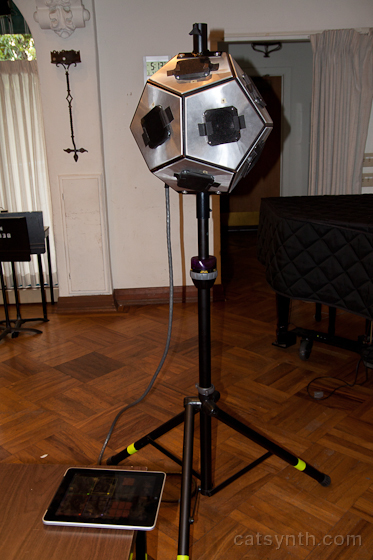
[click image for larger view.]
Here is the Wicks Looper (which I had recently acquired) along with the dotara, an Indian string instrument often used in folk music.
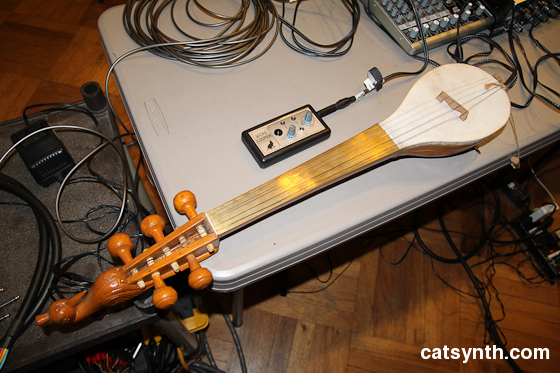
[click image for larger view.]
I organized the concert such that the first half was more focused on showcasing music technologies, and the second half on more theatrical live performance. This does not imply that there wasn’t strong musicality in the first half or a lack of technological sophistication in the second, but rather which theme was central to the particular pieces.
After a very generous introduction by David Wessel, I launched into one of my standard improvisational pieces. Each one is different, but I do incorporate a set of elements that get reused. This one began with the Count Basie “Big Band Remote” recording and made use of various looping and resampling techniques with the Indian and Chinese instruments (controlled by monome), the Dave Smith Instruments Evolver, and various iPad apps.
Electroacoustic Improvisation – Regents Lecturer Concert (CNMAT) from CatSynth on Vimeo.
The concert included the premier of a new piece that was specifically composed for CNMAT’s impressive loudspeaker resources, the dodecahedron as well as the 8-channel surround system. In the main surround speakers, I created complex “clouds” of partials in an additive synthesizer that could be panned between different speakers for a rich immersive sound. I had short percussive sounds emitted from various speakers on the dodecahedron. I though the effect was quite strong, with the point sounds very localized and spatially separated from the more ambient sounds. In the video, it is hard to get the full effect, but here it is nonetheless:
Realignments – Regents Lecturer Concert, CNMAT from CatSynth on Vimeo.
The piece was implemented in Open Sound World – the new version that primarily uses Python scripts (or any OSC-enabled scripting language) instead of the old graphical user interface. I used TouchOSC on the iPad for real-time control.
I then moved from rather complex experimental technology to a simple and very self-contained instrument, the Wicks Looper, in this improvised piece. It had a very different sound from the software-based pieces in this part of the concert, and I liked the contrast.
The first half of the concert also featured two pieces from my CD Aquatic: Neptune Prelude to Xi and Charmer:Firmament. The original live versions of these pieces used a Wacom graphics tablet controlling OSW patches. I reimplemented them to use TouchOSC on the iPad.
The second half of the concert opened with a duo of myself and Polly Moller on concert and bass flutes. We used one of my graphical score sets – here we went on order from one to the next and interpreted each symbol.
The cat one was particular fun, as Polly emulated the sound of a cat purring. It was a great piece, but unfortunately I do not have a video of this one to share. So we will have to perform it again sometime.
I performed the piece 月伸1 featuring the video of Luna. Each of the previous performances, at the Quickening Moon concert and Omega Sound Fix last year, used different electronic instruments. This time I performed the musical accompaniment exclusively on acoustic grand piano. In some ways, I think it is the strongest of the three performances, with more emotion and musicality. The humor came through as well, though a bit more subtle than in the original Quickening Moon performance.
月伸1 – Video of Luna with Acoustic Grand Piano Improvisation from CatSynth on Vimeo.
The one unfortunate part of the evening came in the final piece. I had originally done Spin Cycle / Control Freak at a series of exchange concerts between CNMAT and CCRMA at Stanford in 2000. I redid the programming for this performance to use the latest version of OSW and TouchOSC on the iPad as the control surface. However, at this point in the evening I could not get the iPad and the MacBook to lock onto a single network together. The iPad could not find the MacBook’s private wireless network, even after multiple reboots of both devices. In my mind, this is actually the biggest problem with using an iPad as a control surface – it requires wireless networking, which seems to be very shaky at times on Apple hardware. It would be nice if they allowed one to use a wired connection via the USB cable. I suppose I should be grateful that this problem did not occur until the final piece, but was still a bit of an embarrassment and gives me pause about using iPad/TouchOSC until I know how to make it more reliable.
On balance, it was a great evening of music even with the misfire at the end. I was quite happy with the audience turnout and the warm reception and feedback afterwards. It was a chance to look back on solo work from the past ten years, and look forward to new musical and technological adventures in the future.
CatSynth pic: Gravitarium 2.
Via matrixsynth:

This one in via Silent Strike who composed the tracks for the app with a Clavia Nord Modular 1, Micron Alesis, Jomox Mbase, Reason 4 Propellerheads, M-audio Axiom 25, Elektron Drumachine (pic at the bottom of this post). The app does not allow you to manipulate sound, but I thought it was interesting to acknowledge some of the gear used to create the audio for this app. The Waldorf Blofeld and Yamaha AN200 pictured however were not used.
Looks like Silent Strike had a studio supervisor involved.
There is also info on the app itself.
Gravitarium 2 combines music, art and science in one relaxing experience. Use all your fingers to guide the star flow. You can create 10 different animations depending on the number of fingers touching the screen:
1 – Rocket, 2 – Sparkle, 3 – Energy flow, 4 – Atomic, 5 – 3D freeze, 6 – Circularium, 7 – Fish, 8 – Vortex, 9 – Lasers, 10 – Lightning.
Use different options to create spectacular drawings made of stars. You can load the “Drawing” preset from the “Options” screen.

I will be taking a look at this app. The idea of creativity and relaxation does appeals to me, but the game-play part is a bit less exciting – though it is the trend in the mobile-app space.
Wordless Wednesday: Summer Solstice

猫の上でmonotribe cat on
Another rom asakawaz on YouTube, also seen on matrixsynth:
“猫の上で演奏してみました。スローテンポのほうが落ち着くみたいです。”
猫 is cat of course, but beyond that I need the help of Google translator. I think the cat prefers the slower tempo on the sequencer.
