

Rent Romus and Emergency String (X)tet, Meridian Gallery
Last month, I attended the CD release of Emergency Rental at the Meridian Gallery. Emergency Rental is a collaboration between the Emergency String (X)tet and Rent Romus “exploring sound in and outside the elements of free improvisation between saxophone and strings.”
The personnel for the Emergency String (X)tet changes (hence the “x”), but does have a stable core of regulars. Founder Bob Marsh was joined by Doug Carroll on cello, with Adria Otte, Angela Hsu and Jonathan Segel on violins, Kanoko Nishi on bass koto, and Tony Dryer on contrabass.
Overall, the music moved back and forth seamlessly between free improvisation with extended techniques and passages that borrowed from more idiomatic jazz ideas. Early on, there was a bit of a shuffle beat and jazz-like saxophone lines set against more anxious tones from the strings, a mixture of both long tones and pizzicato. There were times when the saxophone and strings seemed to match one another in both tone and musical structure, such as a section that featured glissandi and scraping tones. The next section featured long bass notes and more scratching melodies set against a very lyrical saxophone line. This gave way to loud growling saxophone against a rich pad of strings.
One piece focused on extended techniques, including prepared strings with chopsticks and other items placed between the strings and bodies of the instruments – something I have often seen the Emergency String (X)tet do. Doug Carroll also reoriented his cello upside-down and sideways at various times. Romus played his saxophone without a mouthpiece, blowing directly into the body the way one might on a brass instrument. He also used a sound that I dubbed the “angry breath noises.”
The second half started off very percussive, and even though the ensemble was entirely acoustic, this section reminded me of the analog electronics in early electronic music like Stockhausen’s Kontakte. This segued into a more idiomatic duo of saxophone and walking bass was set against atonal glissandi from the other strings. There were other interesting sections, such as a syncopated rhythm that came together and broke apart, and a section of pure percussion by all the instruments that reminded me of tapping and bouncing balls.
Emergency Rental, which marks Romus’ 25th album release, is available from Edgetone Records.
CatSynth pic: Bella
Submitted by Alessandro Cilano:

here’s my cat Bella, sitting on the chair of power at my desk.
She’s grumpy as there are too many places to fill in my modular and she’s not allowed to play with the patch cables…
We have seen some pictures in the past of his cat Guiliano.
If You can’t find that perfect setting on Your Synthesizer, try using Your Cat.
Weekend Cat Blogging: New Year and Photohunt:Fuzzy
We at CatSynth attempt to wake up to the new year…slowly. Here is our first published photo of 2011:
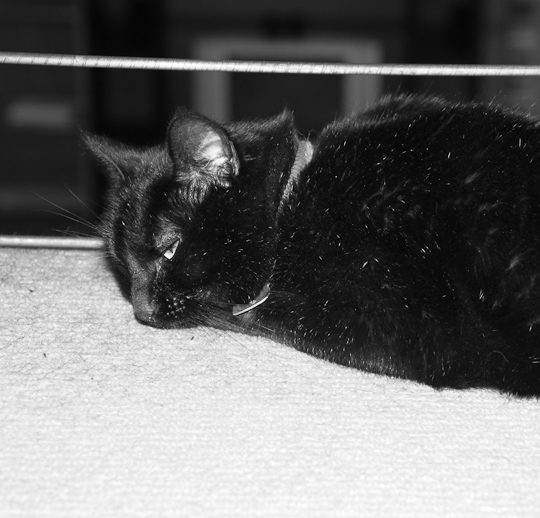
The theme of this weekend’s Photo Hunt is fuzzy, which is easy with Luna around. One can easily see the fuzziness of her thick winter fur. Cats do seem to get thicker fur in the winter…and contrary to stereotypes, we do have a winter season in California.
This may end up being about as much as we do today.
Weekend Cat Blogging #291 New Years Edition is hosted by Pam and the cats at Sidewalk Shoes.
The Photo Hunt is hosted by tnchick. This week’s theme is Fuzzy.
The Carnival of the Cats will be hosted by Nikita Cat.
And life goes on…
Farewell to 2010
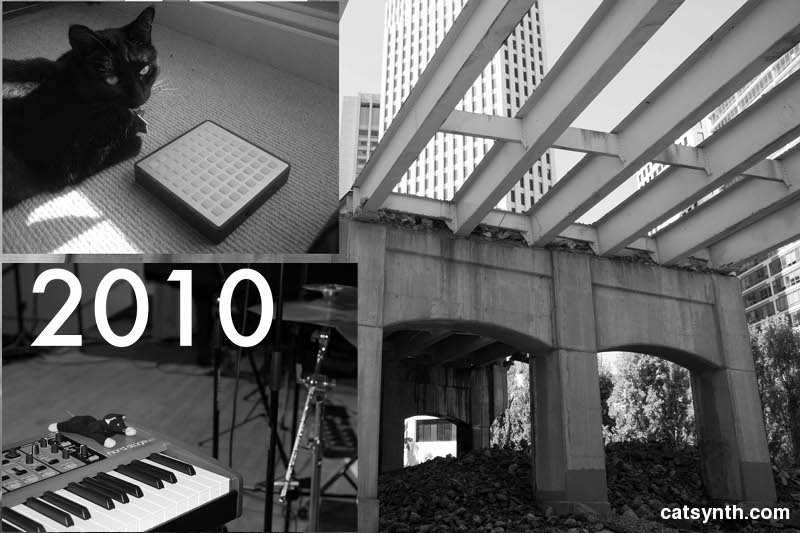
[Click image to enlarge.]
This is not a convenient day for the year to end.
January 1, 2010, was a calm, and truly monochromatic day, which set the initial tone for the year and the first photo I posted reflected the tone. It was turning away from the excitement and adventures in 2009 towards a more inward and local focus on creativity and relationships…and finding a new job. And at the end of the year, much of that remains true: more creative output, both musically and visually than ever, new friends (and deepening ties with old friends), and I did get that new job. But the pace and energy are anything but calm. Life has been hurtling forward at a faster and faster pace, with an ever higher density of activity and experience, and that can’t keep going forever. There are limits. Limits in time, in resources, and in my body. Slowing down is not easy, and may not even be necessary, but this coming year is going to be about doing the best I can within those limits. In terms of this site, there is always the tension between experiences and writing about those experiences, and lately I have been erring on the side of experience versus writing about it. It’s a continuous process to learn how to balance that.
Things don’t always look particularly bright when you’re in the middle of them. This year (like most) was riddled with mistakes and failures, missed opportunities, and more. But if, say, “2008 me” got to look ahead and see “2010 me”, he would probably be amazed at how much has changed…mostly for the better. I saw another interesting perspective yesterday when a friend, in saying good riddance to 2010, pointed around the table and said (and I paraphrase) “your 2010 sucked”, “your 2010 sucked” and then when she pointed to me said “yours was actually pretty good”.
So tomorrow I will simply pick up where things left off today…and keep in mind the phrase from a show I saw at the beginning of the year (by Anthony Discenza), “Everything Will Probably Turn Out OK.”
2010 DroneShift – Long Nights Moon Concert
Two weeks ago, I participated in the 2010 edition of the Droneshift at the Luggage Store Gallery here in San Francisco.
The Droneshift has become an annual event, though this year it was part of the Full-Moon Concert Series, approximately coincident with the Long Nights Moon.
Droneshift is a collaborative concert of improvised drone music. Between 15 and 25 musicians will gather to contribute to a continuous 2 hour drone, each adding their acoustic or electronic instruments here and there, and weaving their sounds together to create gradually shifting tapestries of music. The performance will most likely shift back and forth from completely acoustic music to electric ambiance and post-industrial noise.
Basically, the two hour performance is one continuous ever-changing sound. No individual notes, rests, phrases, breaks, etc. That doesn’t mean it is at all monotonous – there are continuous changes in timbre, dynamics and expression, both within individual parts as various musicians enter and exit the sound.
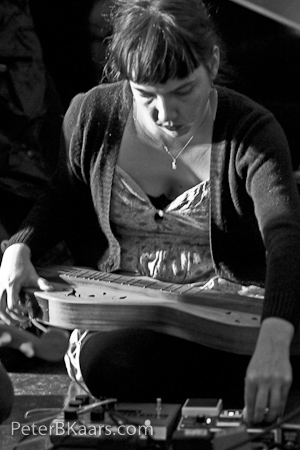
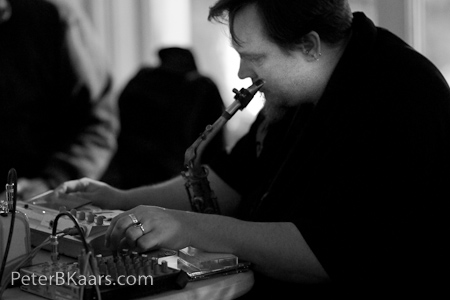
[Rachel Wood-Rome, Rent Romus. Photo: PeterBKaars.com. (Click images to enlarge.)]
There were actually close to (if not more than) 30 performers participating this year. The performers were arranged along periphery of the gallery with the audience situated in the middle looking outward. So between the audience and musicians, things got quite crowded. I was able to stake out some chair space for myself my minimalist setup:
I just had the iPad and an amplifier, and I was primarily running the Smule Magic Fiddle throughout my allotted time. It is a good instrument for droning, as one can linger on the strings pretty much forever, and play subtle pitch and dynamic changes. It’s easy to gradually fade out, and then fade in very slowly another pitch, which will change the overall sound of the performance without causing a distinct note break.
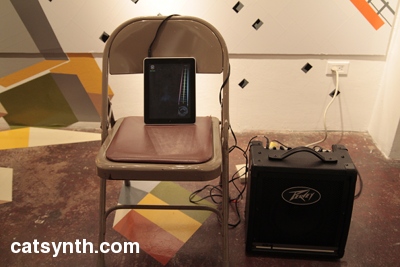
Because the nature of overall drone sound and the large number of participants, it was often difficult to focus on what any one other musician was playing. I mostly shifted between focusing on my own part and getting lost in the overall sound, which was quite meditative at times. I was able to take in some details, such as Matt Davignon’s distinctive glass-vase performance:
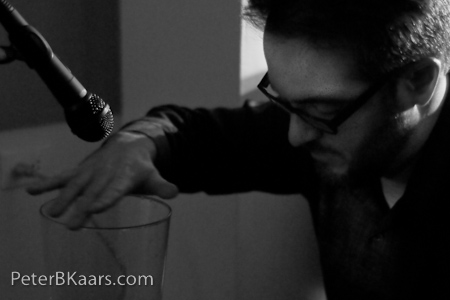
[Matt Davignon. Photo: PeterBKaars.com. (Click image to enlarge.)]
David Michalak’s Omnichord and Joe McMahon’s plastic-tube “didgeridoo” were also quite distinctive (particularly because they were sitting near me):
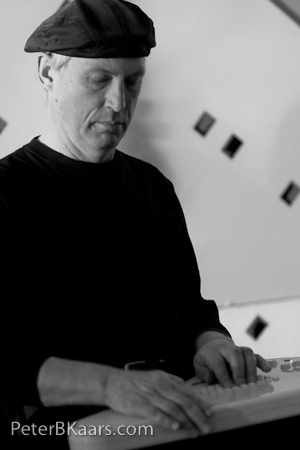
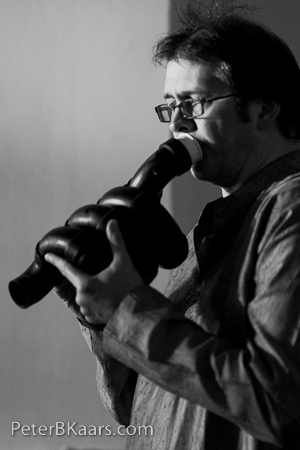
[David Michalak, Joe McMahon. Photo: PeterBKaars.com. (Click images to enlarge.)]
I was sitting across from Adam Fong on upright bass. There were moments when I took cues from him and other string players to re-enter the mix on Magic Fiddle. I was also trying to take cues from purely electronic musicians, such as Kristen Miltner on laptop or Andrew Joron’s theremin:
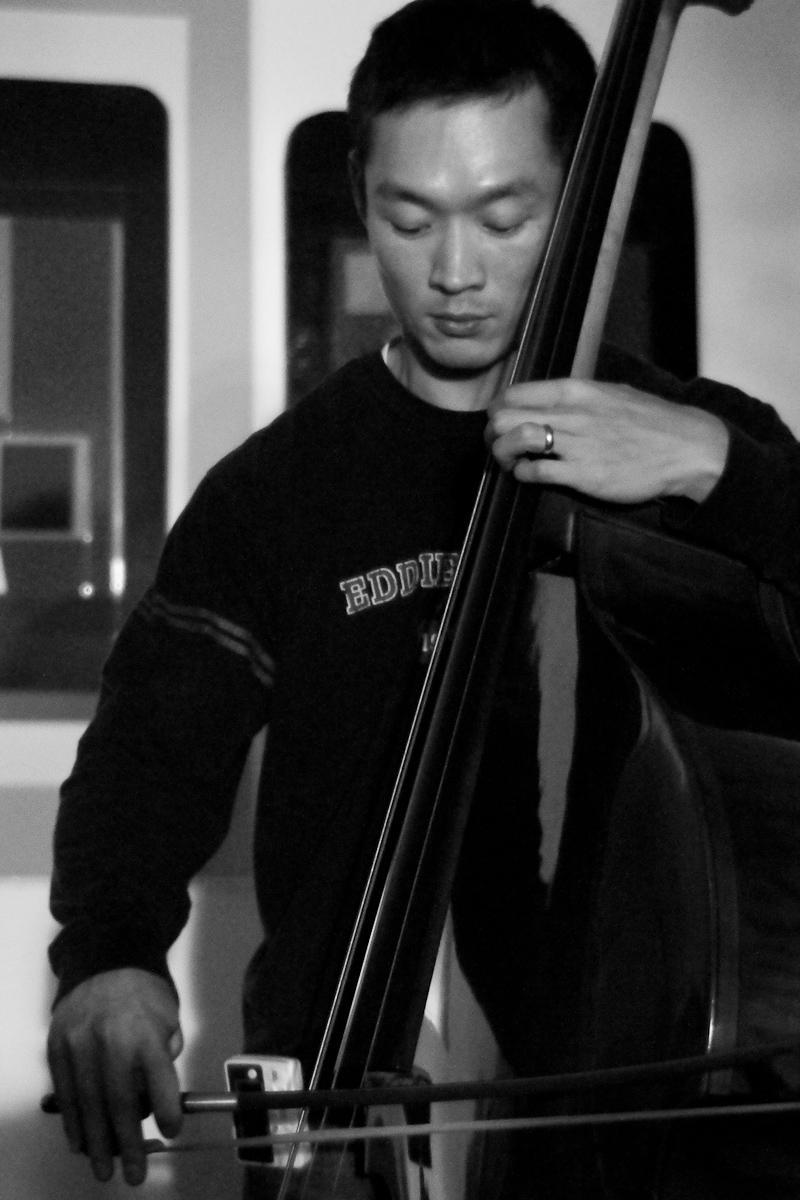
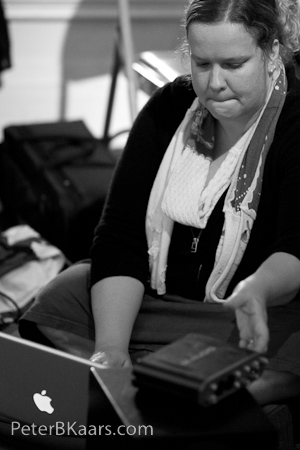
[Adam Fong, Kristen Miltner. Photo: PeterBKaars.com. (Click images to enlarge.)]
Overall, the instrumentation was quite varied and there was a balance between winds, strings, percussion and electronic, although there were a few moments were it seemed some low-frequency analog electronics were overpowering everything else. It was interesting to hear how the textures and orchestration evolved. Sometimes similar instruments (e.g., strings) would cluster together, sometimes the texture became more scratchy and granular with lots of noise elements – something which is pushing the boundaries of what might be considered a continuous “drone” sound. At times, traditional harmonies emerged, e.g., minor or diminished chords, while at other times the timbres themselves were purely inharmonic. There were very sparse sections with only one or two participants, and others that seemed to include much of the ensemble. All of these elements just happen organically, based on how the musicians hear one another and are inspired to layer on their own parts.
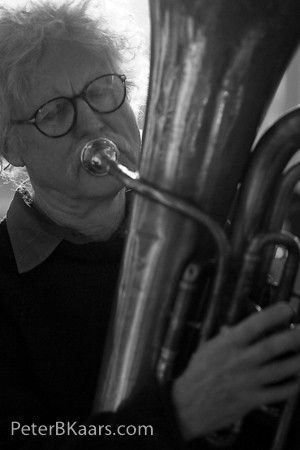
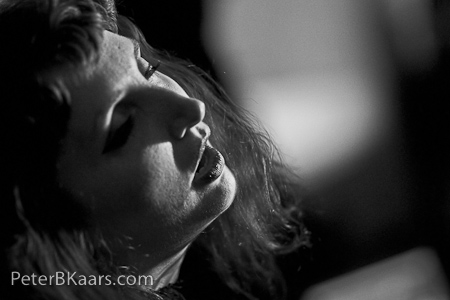
[Ron Heglin, Aurora Josephson. Photo: PeterBKaars.com. (Click images to enlarge.)]
You can listen to a ten-minute excerpt of the full performance in this video, courtesy of Matt Davignon:
As one can hear, the emergency vehicles that inevitably come down Market Street with sirens blaring during Luggage Store Gallery shows became part of the overall tapestry in this performance.
My personal sense of the performance as being meditative, perhaps even more so than previous Droneshifts, was echoed by members of the audience with whom I had spoken.
In addition to reflecting on the music, I would like to call out the photography of Peter B Kaars, which is featured in this article Those who have followed my own interest in photography know I tend to like very sharp, high-contrast black-and-white images. Additionally the monochrome fits with the full-moon theme and overall quality of the music they document. I wish I had space for more, or to call out more individual musicians. A full list of performers appears below:
Tom Bickley – wind controller
CJ Borosque – trumpet
Bob Boster – processed voice
Amar Chaudhary – iThings
Matt Davignon – wine glasses/vessels
Tony Dryer – bass
Adam Fong – bass
Phillip Greenlief – sax/clarinet
Ron Heglin – trombone/trumpet
Jeff Hobbs – bass, clarinet or violin
Travis Johns – electronics
Andrew Joron – theremin
Aurora Josephson – voice
Sebastian Krawczuk – bass
David Leikam – Moog rogue synthesizer
Cheryl Leonard – viola
Brian Lucas – electric bass / tapes
Melissa Margolis – accordion
Bob Marsh – voice
Marianne McDonald – didgeridoo
Chad McKinney – supercollider/guitar
Joe McMahon – didgeridoo
David Michalak – Omnichord
Kristin Miltner – laptop
Ann O’Rourke – bowed cymbal
Ferrara Brain Pan – sopranino saxophone
Rent Romus – sax/tapes
Ellery Royston – harp w/effects
Lx Rudis – electronics
Mark Soden – trumpet
Moe! Staiano – guitar
Errol Stewart – guitar
Lena Strayhorn – tsaaj plaim / wind wand
Zachary Watkins – electronics
Rachel Wood-Rome – french horn
Michael Zelner – analog monophonic synthesizer, iPod Touch
CatSynth pic: Caliope returns
Another submitted by Briana Jones on facebook, featuring Caliope:

A good time to remind readers that you, too, can submit your cat-and-music pics via facebook, twitter @catsynth, or via our handy submission form.
Wordless Wednesday: PARK

Omega Sound Fix, Alfa Art Gallery
Today we look back the Omega Sound Fix Festival, which took place at the Alfa Art Gallery in New Brunswick, New Jersey. The festival spanned two days, Saturday, November 20 and Sunday, November 21, and I was myself scheduled to perform on the second night. (You can read an earlier article about my preparations for the event here.)
As with other events this year, I was live tweeting during the performance @catsynth, using the tag #omegasoundfix. Additionally, PAS has posted videos from the first night of the event, several of which are included below.
After a brief trip to lower Manhattan on Saturday, I headed across the river via the Lincoln Tunnel (which the iPhone assured me had the least traffic of any crossing) and south on the New Jersey Turnpike towards New Brunswick. It was comforting to finally arrive at Alfa Art Gallery after the long trip and come in out of the cold air to the abstract electronic sounds. I arrived in time to hear the second half of Richard Lainhart’s set (I wish I had arrived in time to hear the whole thing). You can see part of Lainhart’s performance below:
Richard Lainhart live at Alfa Art Gallery (Part II) for the Omega Sound Fix Festival from PAS on Vimeo.
I had not arrived in time to hear Lainhart’s introduction in which he explained that piece was by the renowned 20th Century composer Oliver Messaien – a 1937 piece Oraison that was was one of the early pieces written purely for electronic instruments. It was later adapted for acoustic instruments as part of Messaien’s “Quartet for the End of Time”, composed while he was in a German prisoner-of-war camp in 1941. Lainhart’s arrangement of the piece uses the Haken Continuum with a Buchla synthesizer. The music starts out very quiet and melancholy, like a mournful piece of acoustic chamber music. But one can hear the timbral details, suble pitch changes and effects that make it unmistakably electronic. Every so often, there is strong feedback in the sound, but it remains very expressive within the context of the piece. The harmonies move between minor and very anxious augmented. It feels very much like piece of music for a dramatic film, set in forlorn ruins or a desert approaching dusk.
Lainhart then joined Philippe Petit for the next set. I would characterize Petit’s performance as “virtuosic experimental turntable”, as that was the primary instrument he was using (along with a laptop) to generate his sounds that were at once very natural and very constructed. The set began with Lainhart playing long bowed tones on the vibraphone set again Petit’s liquidy granular sounds, scratches, low rumbles and anxious harmonies. There was a strong contrast between the more ethereal and natural timbres, and the lower-frequency and louder machine noises. Petit’s sounds moved from more natural and machine towards snippets from other recordings with bits of distorted harmony, and urban city-like environments. It then changes over to turntable effects, pops and skips and speed changes, and gets noiser and more agressive. Lainhart’s bowed vibraphone provides a constant dreamlike quality against Petit’s changing textures.
Philippe Petit collaborates with Richard Lainhart live at Alfa Art Gallery for the Omega Sound Fix Festival from PAS on Vimeo.
At some point during the set, the duo were joined by a guitarist to form a trio. [Note if anyone can provide me the guitarist’s name, please let me know!] The trio with guitar began scratch and percussive, but became more tonal over time. There is a section which I referred to as the “thud march”, which electrical pops forming a march-like rhythm with other turntable effects filling in the space in between. The rhythm breaks apart after while, with the electronic pops continuing in a more chaotic pattern, and scratching and percussive effects on the guitar providing a counterpoint. Quiet inharmonic synthesizer pads can be heard in the background. The set drew to a large close, starting with a quiet turntable solo and then into a big finish, with loud howling wind-like sounds, and dark harmonies.
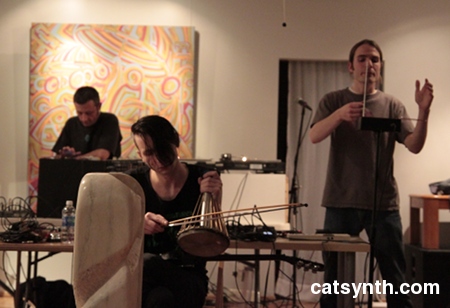
They were followed by PAS (Post Abortion Stress). Petit remained on stage and joined regular group members Michael Durek, Robert L Pepper and John “Vomit” Worthley and guest saxophonist Dave Tamura.
[Click image to enlarge.]
The set began with a very simple pentatonic sequence. On top of this, Worthley played a bowed waterphone waterphone, and Durek soon joined on thermin with a melodic line. Tamura’s saxophone provided a strong counterpoint to the other elements, alternating between very expressive jazz-like lines and a “skronking”. There were moments where the saxophone and thermin seemed to respond to each other, melodically and harmonically. At some point, the original pentatonic pattern cut out, and the music centered around saxophone, theremin and electronic violin. This was followed by a purely electronic section with dark analog sounds and driving electronic drums. Pepper repeatedly slammed his electronic violin against the table, while Tamura played fast runs on the saxophone. Another interesting moment was Pepper using a standard fishing rod as an instrument (perhaps the first time I have seen that), set against synthesizers, guitar and saxophone. Gradually the music gets louder and more insistent, with driving percussive guitar, loud saxophone, and synthesizer sweeps, howls and sound effects in the background. Below is a video of PAS’ entire performance.
PAS live at Alfa Art Gallery with Dave Tamura & Philippe Petit from PAS on Vimeo.
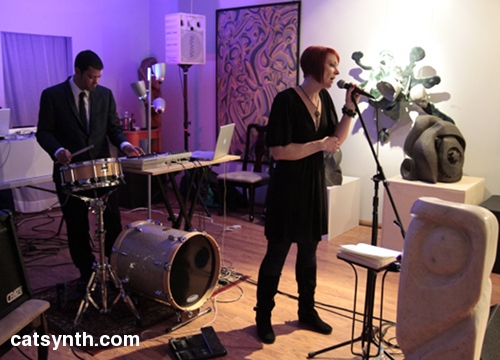
The Sunday program began with blithe (doll). The performance combined acoustic drums as a foundation with live electronics and voice. I particularly liked the combination of loungy Latin rhythm and harmony in one piece with eerie electronic sounds and Phrygian vocal melodies that permeated much of the set. There were sections that were more “spacelike” with analog square waves and loud hits. Overall, the slow rhythms and melodies were reminiscent of goth or darker electronic club music.
[Click image to enlarge.]
This was a fun set to watch and listen too, and the band drew a relatively large crowd. I guess that should be surprising given that the band is local, and husband-and-wife duo of James and Lisa Woodley were well known from the previous band.
Blithe (doll) was followed by Borne (aka Scott Vizioli). He created a large dramatic and very visual soundscapes. Although his sounds included ambient, environmental and noise-based material, there was also a somewhat unsettling minor harmony that seemed to be just under the surface. Nonetheless the overall sound it was quite meditative, and easy to get lost in the soundspace. Over time, a beat emerged, very sparse and minimalist with metallic sounds. It gradually became stronger and more drum-like, with ethereal bell sounds in the background. I also recalled a single sample of a dishwasher (or something that sounded like a dishwasher) towards the end.
Next up was Octant, which could be described as a band consisting of one human and several robots. The electromechanical robots play acoustic instruments (drums, etc.) while the human member of the band, Matthew Steinke performs on lead vocals.

This was a unique set to watch. My focus was definitely on the robotic performance, but I was also listening to the music itself, which reminded of 1960s British rock with lots of chromatic chord changes. (@catsynth It’s not every day I see retro rock music performed by robots #omegasoundfix ). In order to get a rock rhythm feel, the timing among the robots needs to be well controlled – too much jitter or drift between machines and the musical quality is lost. Octant seems to have that down from a musical and technological perspective. Among the individual songs were “Bowl of Blood”, and another that was introduced by Steinke as being a “song about my cat.”

[Click image to enlarge.]
Octant was followed by Ezekiel Honig. As stated in the program notes, “He concentrates on his idiosyncratic brand of emotively warm electronic-acoustic music.” The set began with sounds that evoked water as well as machinery. I was able to hear that we was making extensive use of looping, although as he states he is “using the loop as more of a tool than a rule” and elements come and go freely outside the context of strict looping. A strong heartbeat sound emerged, and then later other elements joined to form a calm rolling pattern. At one point a strong major 7th harmony emerged. The beating changed sublty over time, as did the implied harmonies, which became more minor. Towards the end, the sounds seemed to focus on voices in the distance and other evidence of everyday human activity.
I had to begin setting up for my set after this, but I was able to part of Trinitron, the musical project of local artist Mark Weinberg. More so than Honig’s set, Trinitron’s performance was very focused on looping of processed electric guitar. Weinberg sat with his guitar in the middle of a circle of candles, and began to layer different lines and effects on top of one another. The resulting sounds from were alternately harmonic and gritty or noisy. Overall, his performance had an ambient dream-like quality to it.
Then it was time for me to play. I started the set with one of the “Big Band Remotes”, old radio broadcasts of big band shows made in the 1930s and 1940s. In particular, I used a recording of Count Basie and the Blue Note in Chicago, under the control of the monome so that I could start, stop and jump to different sections at will. I immediately segued from the final note to the Chinese prayer bowl and a similar metallic resonance on the Evolver synthesizer. After a while, I attempted to add the Smule Ocarina to the mix, though attempting to induce feedback from the speakers was a little more unstable than I had hoped. The second piece involved live sampling and looping of several of my Indian and Chinese folk instruments, including the newly acquired dotara, the gopichand, and Chinese temple blocks. Once again, this was under control of the monome. The piece transitioned to more electronic sounds, otherworldly crashing waves and loud resonances, and into a meditative solo using a guzheng app on the iPad. You can see a video of the first two pieces below:
Amar Chaudhary at Omega Sound Fix (Part 1) from CatSynth on Vimeo.
I then performed 月伸1, the video piece featuring Luna that I did at the Quickening Moon concert in February. In this instance, I did not have the Octave CAT synthesizer, but instead used the Smule Magic Fiddle and Korg iMS-20 on the iPad as the main electronic instruments, along with the Bebot app, a simple synthesizer on the laptop controlled by the monome, and the Evolver. I liked the new iPad apps for improvising against the video, it gave it a different musical quality from the premiere performance, though not as different as one might suspect. The video projection was a challenge – it covered the entire back wall, and I found myself standing “inside” the images, sometimes next to a gigantic projection of Luna. The effect of the projection against the artwork was also quite interesting visually. You can see this performance in the video below:
Amar Chaudhary at Omega Sound Fix (Part 2) from CatSynth on Vimeo.
My performance was the last of the evening, and of the festival. Overall, I thought it was a great experience, both as a performer and audience-member. Thanks to Michael Durek and Mark Weinberg for organizing this event, and to the Alfa Art Gallery for hosting.